
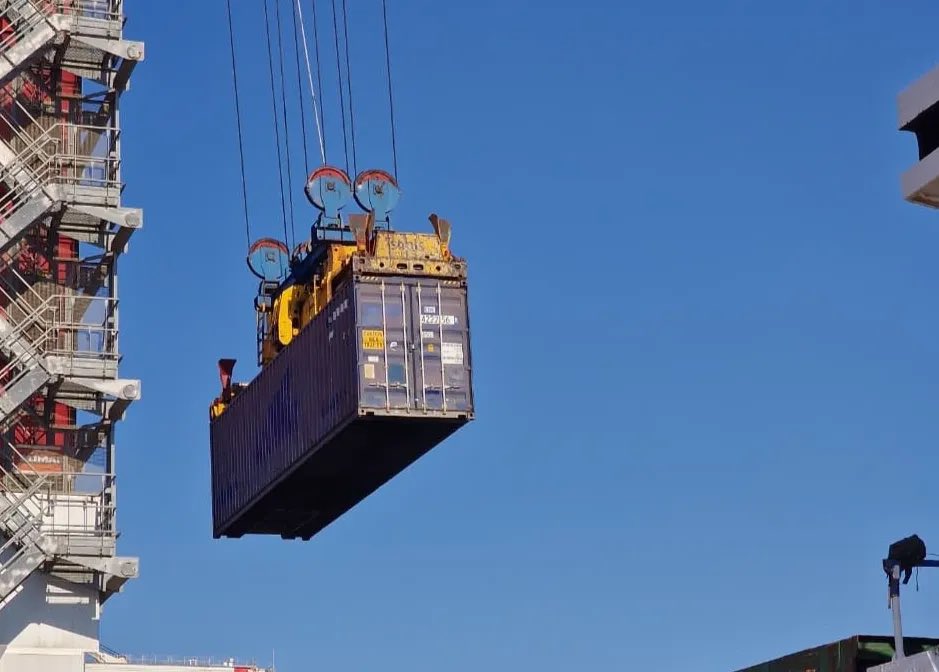
More than 30,000 tonnes of humanitarian aid have been delivered to Gaza via Cyprus’ Amalthea aid corridor since the corridor was created, Foreign Minister Constantinos Kombos said on Sunday.
“Since the beginning of this effort, more than 30,000 tonnes of humanitarian aid have been transferred to Gaza, mainly food,” he told newspaper Phileleftheros, before adding that Cyprus has stationed personnel at the civil-military coordination centre (CMCC), which is located northeast of the Gaza strip in the Israeli town of Kiryat Gat, since it opened.
He said the government now aims to expand the list of products which can be sent to Gaza via the Amalthea corridor “to include dual-use products”.
Additionally, he said, the fact that President Nikos Christodoulides’ invite to the summit on the future of Gaza, which was held in the Egyptian city of Sharm El-Sheikh in October is “an indication of the appreciation of our effort, both by the United States and by Egypt”.
Looking ahead, he said there exists “the possibility of a systematic flow of aid to Gaza through the [Israeli] port of Ashdod”, and that this could be done through the existing mechanism which was established in coordination with the United Nations office for project service (Unops).
“Just a few days ago, another shipment of 1,000 tonnes of humanitarian aid departed, which has already been unloaded and is being distributed to the civilian population,” he said.
The Amalthea plan has had a mixed history, with doubts initially having been expressed by Sigrid Kaag in 2024.
She was at the time the UN’s senior humanitarian and reconstruction coordinator for Gaza, and now the UN’s special coordinator for the Middle East peace process, and said at the time that the Amalthea project could “never be a substitute” for aid deliveries made by land.
Previously, aid had also arrived in Gaza from Cyprus via a temporary jetty attached to the coast of Gaza, which was built and financed by the United States government of the day, though this also faced sundry problems.
The jetty was installed in May 2024, but was only operable for 12 days before being permanently removed two months later.
It had broken apart during high winds, with four US army vessels which were holding it in place being washed up on a beach near Ashkelon, an Israeli town located between the Ashdod and Gaza.
It was taken to Ashdod for repairs before being reattached in early June, but was then removed on two further occasions as officials feared that conditions would lead to it breaking apart again.
In addition to its structural difficulties, the jetty was also impacted by problems regarding delivery after the UN World Food Programme (WFP) in June last year suspended its operations related to the jetty following an Israeli military operation in the area which reportedly killed over 200 Palestinians.
However, more recently, aid has been sent directly to Ashdod, with its transfer to Gaza now appearing to be more stable.
In Sharm El-Sheikh in October, Christodoulides had reportedly included the Amalthea initiative as part of a multi-point plan for how Cyprus can aid in the “implementation and realisation” of United States President Donald Trump’s plan for the future of Gaza.
It was reported at the time that his plan stated that “the mechanisms and procedures which have been developed within the framework of Amalthea for fast-track security checks in Cyprus are usable for the next phase and can offer important solutions”.





Click here to change your cookie preferences