
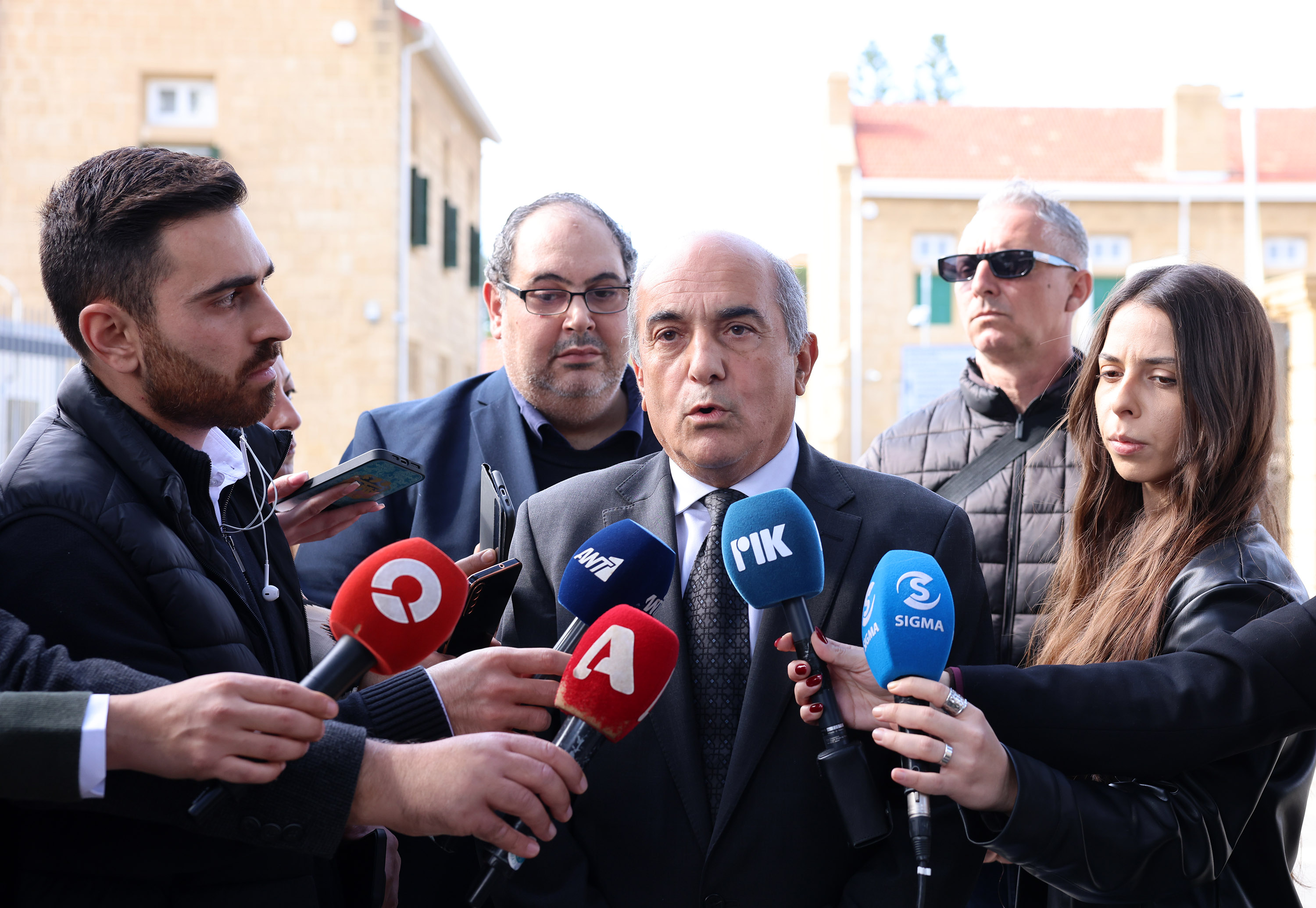
The legal service announced on Wednesday it will file an appeal against the acquittal of former House speaker Demetris Syllouris and Akel MP Christakis Giovanis, insisting that judicial discrepancies were identified in the initial ruling.
The decision follows a judgement on Tuesday by the Nicosia permanent criminal court, which by a two-to-one majority cleared both men of all charges linked to alleged corruption in naturalisations under the former investment programme, exposed internationally by an undercover investigation broadcast by Al Jazeera in 2020.
The Nicosia permanent criminal court ruled that although the Al Jazeera investigation prompted the case, its undercover video could not be regarded as evidence.
Judges stressed that their verdict could rely only on admissible testimony and documents before the court.
Three charges were examined, those being two counts of trading in influence and one count of conspiracy to defraud the state.
The verdict was not unanimous, however, as judge Maria Loizou dissented in part, saying she would have convicted on the latter conspiracy charge but agreed with acquittals on the former two.
Speaking at a press conference on Wednesday, legal service communications head and public prosecutor Polina Evthyvoulou said the right to appeal was both lawful and necessary.
“Court decisions must be respected, but that does not mean we have no right to disagree,” she insisted.
“An appeal will be filed because judicial errors have been identified. The presumption of innocence is respected, but it does not remove the right of the prosecution to seek review.”
Evthyvoulou said the Law Office had studied both the majority and minority judgements, remarking that the dissenting judge had found the evidence sufficient to convict on one of the three charges.
“That alone raises reasonable questions,” she asserted,
On the two trading-in-influence counts, the majority ruling on Tuesday found that the prosecution failed to prove crucial elements, including why an investor turned to a particular firm or how a naturalisation application was allegedly expedited.
Two key witnesses denied any undue pressure, and the court held that seeking updates on an application did not, by itself, amount to improper influence.
Central to the ruling was the absence of proof of intent to corrupt.
The judges said contact or relationships alone were insufficient and warned against speculation unsupported by evidence.
The court also cited substantial investigative gaps, including failures to question the accused on key documents during the investigation, and ruled that suspicion could not replace proof beyond reasonable doubt.
It was on the third count – of conspiracy to defraud the state – that the verdict was not unanimous, however, as judge Maria Loizou dissented in part.
It is this minority judgement – that at least one charge could have been sustained – which is the divergence that the legal service says strengthens the basis for appeal.
Evthyvoulou said that the ruling had prompted widespread public debate, particularly over the withdrawal of the Al Jazeera video as evidence early in the court case.
“The question many ask is why the video everyone saw was not presented as testimony.”
She explained that “for any evidence to be submitted, it must be legal. If it is the product of an illegal act, it cannot be used. An audio or video recording made without consent cannot be presented as testimony.”
Instead, prosecutors sought to rely on the testimony of individuals who took part in the recorded conversations.
A central tenant of the prosecution case collapsed, however, after two key witnesses failed to testify.
Evthyvoulou outlined in detail the efforts made to secure their evidence, rejecting suggestions of negligence.
One witness, whose testimony was described as essential to the charges levied, left Cyprus abruptly in October 2024 for medical reasons and travelled to the United Kingdom.
Although he initially maintained his willingness to testify, including via videoconference, his position shifted repeatedly.
In January 2025, the witness cited threats to his life for the first time, without identifying their source.
Prosecutors asked for him to testify remotely and attempted to secure updated medical certification.
“For reasons never fully explained, he stopped responding to calls,” Evthyvoulou said.
Although he later sent a medical certificate and again agreed to testify by videoconference, he abruptly withdrew days later, stating that his health no longer allowed him to testify in any form and announcing he would deactivate his phone to avoid further contact.
The second witness, one of the undercover journalists involved in the Al Jazeera investigation, had earlier provided written statements to police and had repeatedly confirmed her willingness to testify.
That position also changed, for after leaving Al Jazeera and becoming unreachable through formal channels, she ultimately informed investigators in June 2024 that she was no longer willing to appear in court, even by videoconference.
Attempts to locate her through Europol as well as Interpol, duly failed.
“With all available mechanisms exhausted, the attorney-general had no other option,” Evthyvoulou conceded.
The acquittal has triggered sharp criticism of the legal service from political parties, lawyers and commentators, some of whom described the case as emblematic of institutional failure.
Former bar association president Christos Clerides said the indictment “could not be proved beyond reasonable doubt” and argued the case should never have been filed.
Evthyvoulou responded viscerally to what she described as attempts to undermine public prosecutors.
“We cannot remain silent in the face of efforts to dismantle the criminal justice system,” she retorted.
“Every time we appear in court, we represent the state. Woe to us if society does not support us. We have received bomb threats; we look under our cars every day. There have also been arson attacks on courts.”
“If we do not have the strength to come to the front line, the entire system will collapse,” she proclaimed.
Senior state lawyer, Andreas Aristides described as “shameful” media claims that the Law Office was “not known for its successes”, arguing that crimes concerning corruption are among the most complex to prosecute.
“We fundamentally disagree with the approach of the initial ruling,” Evthyvoulou concluded.





Click here to change your cookie preferences