
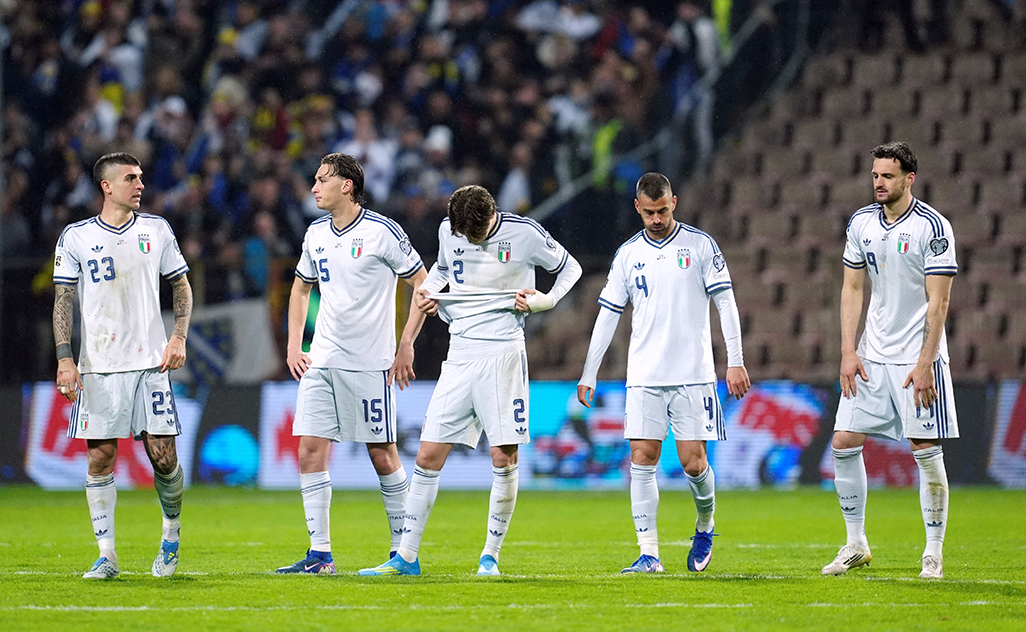
Italian football federation (Figc) president Gabriele Gravina resigned on Thursday, in the wake of the national team’s failure to qualify for a third straight World Cup.
Gravina, in charge of the Figc since 2018, had been urged by the government to step down after Italy’s defeat on penalties in the playoff against Bosnia and Herzegovina on Tuesday.
The federation will hold an extraordinary assembly on June 22 to elect a new chief, while Gravina offered to appear before a parliamentary committee on April 8 “to report on the state of health of Italian soccer”, a statement said.
The Italian team last qualified for the World Cup in 2014 and has won only one match at the finals since lifting the trophy for the fourth time in 2006.
Gravina was elected unopposed in October, 2018, the 72-year-old replacing Carlo Tavecchio who resigned a week after Italy failed to qualify for the 2018 World Cup.
While Gravina’s term included the Euro 2020 triumph, it also involved another two World Cup qualification failures and his position had become increasingly untenable after much criticism from Italian media and senior political figures.
Italy’s Sports Minister Andrea Abodi described Italy’s latest failure as a “definitive defeat” and suggested that Italian football needs to be “rebuilt from the ground up”.
Gravina spoke immediately after the loss to Bosnia, saying he understood the request for resignation but that there was a suitable place to make evaluations.
That place was the FIGC headquarters in Rome, where Gravina met with the six federal components – Serie A, B and C, National Amateur League, Players’ Association and Coaches Association – and informed them of his decision at the start of the meeting.
Gravina was re-elected in February 2021, and again in February 2025 with his mandate due to end in 2028, but the search now begins for his successor.
Names already being mentioned include 67-year-old former head of Italy’s Olympic Committee (CONI) Giovanni Malago and previous FIGC president Giancarlo Abete. Abete, 75, held the role from 2007 to 2014.





Click here to change your cookie preferences