
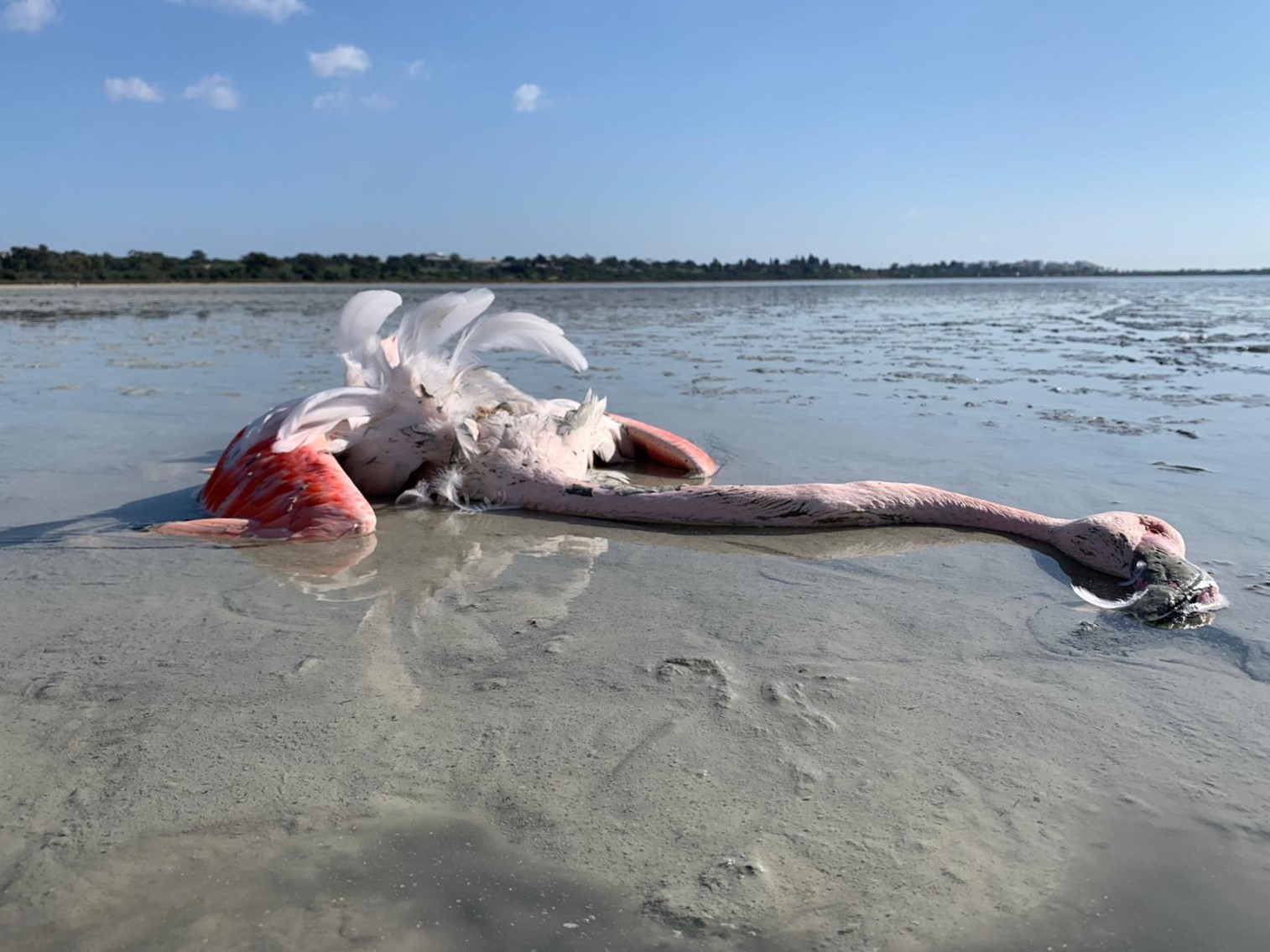
Flamingos arrive in Cyprus in November and leave by the end of February, with their pink colour and height reaching 1.45m making them a popular sight at Cyprus’ wetlands, however in the past 25 years 169 of these majestic birds have suffered lead poisoning as the state has failed to protect them, BirdLife Cyprus said on Tuesday.
A study conducted in the framework of European project Life IP Pandoteira has highlighted the presence of lead in two important wetlands in Cyprus, protected under Natura 2000; the Larnaca salt lake and the Paralimni lake.
BirdLife Cyprus said the pressure on wildlife at these wetlands was investigated, including hunting, illegal access and the presence of lead.
Regarding lead in particular, sediment and soil sampling was carried out, indicating high concentrations at specific points of the lakes.
At Larnaca’s salt lake, high concentrations of lead in sediments was linked to an old shooting range in the area.
As the distance from the old shooting range increases the concentrations lower, showing that the range was the main source of pollution, BirdLife said.
The salt lake complex includes the Latsi lake in Meneou, also known as Soros lake, where hunting is allowed.
A separate study at Latsi lake confirmed the presence of lead, which is linked to lead pellets from hunting cartridges.
“The impact on wildlife is already evident,” BirdLife Cyprus said.
Data obtained from the Gaming Fund indicated 169 flamingos had suffered lead poisoning in Larnaca’s salt lake complex since 2020.
In Paralimni, the presence of lead in the local lake is also mainly due to shooting and hunting.
A shooting range is still in operation on the south side of the lake within the protected area, while hunting is allowed in part of the Natura 2000 area during hunting season.
The pellets gather on the ground among the lake’s sediment, leading to high concentrations of lead in the wetland.
In 2012, the European Court of Justice convicted Cyprus for failing to protect the Paralimni lake and for tolerating activity that placed the lake ecology in serious danger, including the absence of measures to protect the water snake.
One of the problematic activities cited in the court’s ruling was the operation of the shooting range.
BirdLife pointed out that although a law had been passed in 2023 banning the use of lead pellets near wetlands, the legislation is not being implemented.
Apart from the obvious need to implement and uphold the law, these findings also underline the need to restore the wetlands to minimise the risk of aquatic birds suffering lead poisoning, and support the European Commission’s proposal to completely ban lead in hunting pellets and fishing plummets across the EU, as alternatives are available.
BirdLife Cyprus said lead is a particularly toxic metal and there is no safe level of exposure.
It added that the presence of lead in the environment “constitutes a serious threat to biodiversity and human health, and makes taking immediate measures imperative.
“These wetlands are home to thousands of migratory birds every year, which makes protecting them extremely important, both for nature and public health.”
The EU-funded Life IP Pandoteira project is running from 2019 till 2029 with the participation of 14 partners, including BirdLife Cyprus.
The study can be found here.





Click here to change your cookie preferences