

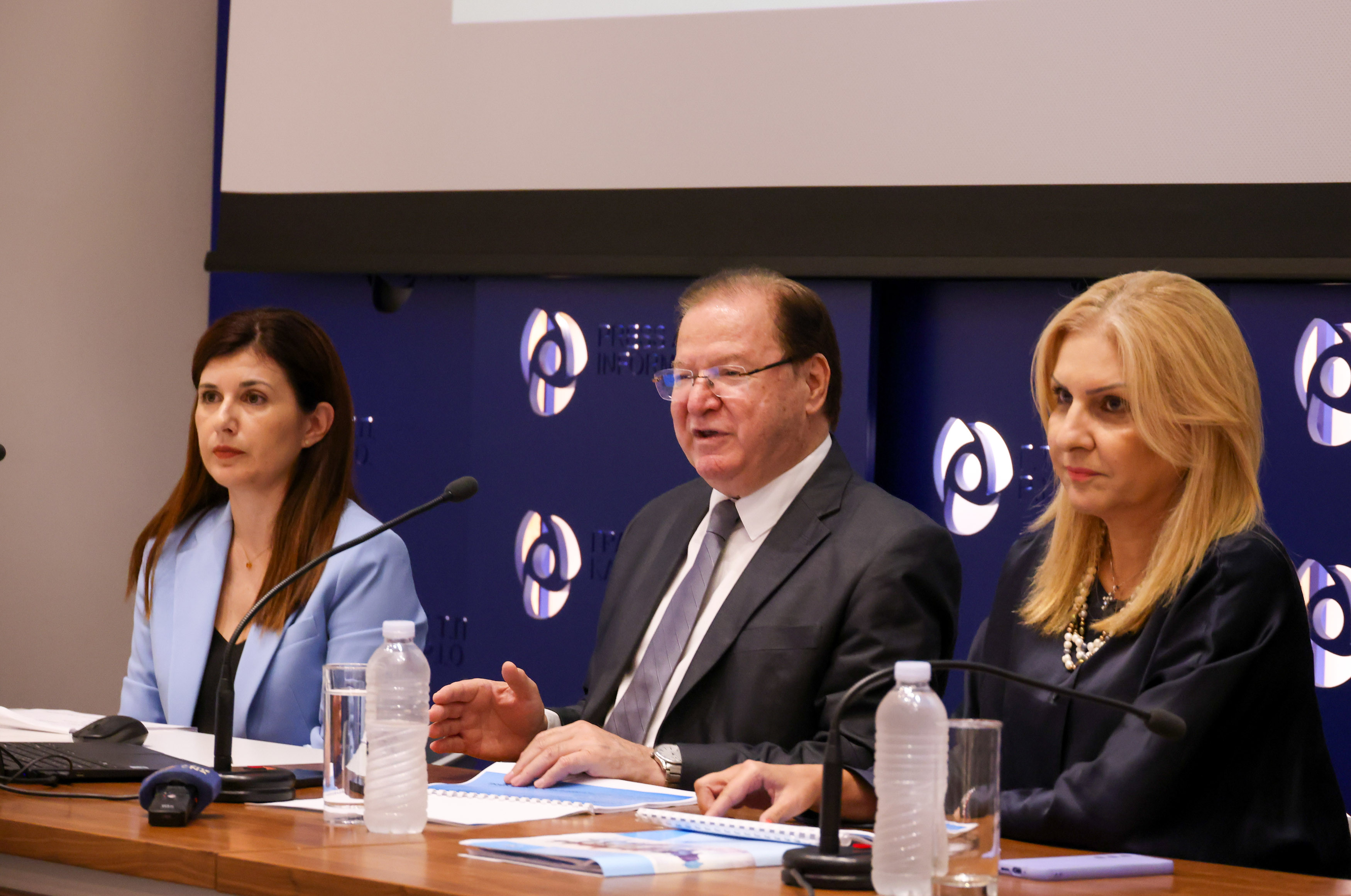
Raising the basic pension, without impacting the robustness of the Social Insurance Fund, is a key government objective, the labour minister said on Tuesday.
“What I can say for sure, is that the basic pension will be lower than €1,088,” Marinos Mousiouttas told journalists during a Q&A after a presentation of the ministry’s work and its goals going forward.
He was being asked to pinpoint what the basic pension amount would look like after the reform of the pension system.
The €1,088 number he referenced is the national minimum wage.
Weighing in, the permanent secretary at the labour ministry said: “We are giving the maximum possible, without causing an imbalance.”
The basic pension to be announced would be “according to the capabilities” of the Social Insurance Fund (SIF).
The government has already drafted an outline for a reformed pension system, and is currently holding talks with stakeholders – unions and employers organisations – on the particulars.
There are two ‘pillars’, or tracks: the first concerns state pensions; the second concerns provident funds, as well as the cash reserves of the SIF and its investment policy.
As of right now, the statutory pension system in Cyprus consists of two main components: a fixed (basic) pension and a proportional (supplementary) pension, calculated based on contributions.
The basic pension (fixed component) is designed to provide a minimum income based on the average weekly basic insurable earnings, which are revalued annually. It is generally 60 per cent of the weekly average of basic insurable earnings, plus a 10 per cent increase for each dependent.
The other component, the proportional/supplementary pension, is calculated based on total contributions above the basic insurable earnings.
The government’s thinking for the reform is to raise the pension amounts for those on the low end, funding this from cuts to the pensions on those on the high end.
According to Mousiouttas, the timetable for the reform sees the tabling of the relevant legislation to parliament in June, and certainly before the House breaks for the summer recess.
Actual debate on the bills would start in September, with the official launch of the revamped pension system scheduled for January 1, 2027.
Asked if this is feasible given the tight margins, the minister sounded confident, noting that the stakeholders appear to largely converge on the first pillar of the reform.
Regarding the second pillar, he said, the stakeholders agree that its rollout would come later – three to four years.
The overriding goal, stressed the minister, is to ensure adequate and resilient pensions for all, reducing the risk of poverty among pensioners, and the long-term viability of the SIF.
The last major reform on the pension system took place in 1980, with additional changes introduced during 2012-2013 as part of Cyprus’ agreement with international lenders.
On the investment policy envisioned for the SIF, Mousiouttas said they are coordinating with the finance ministry.
For decades, the state has dipped into the SIF for financing, paying it 2.15 per cent interest for the money it borrows. In January, Mousiouttas told a parliamentary committee that the state’s accrued debt to the SIF comes to €11.3 billion.
Regarding how the state will gradually repay this, the minister said the formula applied would be such that “the money keeps coming into the Fund without endangering the economy at large”.
At present, the reserves of the SIF appear robust. Citing data for 2024, Mousiouttas said contributors to the SIF increased to 592,000. Actual contributions came to €2.7 billion, while payouts clocked in at €2.06 billion.
In 2024, the SIF registered a €290 million surplus.
Another plus is the high level of employment in Cyprus. In 2025, the joblessness rate was under 4.4 per cent, compared to the six per cent average across the EU.
At the same time, average earnings in Cyprus last year came to €2,605, while the median salary registered at €1,968.
The minister recalled that as of January this year, the national minimum wage was revised upward to €1,088 – benefiting some 40,000 low wage earners.
Going forward, one of the goals set by the government is to crack down on undeclared work and illegal employment.
During 2025, 7,920 inspections at workplaces were carried out, tracking around a thousand undeclared workers. Overall, the percentage of undeclared work was calculated at 5.48 per cent – it was much higher among foreign nationals, at 23.24 per cent.
Authorities issued fines totaling €1.8 million for undeclared work.




Click here to change your cookie preferences