
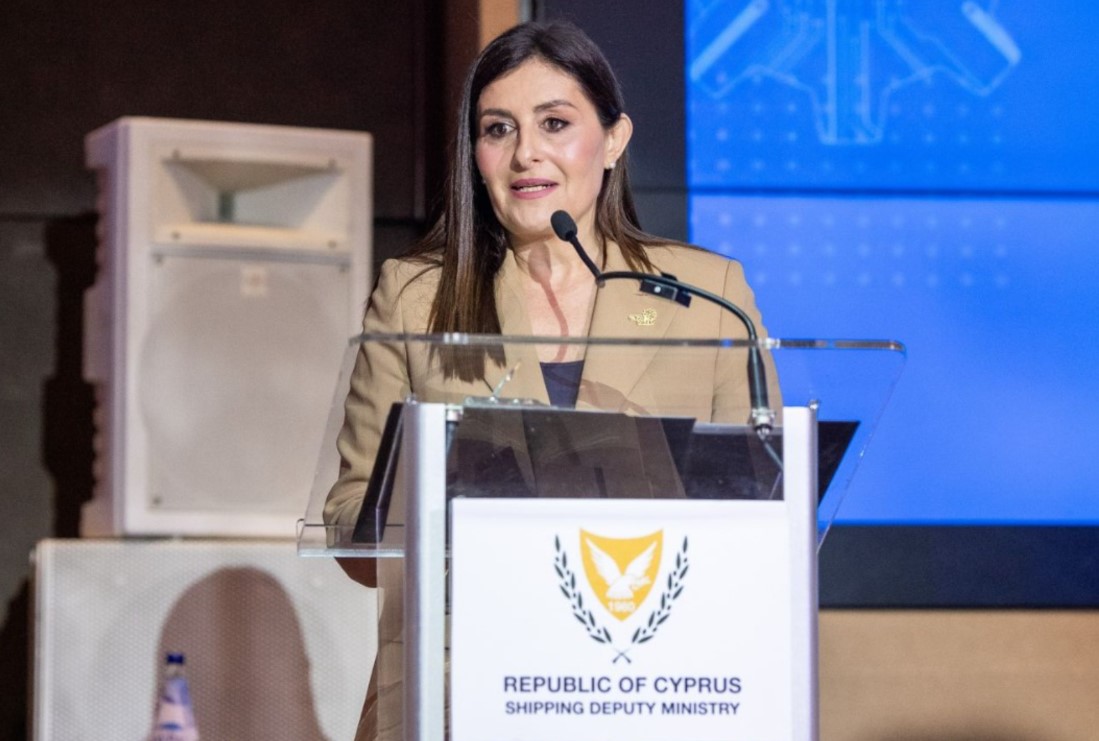
Shipping Deputy Minister Marina Hadjimanolis on Tuesday called for seafarers to be placed at the heart of maritime policy, saying the future of global shipping depends not only on regulation and technology, but on the people who keep the industry moving.
Speaking at the High-Level Ministerial Stakeholders Conference on ‘Investing in Seafarers: Securing the Future of Global Shipping‘, held in Limassol within the framework of the Cyprus Presidency of the Council of the EU, Hadjimanolis said the sector is facing a defining period as greener shipping, digital transformation and increasingly complex supply chains reshape the industry.
“This conference places people firmly at the centre of maritime policy,” she said in her welcome address.
“The future of shipping is not determined only by technology, regulation, or infrastructure, but by the people who operate, manage, and sustain it every single day,” she added.
The conference brought together government officials, senior maritime stakeholders, representatives of regional and international maritime organisations, and prominent figures from the global shipping industry.
Among those attending were European Commissioner for Sustainable Transport and Tourism Apostolos Tzitzikostas, Greek Minister of Maritime Affairs and Insular Policy Vassilis Kikilias, and MEP Elissavet Vozemberg-Vrionidi, chair of the European Parliament’s Committee on Transport and Tourism.
The event focused on seafarers’ education and training, ways to attract and retain talent in the shipping industry, and initiatives aimed at raising awareness of maritime and seafaring professions.
Hadjimanolis said the transition now under way brings both opportunity and responsibility, particularly as the industry seeks to attract, train and retain the next generation of seafarers.
“As we meet here today, the maritime sector stands at a defining moment,” she said.
“The transition towards greener shipping, the rapid pace of digital transformation and the growing complexity of global supply chains are reshaping our industry. These developments bring opportunity, but also responsibility,” she added.
At the same time, the deputy minister described seafaring as a profession rooted in resilience, discipline and sacrifice, stressing its wider role in supporting global trade and connecting economies.
“Seafaring is more than a career. It is a calling built on courage, discipline, sacrifice, and adventure,” Hadjimanolis said.
“It connects nations, powers global trade, and keeps the world moving. For generations, seafarers have carried not only cargo across oceans, but also the spirit of resilience and progress,” she added.
Hadjimanolis said the industry must do more to make maritime careers visible and attractive to young people, particularly as shipping adapts to new environmental and technological demands.
“Now, it is our turn to keep that journey alive,” she said.
“The maritime world is evolving, and so must we. We must inspire them to see the sea not as a distant horizon, but as a future worth pursuing,” she added.
During the event, Hadjimanolis, on behalf of the Republic of Cyprus, presented an award of recognition to Captain Panagiotis Tsakos for his contribution to the advancement of the maritime sector internationally.
The award also recognised his long-standing work in nurturing knowledge, strengthening values and creating opportunities for those who serve at sea.
Hadjimanolis concluded by saying that investment in young people is essential for the long-term future of the sector.
“Because when we invest in young people, we keep the spirit of the sea alive,” she said.



Click here to change your cookie preferences