
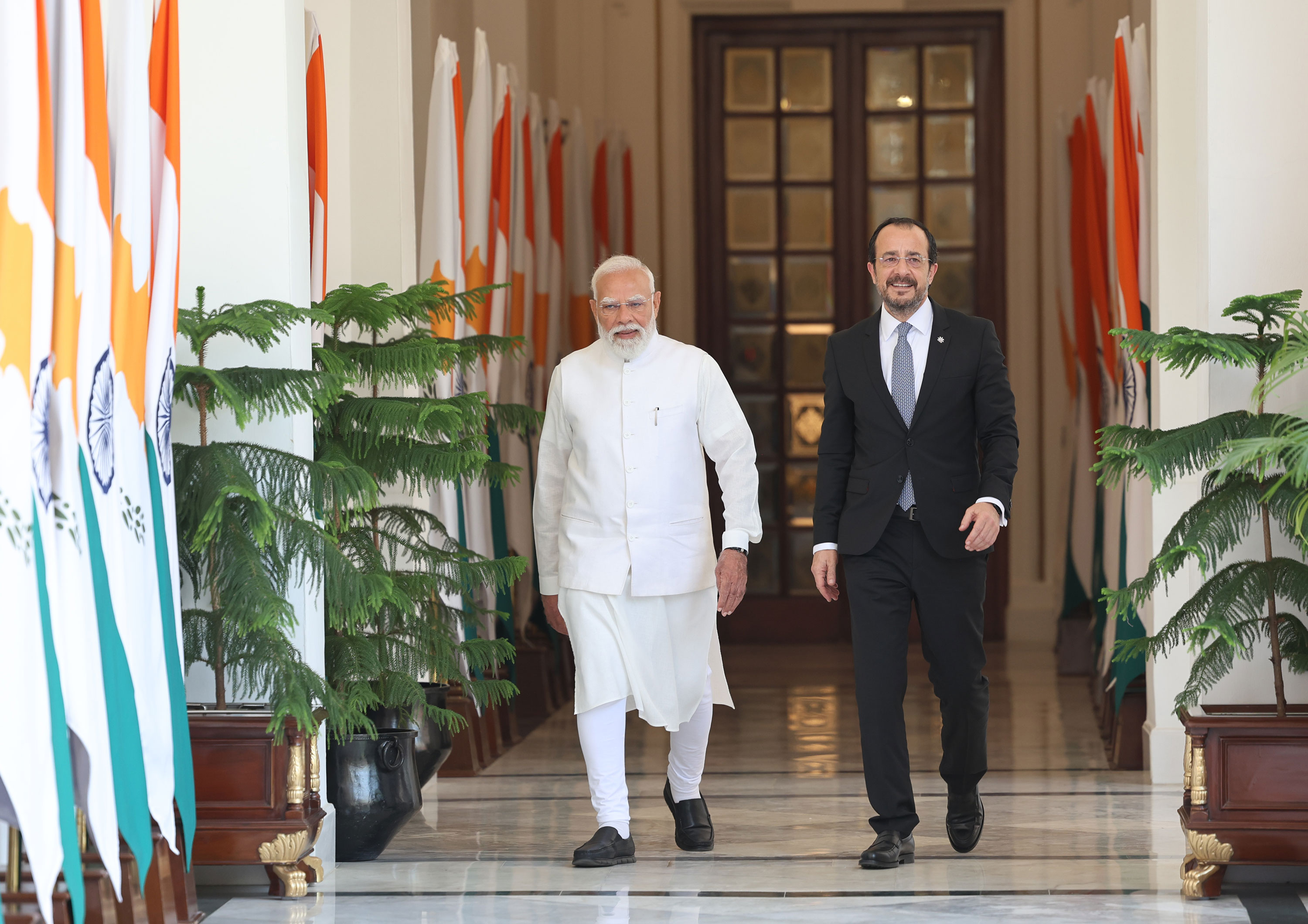
Relations between India and Cyprus “have stood the test of time”, Indian Prime Minister Narendra Modi said on Friday as he welcomed Cyprus President Nikos Christodoulides to his official residence, Hyderabad House in New Delhi.
“The friendship between Cyprus is not only strong, it is future-facing as well. We respect the sovereignty and territorial integrity of all nations. India is firmly committed to these principles, and will continue to be so,” he said.
He added that “as we enter a golden era of relations between India and Europe, this is exactly the time when Cyprus is not only holding the presidency of the Council of the European Union, but also emerging as an important gateway between India and all of Europe for investment”.
To this end, he pointed out that Cyprus is “among the top 10 investors” in India over the course of the last decade, and that in recent years, the value of Cypriot investments in India has “nearly doubled”.
“With the growing trust between both countries and the opportunities being created by the free trade agreement between India and the European Union, we can once again double this figure within the next five years, and that is a target we have set,” he said.
To achieve that target, he said, “we have decided to upgrade our trusted relationship to a strategic partnership.”
This strategic partnership between India and Cyprus will closely connect the financial and services hubs of both countries and unlock capital for commerce. It will offer new opportunities for Indian companies in infrastructure, commerce and energy in Cyprus, and drive new investment into rapidly expanding maritime and services sectors of India, he said.
He went on to say that cooperation in the field of security is an “important pillar of our relations”, and said to this end that “we are very pleased that over the last few years, military exchanges and training cooperation has increased”.
Additionally, he made reference to the memorandums of understanding signed at the day’s meeting geared towards strengthening cooperation between India and Cyprus in the fields of cybersecurity and counterterrorism.
Christodoulides’ remarks, meanwhile, were similar in nature.
He said “we stand together in marking another milestone in further strengthening the longstanding bond between our two countries, and in deepening and expanding our strategic cooperation”.
Additionally, he stressed the European element of his visit, saying that “my focus is on bilateral relations, and at the same time, on the broader strategic relationship between India and the European Union”.
To this end, he pointed out that Cyprus currently holds the Council of the European Union’s rotating presidency, and said that “these paths cross at a juncture when both our bilateral relations and EU-India relations have made leaps of progress over the last year.
“We are here to put more building blocks on these partnerships,” he said, before returning to the matter of Cyprus’ relations with India and saying that “what began as a strategic vision is now evolving into a concrete partnership” which is “already producing tangible results across key areas”.
Cyprus and India are set to create a joint task force which will deal with key sectors such as infrastructure, shipping and economic cooperation, while a roadmap has been devised to further deepen cooperation across strategic sectors.
“Together, these agreements reflect both the breadth of our partnership and our shared commitment to further expand the horizon of Cyprus-India cooperation. This historic bond, this affinity between our two countries and our two peoples goes back centuries,” he said.
He added that relations between Cyprus and India are “rooted in shared historical experiences and common values”, and that they were “forged through common struggles for freedom and the right of peoples to self-determination”.
In the modern era, he said, “they are consistently strengthened through our shared commitment to peace, democracy, and respect for international law”.
Regarding relations between the EU and India, he said that “Europe and India have every reason to deepen their cooperation further, on security, trade, technology, innovation, and connectivity”.
“Together, the European Union and India, the world’s largest democracy, can play a defining role not only for our regions, but also for global stability and prosperity,” he said.
On the matter of the India-Middle East-Europe Economic Corridor (Imec), Christodoulides stressed the advantage of Cyprus’ geographical location.
“Cyprus, located at the crossroads of three continents and the gateway to Europe, stands ready to contribute actively to this shared vision,” he said, describing the vision as one of connectivity, openness and partnership.
He said that Cyprus has formed a group named Friends of Imec, which will allow “signatories and interested states to advance connectivity, stability and economic cooperation across our wider region”.
Modi also spoke about how “Indian professionals and students in Cyprus are further strengthening relations between our peoples”.
On this matter, he said that “to further strengthen these ties, we have agreed to sign a comprehensive migration partnership and social security agreement as well”, while memorandums of understanding signed on Friday also related to higher education and culture.
Concluding his speech, he said that “the launch of the strategic partnership today will give our relations new ambition and new momentum.
“Let us together take our relations from cooperation to co-creation. India and Cyprus together will produce a more prosperous and brighter future.”





Click here to change your cookie preferences