
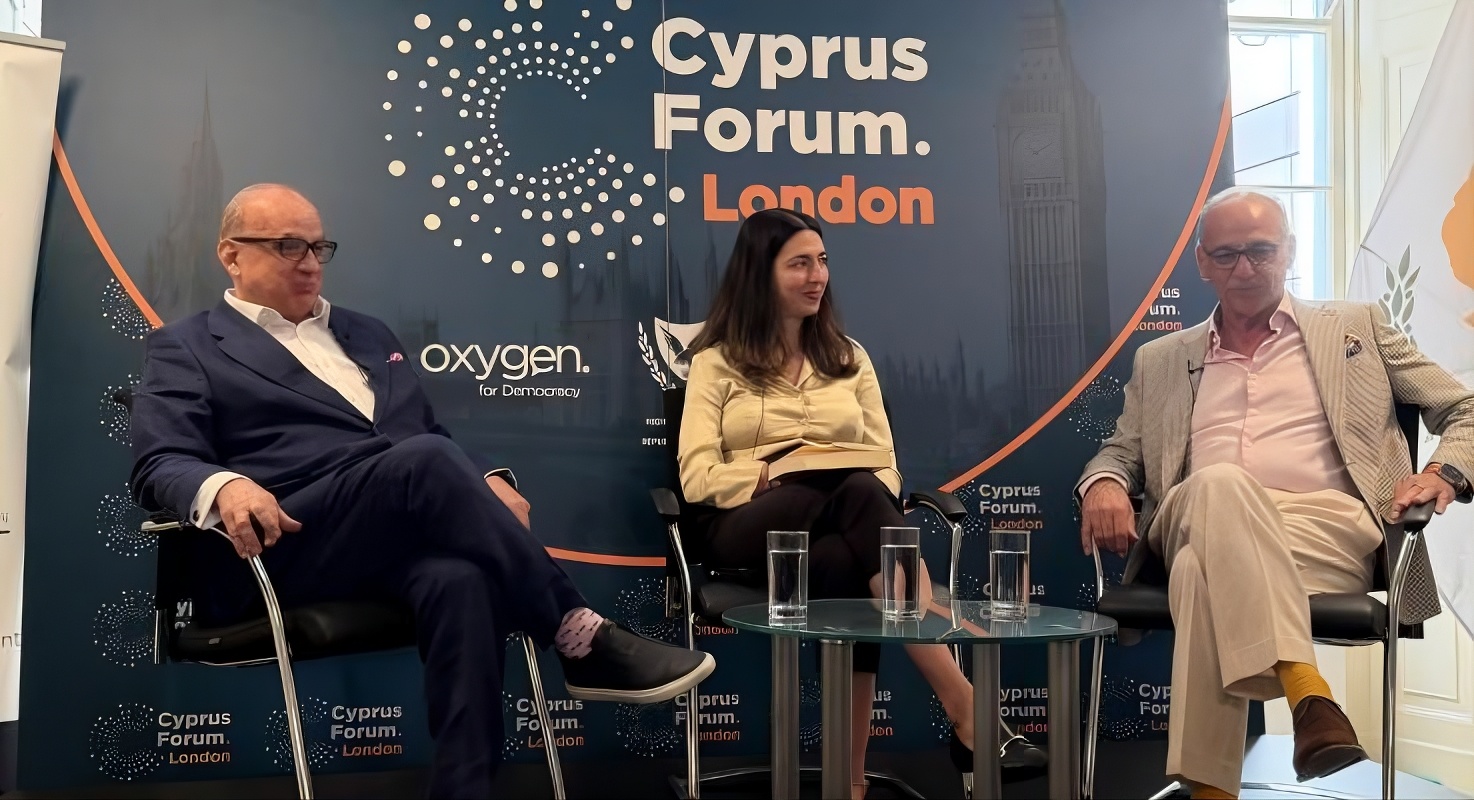
Prominent British Cypriot entrepreneurs Theo Paphitis and Touker Suleyman recently shared their experiences and views on entrepreneurship, artificial intelligence and the role of the diaspora during a special event organised by the Cyprus Forum London at the Cyprus High Commission in London.
The event aimed to highlight the contribution of the Cypriot diaspora to British society and its role in supporting the country’s economic development.
The discussion also touched on the challenges facing modern businesses, the impact of artificial intelligence, support for young entrepreneurs and the future of relations between Cyprus and the United Kingdom.
Both businessmen reflected on their families’ arrival in Britain and the opportunities they found despite the difficulties of adapting to a new country.
Paphitis recalled arriving in Manchester in 1966 and spoke about the efforts made by Cypriot immigrants to create better prospects for future generations.
Suleyman recounted how his own family arrived from Cyprus in the late 1950s.
The two entrepreneurs agreed that success in business does not necessarily require revolutionary ideas, but rather depends on integrity, passion, hard work and perseverance.
Suleyman argued that young entrepreneurs should focus on improving existing products and services rather than trying to reinvent everything.
Paphitis stressed the importance of understanding the market and competitors, saying that many businesses fail because founders do not conduct sufficient preparation before launching.
A significant part of the discussion focused on artificial intelligence, which both speakers described as a technology that will fundamentally reshape business operations.
Suleyman said AI has already become an inseparable part of the business environment and encouraged younger generations to become familiar with new tools from an early age.
Paphitis said one of the major challenges for education systems would be adapting to an era in which information is instantly available and where the ability to use knowledge effectively matters more than memorising facts.
The pair also spoke about setbacks encountered throughout their careers.
Suleyman revealed that he nearly lost everything when, at a young age, he headed two listed companies that later ran into serious difficulties.
Moreover, he described that period as the most important lesson of his life.
Paphitis said failures and poor decisions are an inevitable part of entrepreneurship and help shape both character and judgement.
Much of the conversation centred on the role of the Cypriot community abroad and ways in which Cyprus could support younger entrepreneurs living overseas.
Suleyman proposed the creation of a mentoring network through which experienced business figures could provide guidance to younger members of the diaspora.
Paphitis emphasised that the true strength of communities lies in networking, collaboration and the exchange of knowledge.
The event was organised jointly by the Cyprus High Commission in the United Kingdom, the organisation Cypriots in the City and the Cyprus Forum.
Cyprus High Commissioner to the United Kingdom Kyriacos Kouros said that human connections constitute the strongest foundation underpinning relations between Cyprus and Britain.
He referred to the long history of Cypriot migration to Britain, explaining that the first waves began in the 1930s before larger movements followed during the 1950s and 1960s and again after the events of 1974.
He also said that Cyprus’ accession to the European Union had created new opportunities for thousands of young Cypriots choosing the United Kingdom for study and professional careers.
“Human ties remain the most important foundation of relations between Cyprus and the United Kingdom,” Kouros said.
Cypriots in the City co-founder and president Phanos Theophanous described the diaspora as “a community that has excelled in business, finance, culture and public life”.
He added that the achievements of figures such as Paphitis and Suleyman provide inspiration for a new generation of Cypriot professionals.
The discussion was moderated by Guardian political editor Eleni Courea.
The event concluded with an extensive question-and-answer session attended by young entrepreneurs, business executives, investors and members of the Cypriot community.
Participants said the discussion reflected the Cyprus Forum London’s ambition to serve as a platform for dialogue and cooperation between Cyprus, the United Kingdom and the diaspora.
Asked about Brexit, both entrepreneurs acknowledged that Britain’s exit from the European Union had created difficulties, particularly in trade and labour markets.
However, they argued that the priority now should be strengthening commercial and political ties between Britain and Europe rather than revisiting past divisions.


Click here to change your cookie preferences