
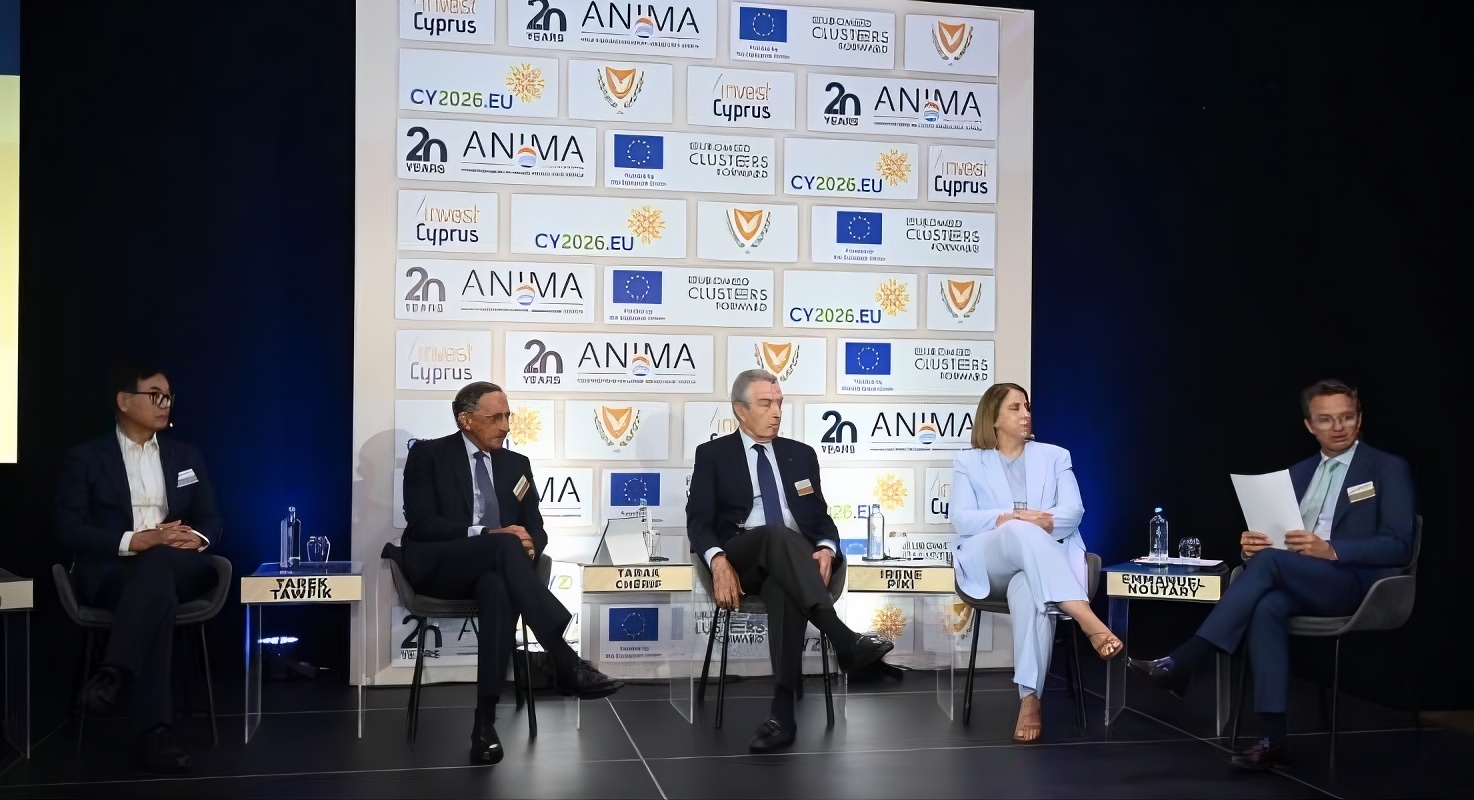
Cyprus’ role as a bridge between Europe, the Middle East and Africa came into focus on Monday, as officials, business leaders and investment experts gathered in Nicosia for the EuroMED Days conference.
The event, held at a hotel in the capital on the occasion of the Cyprus Presidency of the Council of the European Union, focused on strengthening economic cooperation, investment and technological interconnection across the wider Mediterranean region.
Participants said the Mediterranean is entering a new period of strategic importance, as geopolitical shifts, changing supply chains, the energy transition and the digital economy create both new challenges and opportunities for sustainable growth.
Opening the conference, Invest Cyprus president Evgenios Evgeniou said Cyprus has long served as a meeting point for cultures, trade routes and ideas, adding that its role as a bridge between Europe, the Middle East, Africa and Asia has become even more relevant.
In an environment marked by geopolitical uncertainty and shifting economic conditions, he said investors are increasingly looking for countries that offer stability, institutional credibility and long-term growth prospects.
Evgeniou said Cyprus combines full access to the single European market with a business-friendly environment and a strategic geographical position that opens the way to neighbouring markets.
At the same time, he pointed to Cyprus’ strong economic performance in recent years, saying the country has recorded one of the highest growth rates in the European Union, while technology is becoming one of the main pillars of the economy, contributing around 14 per cent of GDP.
ANIMA Investment Network president Tarak Cherif said stronger economic ties between Europe, the Middle East and Africa are essential for creating more growth and employment opportunities, particularly for younger generations.
At a time when international institutions and traditional forms of multilateral cooperation are being tested, he said maintaining dialogue and building relationships of trust have become even more important.
BusinessMed president Tarek Tawfik said the future of the region must be based on joint production and shared prosperity.
“Let us produce together and prosper together,” he said, adding that cooperation across the Mediterranean cannot work in one direction only but must deliver mutual benefits.
Despite the region’s significant potential, Tawfik said economic integration remains fragmented, both between North and South and among the countries of the Southern Mediterranean themselves.
He referred to the East Mediterranean Energy Hub, energy interconnections involving Egypt, Greece, Tunisia and Morocco, as well as circular migration agreements, describing them as examples of cooperation that could support a more integrated regional development model.
Deputy Minister to the President Irene Piki also emphasisied the Mediterranean’s growing importance for the European Union, saying the region has become more strategically relevant following the developments of recent years.
Speaking during a round table discussion, she said the Cyprus Presidency had sought from the outset to place the Mediterranean higher on the European agenda, not only politically but also in terms of the economy, energy and development.
“For us, the Mediterranean is not just an area of interest. It is the reality in which we live and operate,” Piki said.
“We understand very well the challenges but also the opportunities that are created in the region and we can function as a bridge of understanding and cooperation between the EU and the countries of our wider neighbourhood,” she added.
Piki said the main objective of the Cyprus Presidency was to move the discussion beyond broad declarations and towards more tangible and measurable cooperation initiatives.
She said the Presidency’s approach is based on the need to build a Europe that is strategically autonomous, while remaining open to the world through cooperation and a common response to modern challenges.
“We live in an increasingly interconnected world. No country can face the challenges we face alone,” she said.
“What we need is greater joint capacity to act, more cooperation and joint investments that will create real added value for all,” she added.
Piki identified four main areas where future investment and cooperation in the wider Mediterranean region should be directed, starting with energy, particularly electricity interconnections, renewable energy, energy storage and infrastructure that can strengthen regional energy security.
Just as important, she said, is digital connectivity and technological infrastructure, which have become central to economic growth and competitiveness.
She also pointed to transport, logistics and the new trade corridors developing between Europe, the Middle East and Asia, as regional supply chains are being reshaped.
Beyond infrastructure, Piki said human capital will be equally crucial, as the global competition to attract and retain talent intensifies. In this context, she noted that the Mediterranean has strong potential to become a hub for specialised professionals, researchers and entrepreneurs.
World Investment Conference president James X. Zhan focused on the shift from global value chains to regional production ecosystems.
He said geopolitical developments, sustainability requirements and technological change are leading to smaller, more regional production chains.
According to Zhan, a new “tripolar” economic model is gradually emerging, built around three major regional zones: Asia centred on China, the American continent centred on the US, and the wider European and Mediterranean region.
Within this new setting, he said the Mediterranean is gaining greater importance as a regional hub for production, investment and trade.
Deputy Minister of Research, Innovation and Digital Policy Nikodemos Damianou placed particular emphasis on technological sovereignty and the role of digital infrastructure in the new global economy.
He said Europe remains heavily dependent on non-EU providers for critical digital technologies, making it necessary to strengthen European technological autonomy in areas such as artificial intelligence, cloud computing, semiconductors, data centres and connectivity infrastructure.
Damianou said technological sovereignty should not be understood as isolation, but as the development of strong and reliable partnerships.
In this context, he described the Mediterranean as a critical area for digital connectivity and strategic cooperation, adding that Cyprus can act as a reliable digital gateway between Europe, the Middle East and Africa.
Nicosia mayor Charalambos Prountzos highlighted the role of cities in development and investment attraction.
He said most of the population and economic activity is concentrated in urban areas, making cities central to the success of any investment strategy.
Prountzos said smaller cities such as Nicosia can serve as ideal “testing laboratories” for new technologies and innovative solutions in areas such as energy, water, mobility, data and logistics, before these are expanded to larger markets.
At the same time, he referred to the difficulty of attracting investment capital for smaller-scale infrastructure projects, saying new financial tools are needed to respond to the needs of European cities.

Click here to change your cookie preferences