
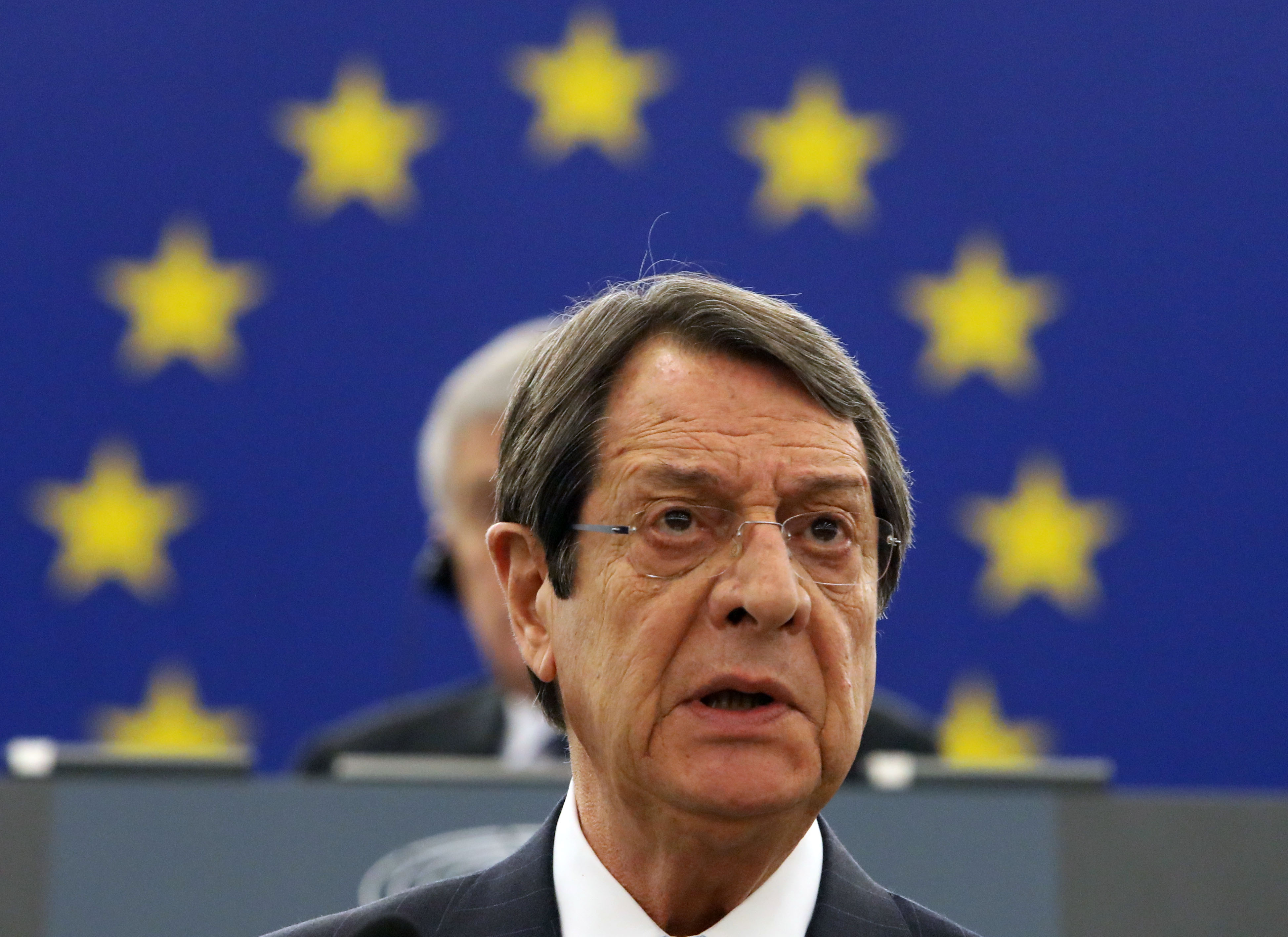
The anti-corruption authority on Tuesday found that former president Nicos Anastasiades, as well as others, may be criminally liable, following the conclusion of its investigation into allegations made against him and others by journalist Makarios Drousiotis, who formerly worked as his advisor, in his book Mafia State.
The report wrote that Anastasiades may have committed abuses of power while in office on several occasions, with one possible abuse of power on Anastasiades’ part was found in relation to the payments made between a company named Focus Maritime and another named Rizokarpasso Shipping.
It had been found that €450,000 had been transferred from Focus Maritime to Rizokarpasso Shipping, and then subsequently transferred to another company, named Holiday Tours, via a company named A&L Shipholding, with these funds intended to cover the costs of airline tickets to bring people to Cyprus to vote for Ioannis Kasoulides at the 2008 presidential election.
The investigation into the transfers found that an initial €500,000 transfer to Disy had been revoked, as the initial amount transferred to the party had one too many zeroes, with €450,000 as such being returned to Focus Maritime.
This money was then sent to Holiday Tours via both Rizokarpasso Shipping and A&L Shipholding. Investigators found that, contrary to initial allegations, A&L Shipholding was a real company, but became inactive after it sold the single ship it owned.
Anastasiades’ possible criminal liability stems from the fact that when the case was initially being investigated, he had “expressed strong dissatisfaction with [its] course” in the direction of the attorney-general of the day, Costas Clerides.
The report found that “this intervention may constitute an inappropriate exercise of executive pressure on the legal service, which is constitutionally independent, and it could affect the integrity of the investigation”.
Possible liability for abuse of power was also found regarding the development of Turkish Cypriot-owned property in the Larnaca district village of Dromolaxia, with the report finding that Anastasiades had personally intervened to overturn the land registry and late interior minister Socrates Hasikos’ decision to block the property’s development.
The report wrote that the property fell under the ownership of a vakif – an inalienable charitable endowment – and that the vakif’s administrator, a woman named Suzan Dikraz, had signed an agreement with the company wishing to develop it.
Anastasiades, the report said, mediated in a meeting involving the government of the day, the then deputy attorney-general Rikkos Erotokritou, representatives of both the company and the land registry, and then Edek MP George Varnava.
It found that while Anastasiades did nothing “reprehensible” at that meeting, he had, in mediating, “intervened in the duties” assigned by the constitution to the legal service.
As such, it said, “despite the fact that the former president’s interventions appear to have been well-intentioned during a period of economic crisis and were not made for personal gain”, actions he undertook “should not fall within the duties of the president”.
Another case of possible abuse of power was found by investigators regarding a case in which Anastasiades requested that Mokas, the police’s anti-money laundering unit, launch an investigation into claims levelled against him by the Organised crime and corruption reporting project (OCCRP), with the aim of clearing his own name.
This, it said, was done “to protect his public image and that of a private company which bears his name, in which his two daughters were shareholders”.
It said that this ordering of an investigation “may have led to a false public acquittal of any liability, which undermines public confidence in the impartial application of the obligations of the competent authorities”.
As such, it said, Anastasiades had “exerted institutional pressure to direct Mokas, an operationally independent and autonomous unit, to investigate the private company which bears his name and in which his two daughters were shareholders, seeking to ensure public exoneration and protection from independent, strict scrutiny”.
“The arbitrary nature of this action is reinforced by the timing, since while Mokas claimed to have acted of its own volition based on publications in the media, and taking to account that it had already received a referral from an audit firm regarding the relevant transactions eight days earlier, it nevertheless took no action until [Anastasiades] publicly requested an investigation,” it said.
The report also found that Anastasiades may be guilty of influence peddling, writing that prior to his election as president, when he was the leader of Disy and a member of parliament, he had “abused the influence he could exert on other persons in decision-making”.
It said he used this influence to secure a “private meeting with the then interior minister”, Akel’s Neoklis Sykliotis, “attempting to bypass the usual procedure and influence the course of the naturalisation file of a private client”.
“These actions undermine the legal naturalisation process that was in force at the time in question, as well as the rights of other applicants with regard to the principle of equality,” it said.
The client in question was Russian oligarch Alexander Abramov, the founder and then chairman of steel manufacturing and mining company Evraz.
Additionally, the report pointed out that Anastasiades’ wife had signed the naturalisation application of Leonid Lebedev, a then sitting member of Russia’s federation council – the upper chamber of its legislature.
In exchange for this, it said, Anastasiades’ law firm received a “financial benefit”, as well as “other unjustified advantages, including the free use of Lebedev’s luxury private jet by Nicos Anastasiades”.
The report also said he may have committed the offence of influence peddling in another context prior to the 2013 presidential election, writing that he had “abused the influence he could exert on other persons in decision-making and, acting as an influence-peddler, sought to misclassify a transaction with Laiki Bank”.
It said that he had done this “so as to conceal its true nature and beneficiary”.
“Specifically, taking advantage of the practice of banks to pay commissions for clients referred to the bank by intermediaries, he received amounts from the Laiki Bank for support in his election campaign in the 2013 presidential elections, under the pretext of said commissions,” it said.
Those commissions, it added, were “misleadingly categorised in the bank’s accounting books as ‘introducer fees’” – in other words, they were referenced as commissions for referring people to the Laiki Bank rather than political donations. The amount received by Anastasiades totalled at €250,000.
“By receiving the relevant amounts, which constitute an irregular advantage, [Anastasiades] is involved in passive influence peddling,” it said.
Mafia State was first published by Makarios Drousiotis in 2022, with the anti-corruption authority launching an investigation into its findings the following year, after former Greek Cypriot chief negotiator for the Cyprus problem and then presidential candidate Andreas Mavroyiannis had written to them.
The investigation into its findings began in 2024, with the investigation committee being chaired by Australian jurist Gabrielle McIntyre, who had previously chaired the Seychelles’ truth, reconciliation, and national unity commission, which was established with the aim of creating a common understanding of events related to the country’s coup d’état of 1977.
She worked alongside Cypriot lawyers Charilaos Chrysanthou, Orestis Nikitas, and Andreas Efthymiou,
In total, 150 people were interviewed across 200 sessions, with no fewer than 793 pieces of evidence being submitted during the course of the investigation.




Click here to change your cookie preferences