
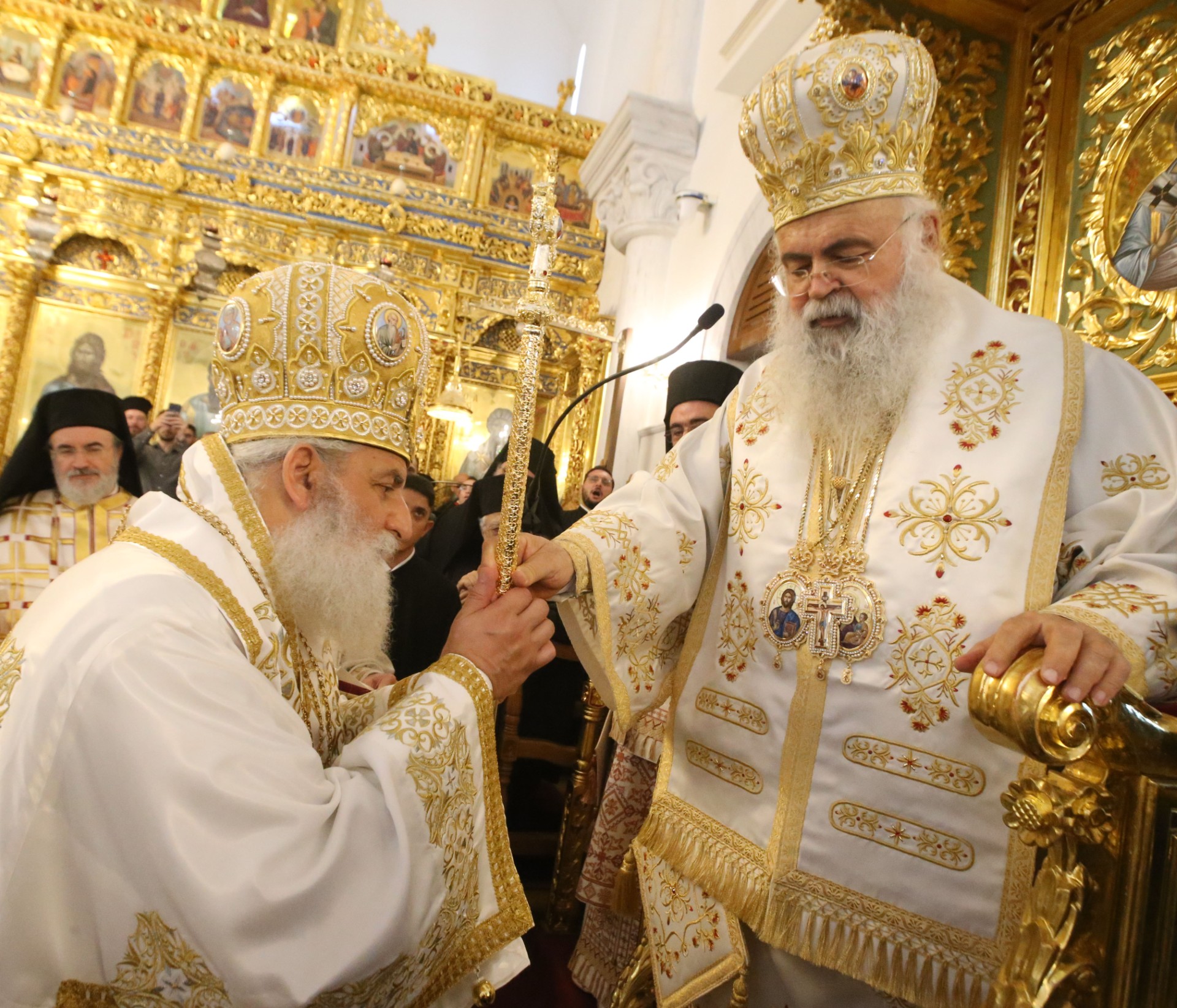
Archbishop Georgios insisted on Monday that the church had no involvement in the state land exchanges examined by the anti-corruption authority’s probe into the findings of the book Mafia State, adding that the church is prepared to return a donation received from Malaysian fugitive Jho Low should a court order require it.
Speaking on Alpha, the archbishop addressed allegations surrounding the transfer of state land to the archbishopric as well as the wider findings published by the authority, which recommended a criminal investigation into former agriculture minister Nicos Kouyialis over a land compensation arrangement involving church property in Engomi.
According to the authority’s findings, the state expropriated church land in Engomi and subsequently approved the transfer of state-owned plots in Ayia Napa to the archbishopric as compensation.
While the land was presented to competent authorities as having a value of €5.7 million, later cadastral records showed the plots ultimately transferred had an estimated value exceeding €10.6 million.
The authority concluded that the state may have suffered a significant loss of state property and recommended that Kouyialis be investigated for possible abuse of power.
The findings stated that no evidence had emerged indicating that the former minister received any personal benefit.
Archbishop Georgios firmly rejected suggestions that the church played a role in determining the land selected or its valuation.
“From the information we have received, it appears the Church had no involvement,” he said.
He argued that the state itself requested the expropriation of church land for the construction of a school in Engomi and subsequently assumed responsibility for identifying replacement properties.
“We were not asked to provide explanations. The government undertook to find properties of equal value for exchange,” he said.
The allegations form part of the broader allegations levied by journalist Makarios Drousiotis in Mafia State.
Among the claims examined by the anti-corruption authority was whether the archbishopric benefited disproportionately from the compensation arrangement approved by the state.
The archbishop said the church would abide by any legal findings relating to the matter.
“If there is again a court decision, the archbishopric does not want any shadows cast over it,” he said.
He made similar remarks when questioned about a donation received from Jho Low, the businessman at the centre of the international 1MDB corruption scandal.
The Church received approximately €300,000 from Low as a contribution towards the construction of its theological school during the tenure of the late Archbishop Chrysostomos II.
The donation came before Low became an internationally wanted fugitive and before the full extent of allegations surrounding the Malaysian sovereign wealth fund emerged.
Asked whether the church would return the money, Georgios said it would comply with any judicial ruling.
“If there is a court decision, the church does not want any shadows cast over it,” he said.
The comments come less than two weeks after a Nicosia court ordered the seizure of a luxury villa in Ayia Napa belonging to Low.
The property, valued at around €6 million, was impounded following a joint application by the attorney-general and the anti-money laundering unit (Mokas).
Low secured Cypriot citizenship in 2015 through the now abolished citizenship by investment programme after purchasing luxury real estate on the island.
His passport was revoked by the cabinet in 2024.
Malaysian authorities accuse Low of helping siphon billions of dollars from the 1MDB sovereign wealth fund.
Although he was under investigation at the time he obtained Cypriot citizenship, he was not formally declared a wanted person until Interpol issued a red notice in 2016.
During the interview, Georgios also defended the church’s commercial activities, saying they are conducted for the benefit of society rather than individual church officials.
“The aim is the common good,” he said, adding that church assets are not the personal property of either the archbishop or any other member of the clergy.


Click here to change your cookie preferences