
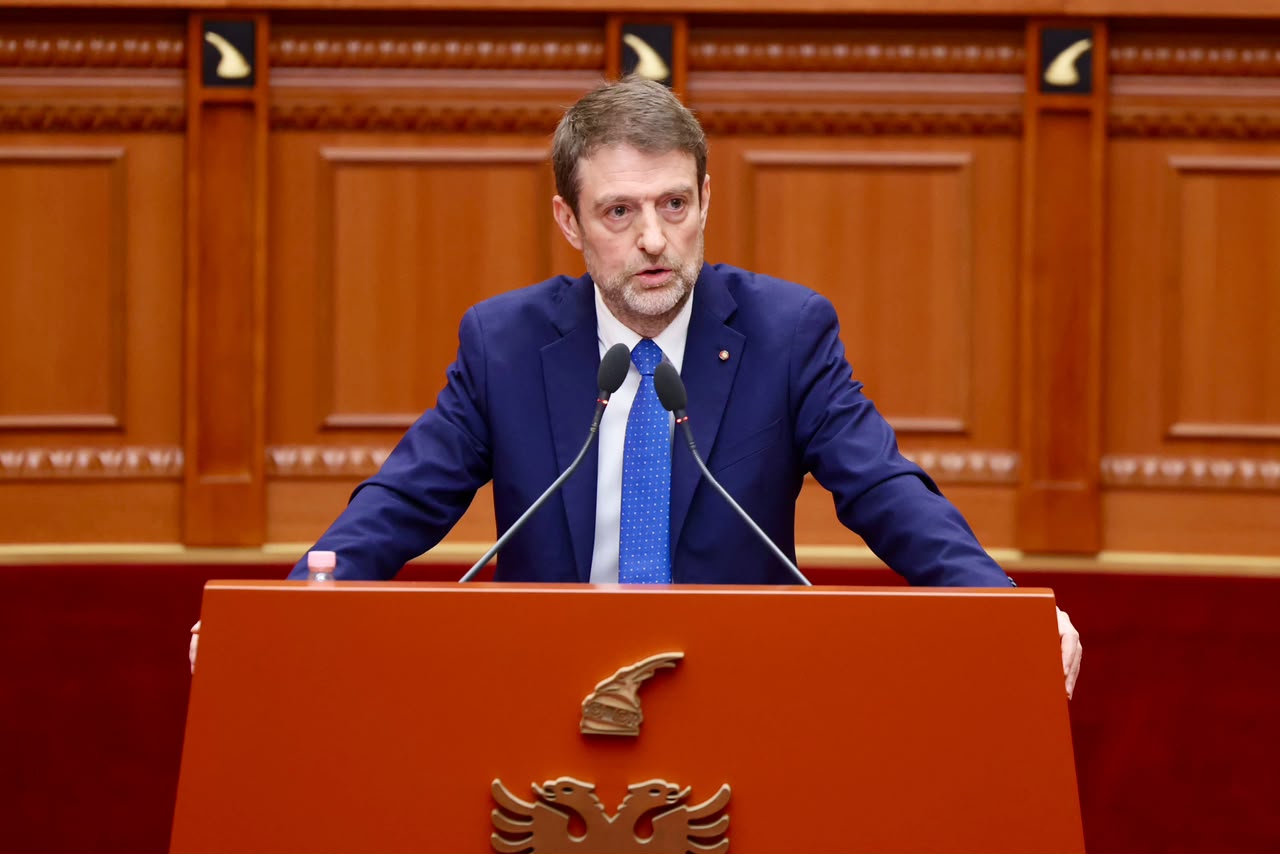
Albanian Foreign Minister Ferit Hoxha on Thursday offered high praise for Cyprus’ performance during its six-month term as the holder of the Council of the European Union’s rotating presidency, as he met President Nikos Christodoulides in Nicosia.
He singled out Cypriot European Affairs Deputy Minister Marilena Raouna for her work to advance the process of EU enlargement, saying that the work carried out was “truly admirable”.
“The issue of enlargement was handled exceptionally well, and we could not be more grateful. The Cyprus presidency passed the tests with great success in all areas,” he said.
Christodoulides, meanwhile, spoke of a “common will to further strengthen bilateral relations between Cyprus and Albania”, while also stressing “the Republic of Cyprus’ support for Albania’s accession process”.
Most recently, Raouna and Albanian chief negotiator Majlinda Dhuka had spoken on the matter last month, with Raouna saying that Albania is “continuing its steady progress on its reform path”, regarding the various legal reforms required for a country to join the EU.
EU enlargement, she added, is a goal which “we continue to advance with determination and a results-oriented approach, in line with the merit-based process”.
Albania was described by European Enlargement Comissioner Marta Kos in March as “a frontrunner in the EU accession process”, with the final negotiation cluster for EU membership having been opened with the country in November last year.
In April, Kos said that Albania “still has a lot of work ahead, but it has already made substantial progress” toward EU membership.
“We are currently in the process of approving the interim benchmarks related to the rule of law. Once these are in place, Albania can begin closing chapters. So, while much needs to be done, the Albanian leadership aims to conclude negotiations by 2027 or 2028, and we support it,” she told The Parliament magazine.
Meanwhile, Albanian Prime Minister Edi Rama and Serbian President Aleksandar Vucic penned a joint article in German newspaper Frankfuter Allgemeine Zeitung calling for an accelerated process of integration into the EU, which would see both countries gradually incorporated into the bloc.
Their proposal would see both countries join the European single market and the continent’s border-free Schengen zone, but not be immediately entitled to European commissioners, members of the European Parliament, or veto rights at the European Council level – something all 27 current EU member states enjoy.
That article comes after Rama had said words to the same effect as conversations surrounding a “two-speed Europe” abounded at the beginning of the year.
“At the end, they are the adults in the family who make the important decisions,” he said, before adding that in a post-veto EU, one advantage would be that if the larger member states “f*ck up”, the smaller member states would not be to blame.
It has now been almost 13 years since Croatia, the last country to join the EU, did so in 2013, and in the intervening years, one member state, the United Kingdom, has left the bloc.
This period between new member states’ joining is the longest since the 20 and a half years between the creation of the European Coal and Steel Community in 1952 and the accession of Denmark, Ireland and the UK to the European Communities in 1973.
Raouna had said last month that enlargement is an “indispensable commitment” for the EU, stressing that “our union is a project that has constantly evolved, not despite crises, but because of them, in many cases, because it is those moments that have driven the deeper integration of the European Union“.




Click here to change your cookie preferences