

When people start seriously considering life without glasses or contact lenses, two procedures usually come up first: LASIK and PRK. Both are well-established forms of laser vision correction that can reduce dependence on corrective lenses and significantly improve vision. However, they differ in how the surgeon performs the procedure, and they are not always recommended for the same type of patient.
So what exactly separates LASIK from PRK?
Quick Answer: LASIK involves creating a thin corneal flap before reshaping the tissue underneath, while PRK removes the outer surface layer of the cornea and treats the surface directly without creating a flap. Because of this difference, the two procedures vary in recovery time, post-operative comfort, and patient suitability.

Patients often come in with every question imaginable. “I heard LASIK is faster.” “Someone told me PRK is safer.” “My friend had LASIK – should I just do that too?”
The confusion is completely understandable, and it’s exactly why a clear comparison of these two procedures is so important before you walk into a consultation.
What is LASIK?
LASIK stands for Laser-Assisted In Situ Keratomileusis. It is currently the most widely performed refractive eye surgery worldwide. It accounts for roughly 70% of all laser vision correction procedures performed each year, and for good reason: the results are fast, and most people are back to their normal routine within a day or two.
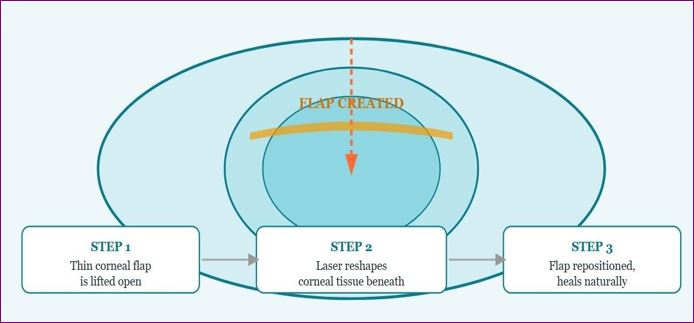
How LASIK Works
- Numbing drops are applied so you feel nothing throughout the procedure.
- A femtosecond laser (or, in older systems, a microkeratome blade) creates a very thin hinged flap on the surface of the cornea – roughly the width of a human hair.
- That flap is gently lifted back, exposing the corneal tissue beneath.
- An excimer laser precisely reshapes the exposed corneal tissue to correct your specific refractive error – whether that’s nearsightedness, farsightedness, or astigmatism.
- The flap is then repositioned, where it naturally adheres without stitches.
The entire procedure for both eyes takes about 15 minutes. Most patients notice significantly clearer vision within 24 hours, with many experiencing improvement the very same evening.
Recovery After LASIK
This is one of LASIK’s most recognized advantages. The flap acts as a natural bandage, which means the surface heals quickly and discomfort is minimal. Only the thin edge of the flap needs to heal, which happens in the first 24 hours. Most people return to desk work the next day. Most patients are able to resume driving within 24 to 48 hours, depending on their recovery and surgeon’s clearance. Vision typically continues to stabilize over the following weeks, though the early improvement is dramatic and fast.
Advantages and Drawbacks of LASIK
Like any medical procedure, LASIK has genuine strengths and real limitations. Both matter equally when you’re making this decision. Here’s a fair, honest look at both sides:
Advantages of LASIK
- Very fast visual recovery: Most patients see clearly within 24 hours, which is genuinely life-changing for people who need to return to work or normal activities quickly.
- Minimal post-operative discomfort: Because the flap seals naturally, the surface isn’t exposed the way it is in PRK. Discomfort is typically mild and brief.
- High satisfaction rates: Studies consistently show over 95% patient satisfaction, with roughly 90 – 95% of patients achieving 20/20 or better vision.
- Immediate functional vision: Patients often drive to their follow-up appointment the morning after surgery, something PRK patients cannot do.
- Well-established procedure: Over 25 years of data, refinements, and outcomes make LASIK one of the most studied elective surgical procedures in the world.
- Treats a wide range of prescriptions: Effective across most degrees of myopia, hyperopia, and astigmatism within safe limits.
Drawbacks of LASIK
- Flap-related risk: The created flap can, in rare cases, be disturbed by significant eye trauma even years after surgery. This is uncommon, but it’s a real structural consideration for active or high-impact lifestyles.
- Not suitable for thinner corneas: Creating the flap requires adequate corneal thickness. Patients with naturally thinner corneas may not have enough tissue to undergo LASIK safely.
- Dry eye symptoms post-surgery: Cutting the flap temporarily severs corneal nerves that regulate tear production. Most patients experience some degree of dry eye in the months after LASIK, which usually resolves but can rarely persist.
- Not ideal for irregular corneas: Certain corneal shapes or surface irregularities make flap creation more complex or increase the risk of suboptimal outcomes.
- Limited re-treatment options later: In cases where a future enhancement is needed, the residual corneal tissue must be sufficient to work with safely.
Who Is LASIK Generally Best For? According to Dr. David Robinson
LASIK is generally best suited for individuals with adequate corneal thickness, a stable prescription, and a lifestyle without frequent risk of high-impact eye contact. It is especially appropriate for professionals who require rapid functional recovery and cannot afford extended time away from screens, driving, or daily routines. The rapid restoration of vision, along with decades of positive outcomes, often makes LASIK the preferred option for many candidates.
That said, “tends to suit” is not the same as “is right for.” The determination belongs in the consultation room of a specialist with the expertise to read what corneal measurements are actually telling them.
Dr. David Robinson notes that candidacy goes beyond preference because corneal thickness, curvature maps, and several other measurements determine whether LASIK is actually the safer and more appropriate choice for a specific individual.
What Is PRK?
PRK, or Photorefractive Keratectomy, is a type of laser eye surgery used to correct common vision problems such as nearsightedness, farsightedness, and astigmatism. It was one of the first laser vision correction procedures developed and is still widely trusted today for its safety and long-term results.
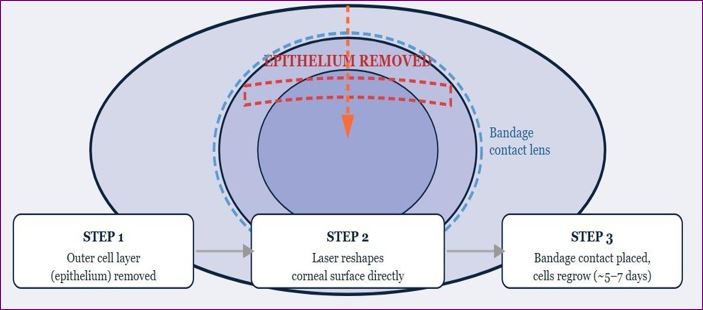
How PRK Works
- Numbing drops are applied – just like LASIK. Most patients feel little to no pain during the procedure.
- In modern Trans-PRK the excimer laser removes the outermost cell layer of the cornea (called the epithelium). There is no flap created.
- The excimer laser then works directly on the corneal surface, reshaping it to correct your vision.
- A temporary bandage contact lens is placed over the eye to protect it while the epithelium regenerates naturally.
- Over the next five to seven days, new epithelial cells grow back over the treated surface. Vision gradually sharpens over the following weeks.
Because no flap is created, the cornea retains more of its structural integrity after PRK. It is a key reason why it remains the preferred choice in many clinical scenarios. A corneal specialist surgeon like Dr. David Robinson recommends PRK for patients with thinner corneas or those who are not ideal candidates for LASIK.
Recovery After PRK
PRK has a longer recovery curve than LASIK. The first few days can involve some discomfort – a scratchy, light-sensitive feeling as the surface heals. Clear vision typically arrives over 1week to no glasses driving vision and 4 weeks to 20/20. By the four to six-week mark, most patients have stable, excellent vision.
Advantages and Drawbacks of PRK
PRK is sometimes misunderstood as the “lesser” option – something you do when LASIK isn’t available. That framing is simply wrong. In the right patient, PRK can be the better choice in the right patient.
Here’s a straight look at why:
Advantages of PRK
- No flap, stronger cornea post-surgery: The procedure preserves more of the cornea’s natural structural integrity because no flap is created. This matters enormously for active patients and for anyone whose eyes might be subject to physical impact.
- Better suited for thinner corneas: PRK removes corneal tissue more superficially because there’s no flap to account for. This leaves a thicker corneal bed post treatment to provide more structural integrity. This opens the door for patients who don’t qualify for LASIK on thickness grounds.
- Preferred for high-contact or active lifestyles: Military personnel, martial artists, contact sport athletes, and those in physically demanding roles are routinely directed toward PRK for this exact reason – there is no corneal flap that could potentially be displaced after surgery.
- Treats irregular corneal surfaces: Certain surface characteristics that make LASIK flap creation riskier are less of a concern with PRK, giving the surgeon more flexibility.
- Same long-term visual outcomes: The longer recovery period is the trade-off, not the final visual outcome. Once fully healed, PRK outcomes are equivalent to LASIK across most major long-term outcome measures.
- Lower dry eye incidence post-op: Because no corneal nerves are severed in a flap cut, PRK generally causes less disruption to tear production compared to LASIK, especially in the early post laser phase.
- Well-established procedure: Over 35 years of data, refinements, and outcomes make PRK probably the most studied elective surgical procedures in the world.
- Treats a wide range of prescriptions: Effective across most degrees of myopia, hyperopia, and astigmatism within safe limits.
Drawbacks of PRK
- Slower recovery: This is the most significant practical drawback, meaning it directly affects patient experience during daily life after surgery. For example, in the first few days following PRK, patients may have difficulty returning to work or performing routine activities due to notable discomfort, heightened light sensitivity, and blurred vision while the corneal surface heals. Unlike LASIK, where functional vision often returns within a day, visual recovery with PRK improves gradually over several weeks rather than 1-2 days.
- More post-op management required: The bandage contact lens is inserted at the end of the procedure and then removed by the surgeon after 5-7 days. Antibiotic and steroid drops are needed post PRK and LASIK. Patients need to follow a careful post-operative routine for several weeks.
- Higher initial discomfort: Without a flap to protect the corneal surface, the healing period involves more noticeable discomfort than LASIK in the first 48–72 hours.
- Risk of haze in higher prescriptions: In patients with higher degrees of correction, there’s a small risk of corneal haze forming during the healing process. Modern Mitomycin-C application during PRK has almost eliminated this risk.
- Vision not immediately functional: Unlike LASIK, you cannot drive the morning after PRK. Patients typically need someone to drive them home and may require time away from screen-heavy work.
Who Is PRK Generally Best For, and Why
PRK is generally the stronger choice for patients with thinner corneas, those in high-impact physical professions or sports, and anyone for whom the risk of a flap complication, however small, is unacceptable. It’s also often recommended for patients with surface irregularities that make flap creation less predictable. The willingness to accept a slower recovery in exchange for a structurally simpler and flap-free outcome is the defining factor. If your life and work can accommodate a week of reduced vision and a few weeks of gradual clarity, and if your anatomy points in this direction, PRK is not a fallback option; in many patients, it is the more appropriate procedure. Determining whether it’s the right answer for your specific eyes requires a detailed corneal assessment that only a qualified specialist like Dr. David Robinson can conduct.
LASIK vs. PRK: Side by Side
Here’s a clear breakdown of how these two procedures compare across the factors that matter most to most patients:
| Factor | LASIK | PRK |
| Technique | Corneal flap created, laser reshapes tissue beneath | No flap. Outer cell layer removed by laser which then reshapes surface directly |
| Procedure Duration | ~10 to 15 minutes per procedure (both eyes) | ~10 to 15 minutes per procedure (both eyes) |
| Initial Recovery | 24 to 48 hours for functional vision; back to work next day | 5 to 7 days for surface to heal; work typically by end of first week |
| Full Visual Stability | 2 to 4 weeks for full stabilization | 4 to 6 weeks for full stabilization |
| Post-Op Discomfort | Mild; eyes may feel slightly gritty for 1 to 2 days | Moderate; scratchy, light-sensitive for the first few days |
| Flap Complication Risk | Small but present – flap can be disturbed by impact | None, no flap exists |
| Corneal Thickness Needed | More corneal tissue required to create flap safely | Suitable for thinner corneas — less tissue removal overall |
| Ideal Lifestyle Fit | Fast recovery needed; less physical contact activity | Contact sports, military, physically active professions |
| Long-term Outcome | Excellent, comparable to PRK in most studies | Excellent, comparable to LASIK in long-term outcome data |
| Approx. Cost (per eye) | ~$3,000 to $3,500 (varies by clinic and technology) | ~$2,500 to $3,000 (varies by clinic and technology) |
Costs and recovery timelines are approximate. Individual factors significantly affect outcomes. Always consult your surgeon for information specific to your anatomy and lifestyle.
So Which One Is Right for You?
Think of it this way: a fork and a spoon are both utensils designed to get food to your mouth. But you wouldn’t try to eat soup with a fork, and you wouldn’t stabilize steak needing cutting with a spoon. They’re built for different jobs, and choosing the wrong one doesn’t just make things harder; it can mean the whole project fails.
LASIK and PRK work the same way. Both achieve excellent vision correction. But each is designed around a specific set of anatomical and lifestyle conditions. And the only way to know which one fits you specifically is to have your corneas evaluated properly by someone with the expertise to read what the measurements are actually telling them.

Dr. David Robinson, a Sydney-based corneal and refractive surgeon at Sydney Laser & Vision Centre, approaches every evaluation from that exact standpoint – so you understand not just the difference between LASIK and PRK, but what actually fits you.
FAQs
Is one procedure safer than the other?
Both have excellent, well-established safety records. Many studies report that approximately 90-95% of appropriately selected patients achieve 20/20 vision or better with either procedure. The safety question is really about which procedure is safer for your specific cornea, and that’s what the preoperative evaluation determines.
Is the end result the same?
In the appropriate candidate, yes – the long-term visual outcomes of LASIK and PRK are comparable in the peer-reviewed literature. The procedures differ in technique and recovery, not in ultimate visual potential for the right patient.
Is PRK making a comeback?
PRK never really went away among specialists who do this work at a high level. It has always been the preferred option in specific clinical situations. What has changed is that more patients are now aware of it as a genuine choice, not a fallback.
Can I choose which one I want?
You can express a preference, and your surgeon will factor that in. But your cornea’s anatomy has more votes than your preference does. A surgeon who recommends one procedure over your expressed wish for the other is almost certainly doing so for a legitimate clinical reason worth understanding.
How do I know if I’m a candidate at all?
The only way to know is a proper evaluation. Factors like corneal thickness, prescription stability, age, and corneal health all influence candidacy. Many people who assume they’re not candidates turn out to be, and some who assume they are, aren’t.
DISCLAIMER – “Views Expressed Disclaimer – The information provided in this content is intended for general informational purposes only and should not be considered financial, investment, legal, tax, or health advice, nor relied upon as a substitute for professional guidance tailored to your personal circumstances. The opinions expressed are solely those of the author and do not necessarily represent the views of any other individual, organization, agency, employer, or company, including NEO CYMED PUBLISHING LIMITED (operating under the name Cyprus-Mail).





Click here to change your cookie preferences