
Pete Weissner was from New York. That detail matters to Kelli Stavast, or at least it explains something. Weissner ran the broadcast journalism program at Chapman University in Orange, California, and the sensibility he carried into that program was shaped by an older version of the profession, one that predated social media, the personality-driven anchor, the reporter who makes themselves the story. He passed that sensibility on with some force.
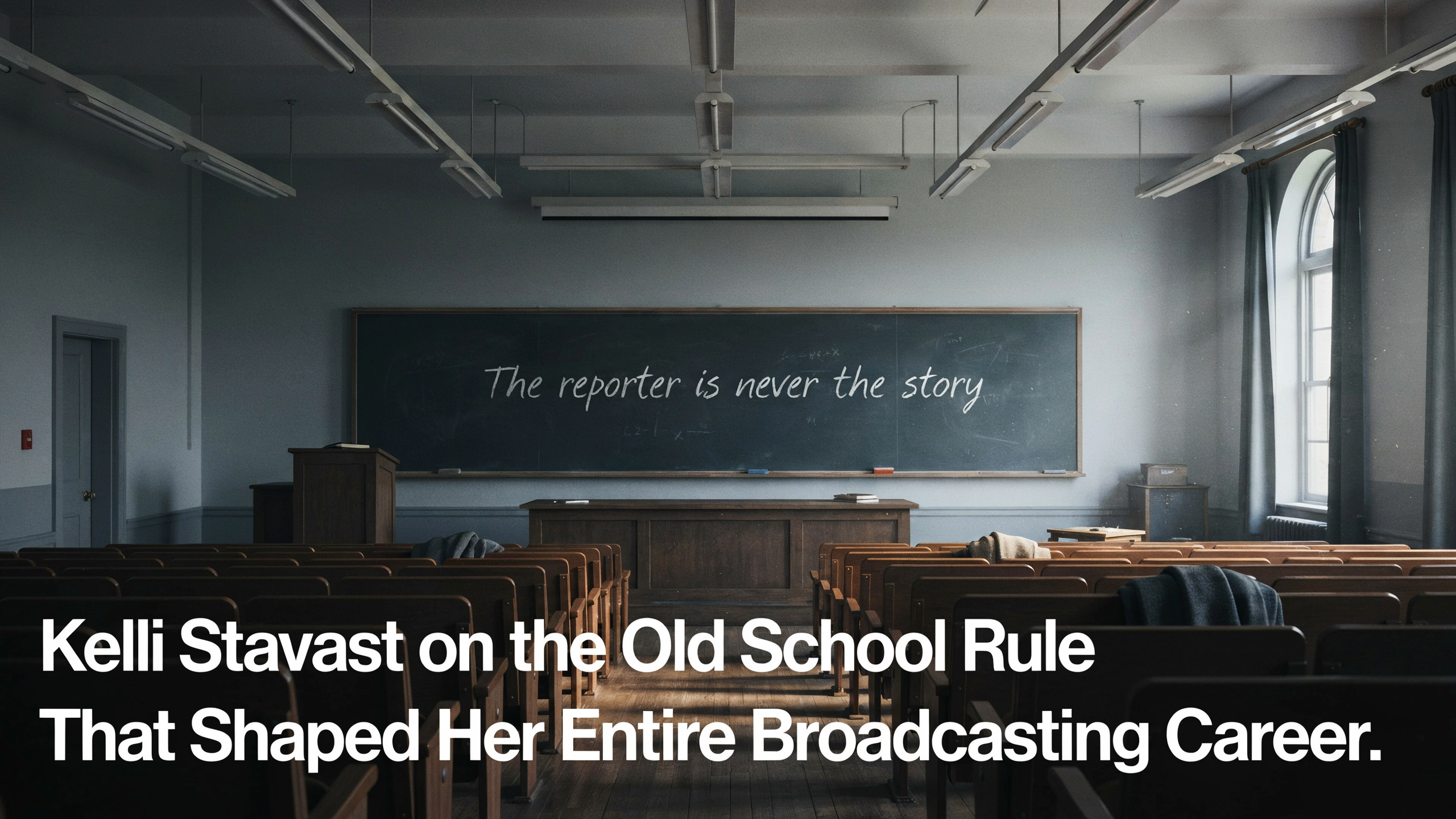
The rule was simple. The reporter is never the story. You are there to cover the subject, to ask the questions, to get the information. The moment you insert yourself, the moment your presence, your reaction, or your perspective becomes the point, you have failed at the job. Stavast absorbed this early and held it.
“It’s never about the reporter,” she said. “It’s always about your subject or who you’re interviewing. It was never about putting ourselves into it.”
She said this in the context of how much broadcast journalism has changed. The reporter as a personality is now standard practice. Personal reactions, self-referential commentary, the journalist as a character within the story they’re covering. Stavast finds it strange. She understands it commercially. It does not appeal to her professionally. “I’ve always just had an old-school mentality,” she said. “You’re never supposed to be a part of the story.”
What Weissner also gave her, more practically, was a career. He sent her to interview for a motorsports sideline reporter role to make the university look good, not because he thought she was a natural fit or expected her to accept. Stavast knew nothing about motorsports. She had grown up in Denver watching football and following her older brother into classic rock, a self-described tomboy who became a broadcast journalism student after watching the local sportscaster do his five-minute segment one night in elementary school and deciding that was the job she wanted.
Motorsports was not the job she wanted. She took the interview as a favor. She got the offer. She took it anyway.
“I knew nothing about motorsports at all,” she said. The next several years were spent trying to get out of it. The first agent she hired was given one instruction: find her anything in football or basketball. He could not. Every opportunity that came was another motorsports gig, and eventually she stopped fighting it.
The pivot happened when she recognized that the niche was an advantage. Women were more present on NFL sidelines and basketball courts by then, but motorsports broadcasts remained thin. She was one of only a few women in the field. “As people were looking to diversify their broadcast group,” she said, “it was like, okay, throw a female into the mix.” She understood what was happening clearly enough to name it without resentment. She was being hired partly because she was useful to fill a gap. She decided to be very good at it.
That meant preparation. Stavast came up before the current information landscape, when you could not simply pull up a driver’s social media feed and construct a pre-race narrative from what he posted that morning. You had to walk to the garage. You had to ask the people who knew. The prep habit that formed then never left. She carried it to NBC Sports, to three Olympic Games, to the IndyCar Series and the NASCAR Cup and Xfinity Series. Race day preparation started days in advance, ran through the night before, and did not end until she was pulling information from drivers during commercial breaks with minutes to go before the green flag.
The philosophy she distilled from all of it came from the same place as the rule Weissner had given her. “You’re not trying to be an expert,” she said. “You’ve got to know how to ask the questions to get the information you need to do a good job.” She described mentoring younger broadcasters on this exact point. NBC had asked her to help with that from time to time, and the advice was always the same. Nobody believes you suddenly have the same depth as someone who spent years in the sport. Nobody expects it. What they expect is that you can find the person who does and ask them the right question.
The distinction between expertise and craft runs through how Stavast has always understood the job. She was assigned the Westminster Dog Show in her first year at NBC, then freestyle skiing at the Winter Olympics in PyeongChang, then diving in Rio. None of it was her area. All of it required the same foundational skill: knowing what you don’t know, then finding someone who does and getting out of their way long enough to ask something useful.
Weissner, the professor who taught her the reporter is never the story, also put her on the path to becoming one of the more recognizable pit reporters in American motorsports broadcasting. He sent her into a field she knew nothing about, where she had no role model and no particular interest, and where she spent years trying to leave. The career that resulted was built on a rule about invisibility, applied consistently enough over two decades that the work itself became visible.
“You’re never supposed to be a part of the story,” she said.
She wasn’t.
DISCLAIMER – “Views Expressed Disclaimer – The information provided in this content is intended for general informational purposes only and should not be considered financial, investment, legal, tax, or health advice, nor relied upon as a substitute for professional guidance tailored to your personal circumstances. The opinions expressed are solely those of the author and do not necessarily represent the views of any other individual, organization, agency, employer, or company, including NEO CYMED PUBLISHING LIMITED (operating under the name Cyprus-Mail).





Click here to change your cookie preferences