
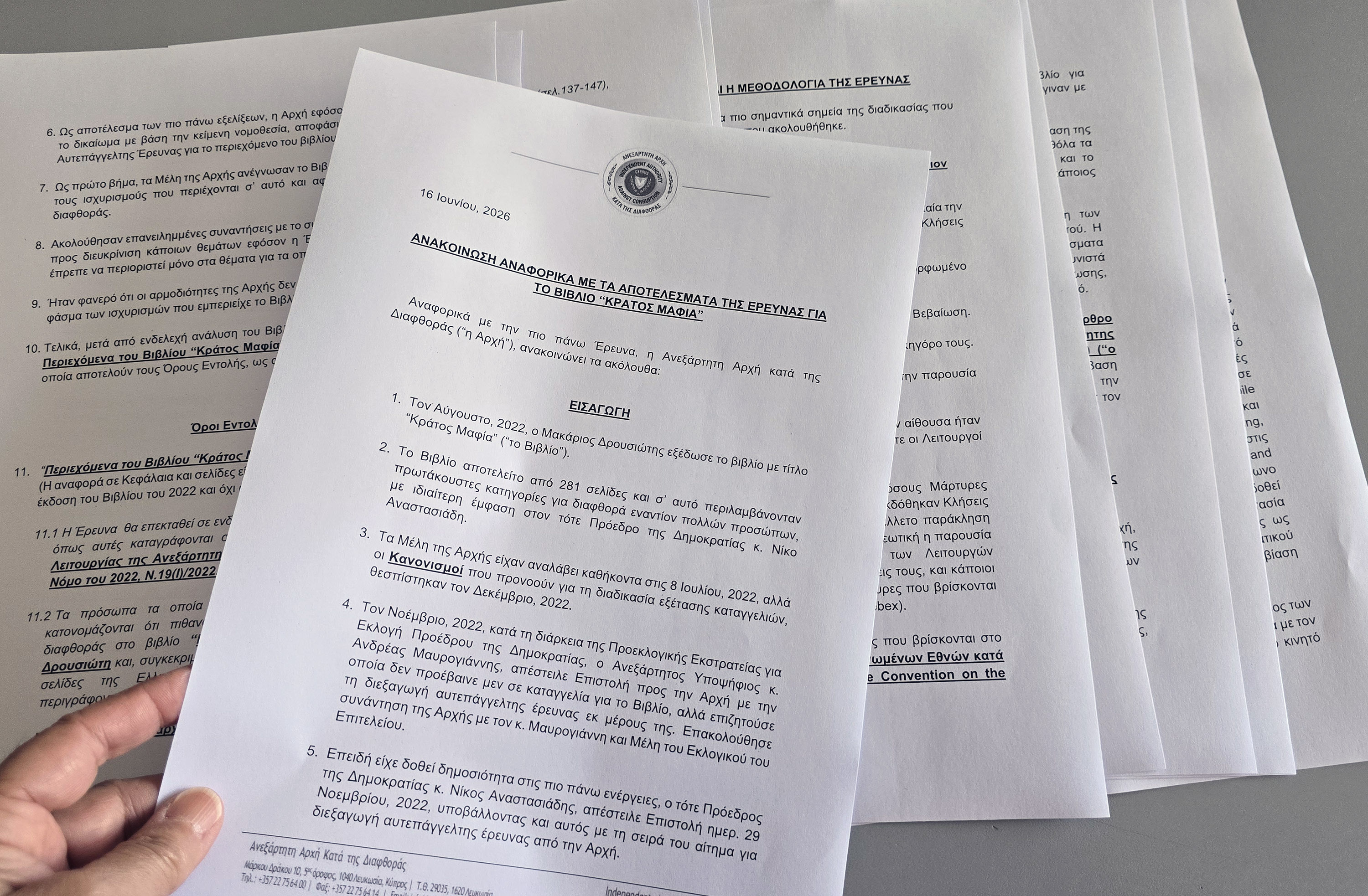
The report, witness testimonies and evidence of the investigation into the Mafia State book should not have been handed over to the cabinet and the police, lawyer representing Makarios Drousiotis, the book’s author, Lito Kariolou said on Monday.
Speaking on state television, Kariolou said the handing over of all the investigation material by the Legal Council which was set up to administer the case after the recusal of the attorney-general and the deputy attorney-general “constitutes an institutional collapse.”
She said that the Legal Council, made up of senior counsel from the Legal Service, received the content of the investigation, including evidence and minutes, and gave this in its entirety plus all other documents to the police and the Council of Ministers.
“When we are talking about the paralysis of the institutions, this is what we mean,” she told the state broadcaster.
“The inspecting officers secured valuable testimony from persons that had never testified to the Cyprus police before and who possibly were not prepared to testify before the police.”
Asked whether she feared that testimony and witness statements could be leaked by police, she said “the police are involved; in several chapters of the investigation, we had serious problems with actions of the police.”
She was of the view that the cabinet should not have been given the report either.
“The witnesses testified only after being given clear assurances from the inspecting officers that the procedure would remain absolutely confidential,” she said. Kariolou never explained how she knew that these assurances of absolute confidentiality had been given to people who appeared before the investigative committee.
She said she had a “huge problem” with the Council of Ministers also having the investigation report in its entirety.
“In this way and the administering of the matter, witnesses and testimony were exposed irreparably to possible dangers. Witness testimony that should have been protected, has been exposed for half a month, at the mercy of suspects.”
She also believed that President Nikos Christodoulides should have stayed out of the procedure completely, as he had served as a minister in the Anastasiades government, gave testimony to the investigating committee and publicly said that he had a met the late Andreas Vgenopoulos, the Greek banker, behind alleged briberies.
“President Christodoulides takes part in the decision for the appointment of investigators,” said Kariolou, pointing out that the problem was “institutional, not personal.”
Why had the president not used the same criteria of impartiality used by the AG and deputy AG, she asked. “For what reason had Mr Christodoulides not recused himself? We are at an impasse.”
The only way out of this impasse for Kariolou was a suggestion made by another lawyer. He proposed that the Transparency Commissioner who was in charge of the Mafia State investigation be given the authority to appoint criminal investigators and take charge of the criminal investigation next week.
This is easier said than done, because the law must be changed to give the power to the anti-corruption authority to carry out a criminal investigation.
The authority in June found that former president Nicos Anastasiades, as well as others, may be criminally liable, following the conclusion of its investigation into allegations made against him and others by Drousiotis.





Click here to change your cookie preferences