
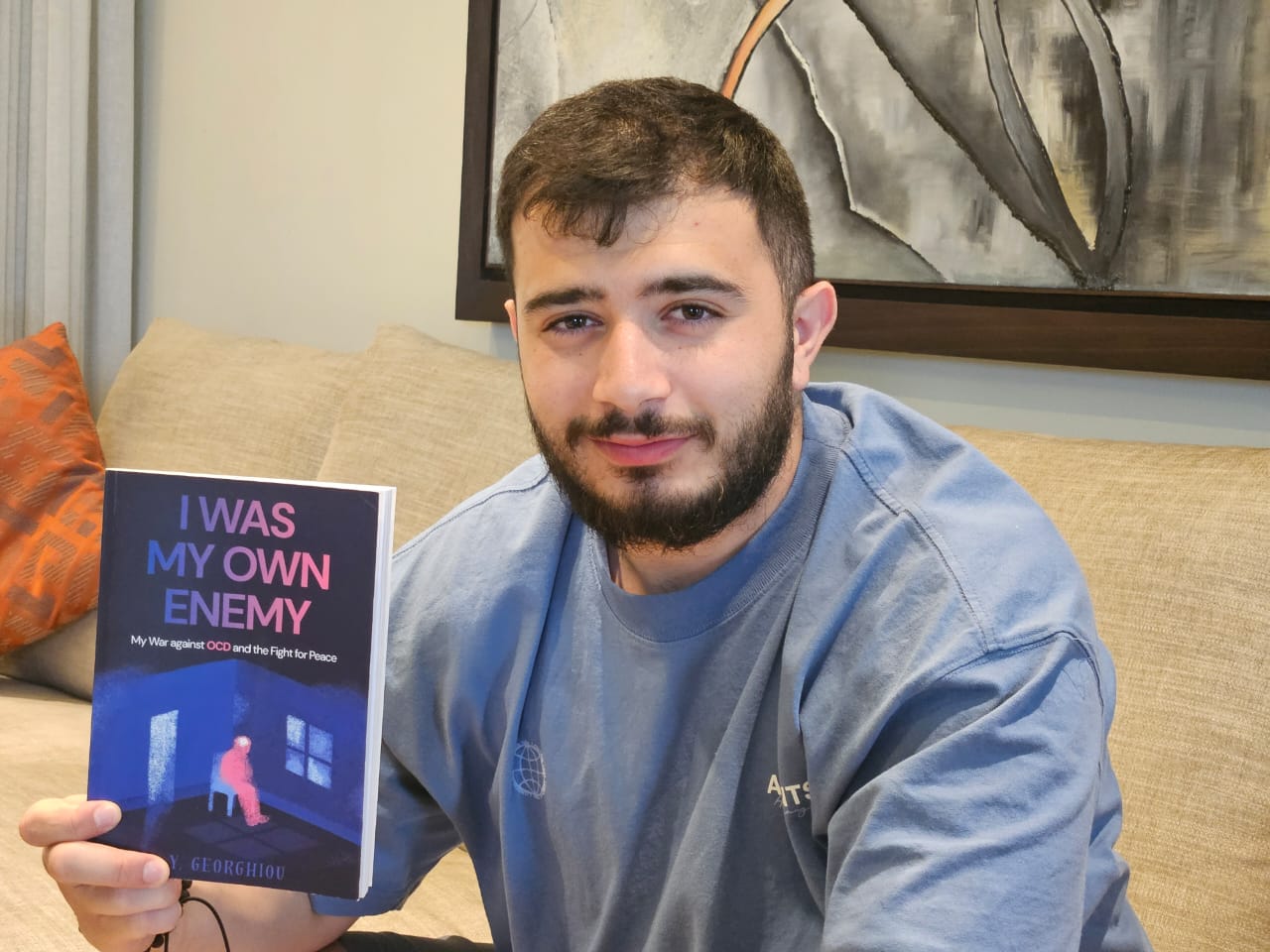
Living inside a mind that refuses to rest proved exhausting for one young man from the island. Detailing how he fought back could help others too
Yiorgos Georghiou puts it bluntly, in the prologue to his book I Was My Own Enemy: “I am not a psychologist. I am not a clinician or a researcher. I am someone who has lived inside this cycle for most of my life – someone who misunderstood it, fought it the wrong way, hid from it, and eventually learned how it works…
“This book is about living inside a mind that refuses to rest.”
We meet at his Nicosia home, a handsome two-storey affair with a view and a Lexus in the driveway. It’s actually his parents’ home; Yiorgos himself is only 22, fresh from his second year of Accountancy and Finance at the University of Leicester.
Inside, there are books on the living-room shelves, mostly non-fiction and a small pile of self-help books – much like the one he himself has written, except that his is based on direct experience. A bit further down is a sort of dining room – really more of a breakfast nook – with a nondescript round table. See that table? he asks. “I couldn’t sit at that table for three years.”
It was about bad energy, he tells me. “My thoughts were making my reality. So if this table had to do with a bad memory, I couldn’t touch it. I couldn’t even look at it.”
Every time he came downstairs, “I was doing this,” he says, shielding his eyes to conceal the offending table. The memory was from when he was in the army – a low point in his life, what he calls “the breaking point” – and came home one day, sat down at the table, and felt his mind “burning” with oppressive thoughts.
“I associated that with the pain, and that was the last time I sat there… Two months ago was the first time I sat down again – after three years. Even my family was emotional.
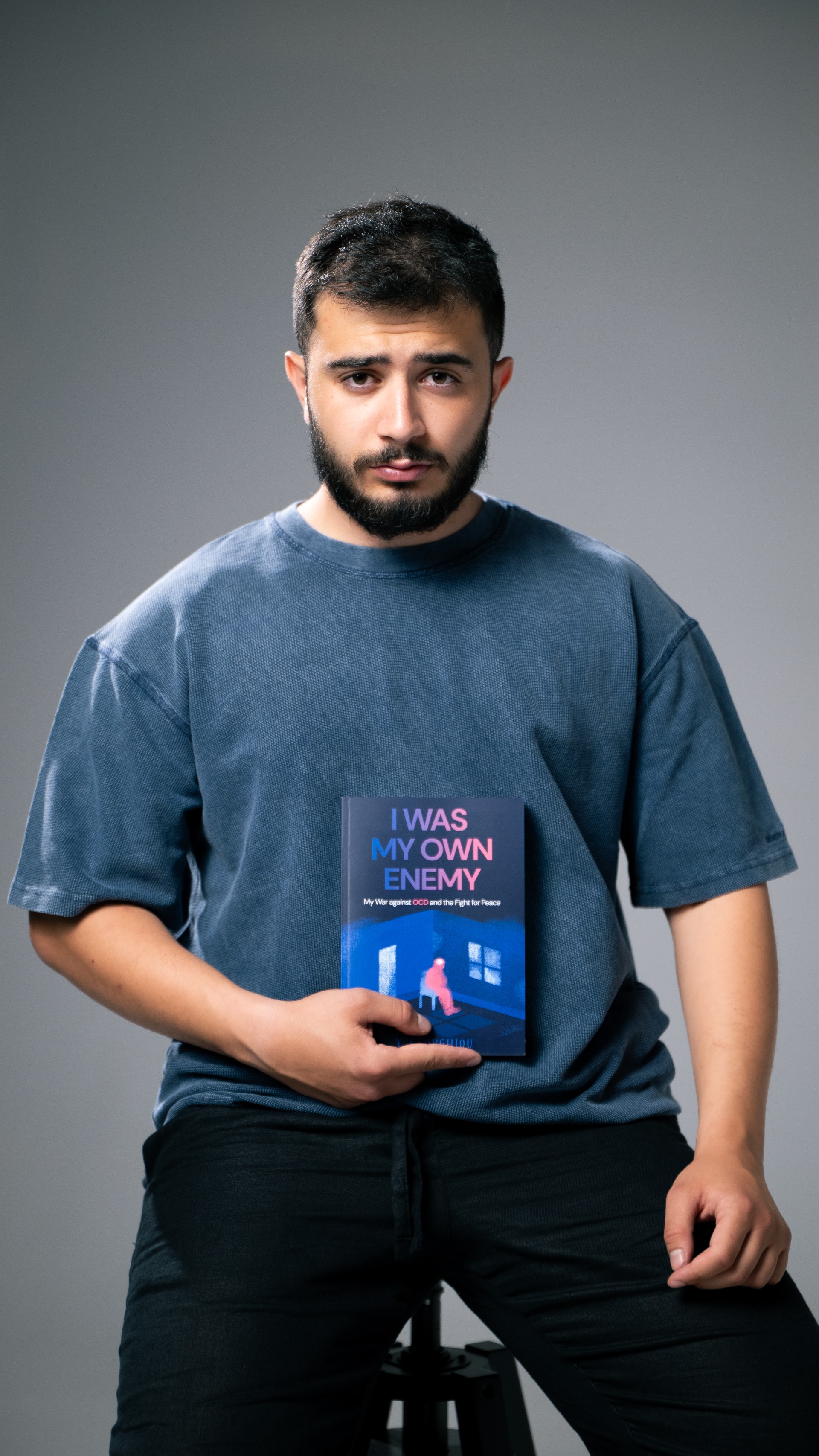
“It was really sad,” muses Yiorgos, “because my family definitely wants to be next to me. They just don’t know what I’m going through – because they can’t see it, and I can’t show it. I’m a really closed person.”
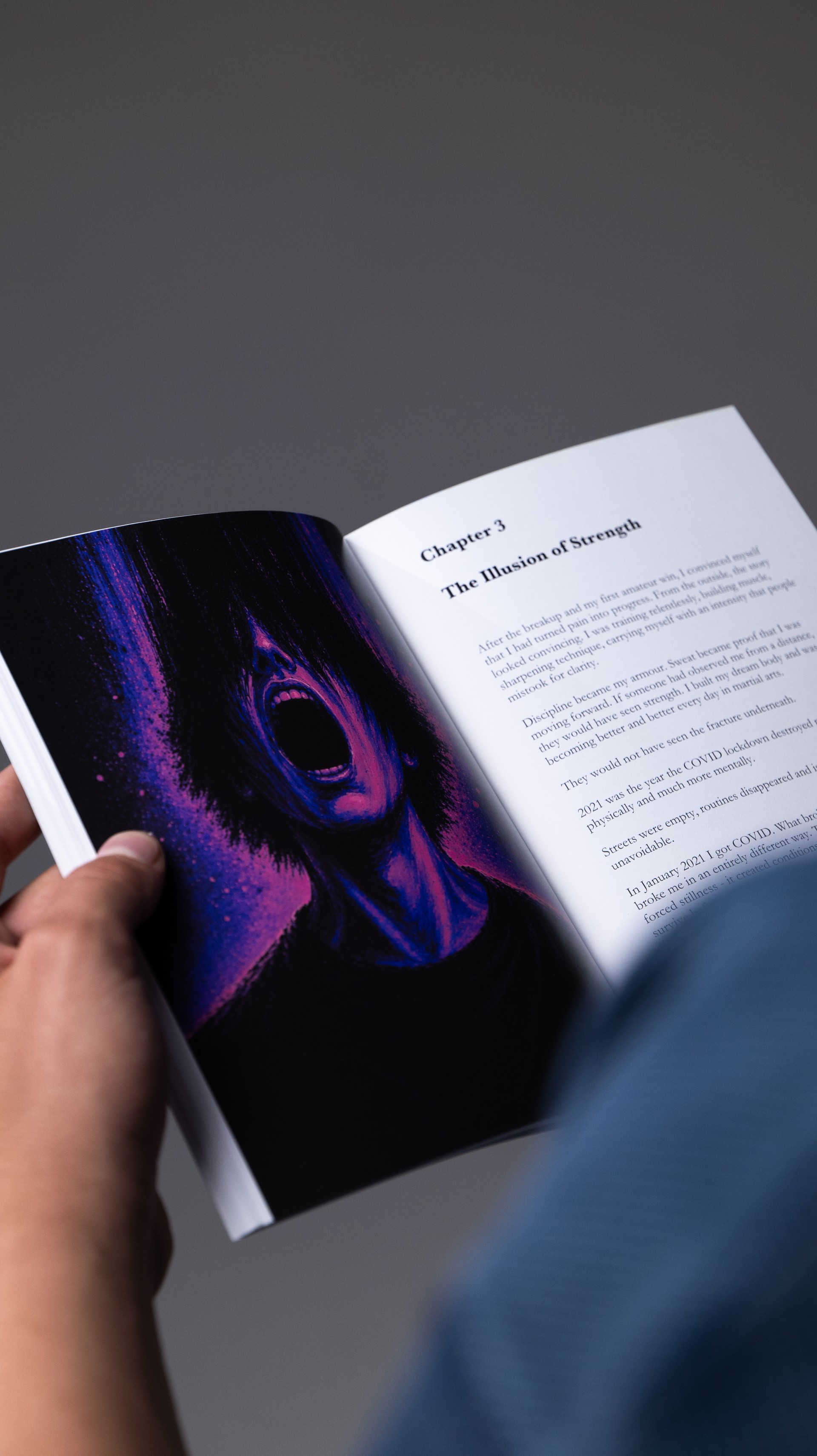
He’s using the present tense (out of habit, presumably) – but of course he’s talking more about the past, before the recent publication of I Was My Own Enemy. The book, which he started writing last November and finished in June, is a candid memoir that lays bare – for his family, and everyone else too – exactly what he’s been ‘going through’: namely, OCD, obsessive-compulsive disorder.
“We say ‘OCD’ very easily these days,” notes Maria Ioannidou, a psychologist who’s also Yiorgos’ therapist – but, to quote Inigo Montoya in The Princess Bride, ‘I do not think it means what you think it means’.
“People think they have OCD because they’re really tidy,” says Yiorgos. “But this is just, like, five per cent of what it actually is.” The other 95 per cent is what he suffers from: “Intrusive thoughts. Being in your mind constantly, so you can’t distinguish what’s real and what’s fake” – and having it take over, to the point where everyday life becomes dysfunctional.
“Maybe you like your cupboard to be really neat,” agrees Maria – “but as long as it doesn’t affect your life, so you’re not like ‘I’m not coming down to the café because I have to tidy my clothes’, then it’s not a disorder.”
Yiorgos’ life was indeed affected, becoming a slave to intrusive thoughts – which everyone has now and then, it’s just that people with OCD are unable to let them go, constructing increasingly elaborate (and irrational, and often self-destructive) behaviours to try and make peace with them.
“My last year at school was a disaster,” he recalls. (He was at the Senior School, hence his fluent English.) “I was a really top student, but at some point my thoughts were so strong that I couldn’t even focus to write the final exam, the A-Level.
“I remember there were questions that my brain told me, ‘Don’t answer this question or your dad will die tomorrow’ – so I wasn’t answering questions. At A-Level! Because my mind was telling me stuff.” He dropped down to an A and two Cs in his last year (after three As the previous year), and was fortunate to be accepted to Leicester. Even there, though, during his first year at uni, his mind was getting in the way – even in multiple-choice exams, “it was telling me ‘Don’t put ‘a’ [as an answer], if you put the letter ‘a’ it means you’ll become a woman in 10 years’ or something… And I was 100 per cent believing it. It was gradually destroying my life.”
By that time, the thoughts were often fully irrational (OCD tends to get worse with age), albeit triggered by anxiety. The most insidious ones, however, stemmed from fear and self-consciousness – the disorder being, in a sense, an extreme form of self-consciousness where every detail gets magnified to monstrous proportions, like the niggly details of an untidy cupboard.
“The first time fear became overwhelming and physical was with something simple: swallowing food,” he writes in the book.
“One day, without warning, the thought entered my mind: ‘What if the food gets stuck in my throat and I choke… and then suffocate?’.
“Once it appeared, it refused to leave. Swallowing, something I had done automatically my entire life, suddenly felt mechanical and deliberate. I chewed more carefully. I hesitated before swallowing. I focused intensely on my throat.
“The more attention I gave it, the tighter it felt.”
Yiorgos was eight at the time, and totally unable to cope with the fear. He stopped eating, he recalls now, “I got really skinny”. Later, the anxiety recurred in different forms – in panic attacks, or anxiety about forgetting to breathe, or about forgetting how to move his eyes.
“My parents were watching their son slowly disappear in front of them,” he writes, of his rapid weight loss as an anxious eight-year-old. “My father didn’t say much. I could see everything in his face instead. The sadness. The helplessness…”

OCD is tough on loved ones too – partly because it’s hard to discern what the problem is. Unlike some severe forms of autism, where the person really does seem locked inside their own head, Yiorgos was otherwise functional, a high achiever and, he says, “really good with people”. (He’s not autistic though he thinks he may be borderline, having a savant-like knack for mental arithmetic.) He’s actually something of a leader, personality-wise – which makes sense since his stress is related to a need for control, and made worse by uncertainty.
He was bullied at school early on, marked out as different by the classic OCD symptoms (touching a table X number of times, and so on), but generally “I don’t have any social anxiety. I’m really open to people, I do events and I’m really, like, an extrovert… But I’m a real over-thinker.”
If that were all, we wouldn’t have much to talk about – but in fact Yiorgos’ life was in the process of unravelling till a couple of years ago, before meds and therapy and the additional therapy of writing the book.
He had no great fear of the army, having done martial arts for many years. Indeed, he joined the commandos, thinking it’d be lots of push-ups and physical fitness – but instead it was peak anxiety, constantly being harried and shouted at.
He dropped out – then was posted to the Green Line, which was just as stressful. “My thoughts were so draining,” he recalls. “I couldn’t even drink water in the base, because it had that bad energy.” (He’d bring water with him, and leave it in the car so it wouldn’t get infected by bad vibes.) “I’d take off my military clothes when I went to bed and put them on again. Take them off, put them on, like nine times…” The other soldiers goggled at his freakishness. Then came university, and getting ambushed by irrational thoughts even in a multiple-choice question.
What would’ve happened, had he gone on like this? What used to happen in the past, before people had access to treatment?
“I think a lot of men were committing suicide from this thing,” he replies soberly – men being famously more reluctant to seek help for mental-health issues. “They were ending their lives from this condition, because they didn’t want to open up. And they got to a point where they couldn’t see light.”
There’s a vicious cycle, says Maria the therapist. “First, the person is socially isolated,” because they’re acting weird and people start to avoid them. The result is depression, feeling helpless and alone, then “an intense feeling of cognitive dysfunction,” the mind trying hard to figure out “what’s real, what’s in my head” – so they start to feel insecure around others, feel uncomfortable, start staying home, and become increasingly cut off.
It’s no secret that anxiety disorders have skyrocketed in Cyprus – starting from the time of Covid though admittedly that was also the time when access to psychologists became available through Gesy, so more cases were being diagnosed – and there is indeed a growing segment of (mostly older) people who’ve withdrawn from society, trapped alone with their anxiety.
Yiorgos is a young man – yet he too was in freefall, his disorder growing worse by the day, until a certain girl appeared in his life.
“I met her in Leicester, she’s Cypriot – and I’m really grateful. It’s like God brought her to me. I was in a really dark place, and I was bringing her down with me…
“But she was by my side, and she stayed, and she’s with me now, and I really hope to marry her in the future.”
The girlfriend (unnamed in the book) was patient, putting up with his odd behaviour, uncomplaining when he couldn’t sleep and kept her up too – but her main contribution was a simple six-word sentence one night, after he’d over-explained an intrusive thought for the umpteenth time:
“Have you ever looked into OCD?”
It seems astounding that, in 20 years, he’d never made the connection – but he had the wrong idea, associating OCD with obsessively neat cupboards and the like. (He may also have been, quite simply, in denial.) That night, he researched the condition for the first time – and found article after article describing, in detail, his own life.
There was a process, of course: deciding – reluctantly, at first – to see a therapist, getting an official diagnosis after years of darkness. But the die was cast. Accepting – and naming – the problem was the game-changer, culminating in the publication of I Was My Own Enemy.
The book is on Amazon (it’s among the top 100 books on OCD worldwide) and in local bookshops. Yiorgos’ next “targets” are translating it into Greek and preparing an audiobook – but meanwhile a lot has changed in his life in general.
He began medication in August 2025, and therapy soon after. He’s also launched a social-media channel called The Indomitable Club – mostly fight clips paired with inspirational quotes – which is growing fast, with 800,000 views for some of its Instagram posts. And, after being unable to complete even multiple-choice tests in his first year at uni – the school didn’t know; “I didn’t even mention all this stuff” – he recently won a prize as the year’s top student in his second year.
It’s not over. It’ll never be officially over. OCD can’t be cured, only suppressed. Even now, though he’s good with people, Yiorgos is something of a loner – happy to go by himself to the cinema, or restaurants – “because I went through all these battles by myself… I like being alone, because it’s how I learned to be”. At the end of his book he lists ‘The 7 Steps to Peace’, how to overcome OCD – but his main suggestion is perhaps the most difficult: ‘Stop Feeding the Compulsion’, i.e. allow intrusive thoughts to exist without reacting to them. But is that really possible long-term, to change the person you are so entirely?
Hopefully. Then again, maybe it doesn’t matter – because, after fighting with himself for 20 years, he can now “see light”, as he put it. Getting through the fear is half the battle. In fact, it may well be the whole battle.
The very last lines of I Was My Own Enemy put it succinctly: “I am still standing. I won”.




Click here to change your cookie preferences