
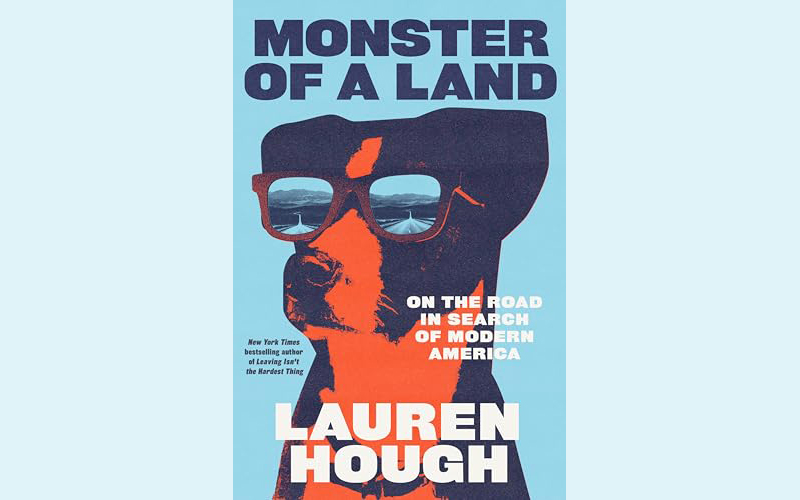
Book Review: Monster of a Land by Lauren Hough
When Lauren Hough set off across America in 2023 in her self-refitted second-hand Dodge van, she had the twin goals of circling the US and not traumatising her dog, Woody Guthrie. As readers setting off across a deeply polarised nation in the company of a six-foot left-wing lesbian who is no fan of the ‘orange billionaire’ or the people who voted for him, we expect that her implicit aim is to illustrate the failings of an America with whose current state the author is clearly at odds. Hough knows this, and she wants us to realise our error just as she realises hers.
Over the course of three months, Hough traverses 37 states, trying to avoid interstates as much as possible, both to see more of America and to avoid traumatising Woody by ceasing to be the kind of person who drives relentlessly to a destination without pausing to realise what’s being missed along the way. This attempt to change herself in what may seem a minor way serves as an echo of the much larger blindnesses that Hough expounds upon as she travels: ‘unfuckable tech-bro gods are destroying everything that’s good in the world, everything that makes us human… while we scroll through social media feeds convincing ourselves that our neighbors and our coworkers are our enemies, so we won’t see that the fuckers who already have it all are taking everything that’s left, so they can keep us working until we fucking die.’
The novel’s title comes from Steinbeck’s Travels With Charley, the book that semi-inspires Hough’s journey: ‘This monster of a land, this mightiest of nations, this spawn of the future, turns out to be the macrocosm of microcosm me.’ If there’s a monster, then it’s me and it’s you. Hough acknowledges this at every turn: she is quick to judge almost everyone she meets, and those judgments are typically negative. And typically wrong. She expects danger, antipathy, hatred. What she gets is kindness, tolerance, respect, help and support. Of course, she expects indifference too, and gets it.
Hough’s trip doesn’t discover a magically hidden idyll. But it does discover something that should be obvious but which has been and continues to be obscured because isolated, miserable human beings make better consumers. ‘Maybe we should all go outside. Take the trip. Talk to strangers. Talk to our neighbors. I think we’ve spent enough time finding ourselves. Maybe we can find one another again.’
You should be able to tell by the volume of Hough’s own words I’ve used in this review that they are words I think deserve to be read. Go read them. Then help make the country you live in less monstrous and more beautiful.





Click here to change your cookie preferences