
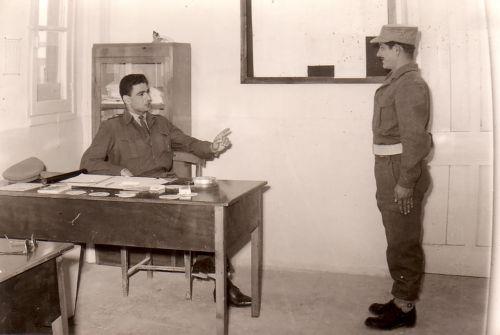
Tasos Markou was a major when he disappeared during the second phase of the Turkish invasion in Mia Milia in 1974, but for his son, who was six years old at the time, “he was not the hero people know, he was my father”.
In an interview with Cyprus News Agency’s Emily Lambrou, Paris Markou recalled the loss of his father, the handful of memories he has of him and what it was like growing up in his absence.
“I remember him wearing his uniform at home. He was a calm, serious man and his presence made us feel safe.”
Years later, Paris followed his father into military life, and the picture he had formed of him took on a different meaning.
“I understood what the uniform meant to him and the weight of the responsibility he bore […] A commander is not just someone who gives orders. He is the one to step to the front and the first to take the responsibility,” he explained.
On the day of his disappearance, Tasos Markou contacted his wife and asked her to take their children to her parents in Limassol to keep them safe. He also told her that from that moment on, she should stand by their children and take care of them because “my soldiers are now my children“.
Paris said those words hurt him when he was young.
“I used to wonder how he could say that his soldiers were his children, when he had us.”
It was not until he joined the military himself that he understood what his father had meant.
Paris remembers the invasion as a time of fear and anguish.
“I remember the sirens, the radio, the information coming in pieces. We had gone to Limassol to stay safe but we didn’t know where our father was or if he was well.”
For his mother, a lifetime of searching began. Paris says he does not know how his mother managed.
She died in 2004 without ever receiving the answer she had been waiting for.
“Until we have a documented answer, my father remains missing,” he said.
Growing up was not easy for Paris, who acknowledged the weight of the name he carried.
“For the world, he was Tasos Markou, the hero of Mia Milia. For us, he was the father who never came home. You grow up, of course, with pride, but pride does not fill the empty place at the table, it does not replace the father at celebrations, at difficult times or life decisions.”
After joining the army and attending military school, Paris met people who had known his father.
“I felt that I had to prove day in, day out who I am and make sure I lived up to his name.”
He said the state had a duty to continue seeking answers for the families of those who remain missing.
“The state must continue to seek answers, not just for Tasos Markou, but for every missing person and every family waiting.”
Paris, now retired from the army, said the best way to honour those who fought for Cyprus was “not to deliver past divisions to the next generations, but the prospect for a better tomorrow”.
“History should not be an instrument of hate. It should help us understand our mistakes and not repeat them.”
Tasos Markou was born in Paralimni in 1936 and is one of the most prominent figures in Cyprus’ modern history, known for his involvement in the 1955-1959 Eoka struggle and his actions during the Turkish invasion in 1974.
He attended the Hellenic Military Academy and, upon returning to Cyprus, joined the newly established National Guard.
Markou opposed the July 15, 1974 coup and subsequently served at Mia Milia during the Turkish invasion.
During the second phase of the invasion, he refused to abandon his post and attempted to cover his men as they withdrew.
The last time he contacted the general staff was on the afternoon of August 15, 1974, saying he was staying to fight. Since then, there has been no trace of him.
He is considered a missing person and for the people a hero and symbol of self sacrifice. After his disappearance, he received an honorary promotion to lieutenant general.




Click here to change your cookie preferences