
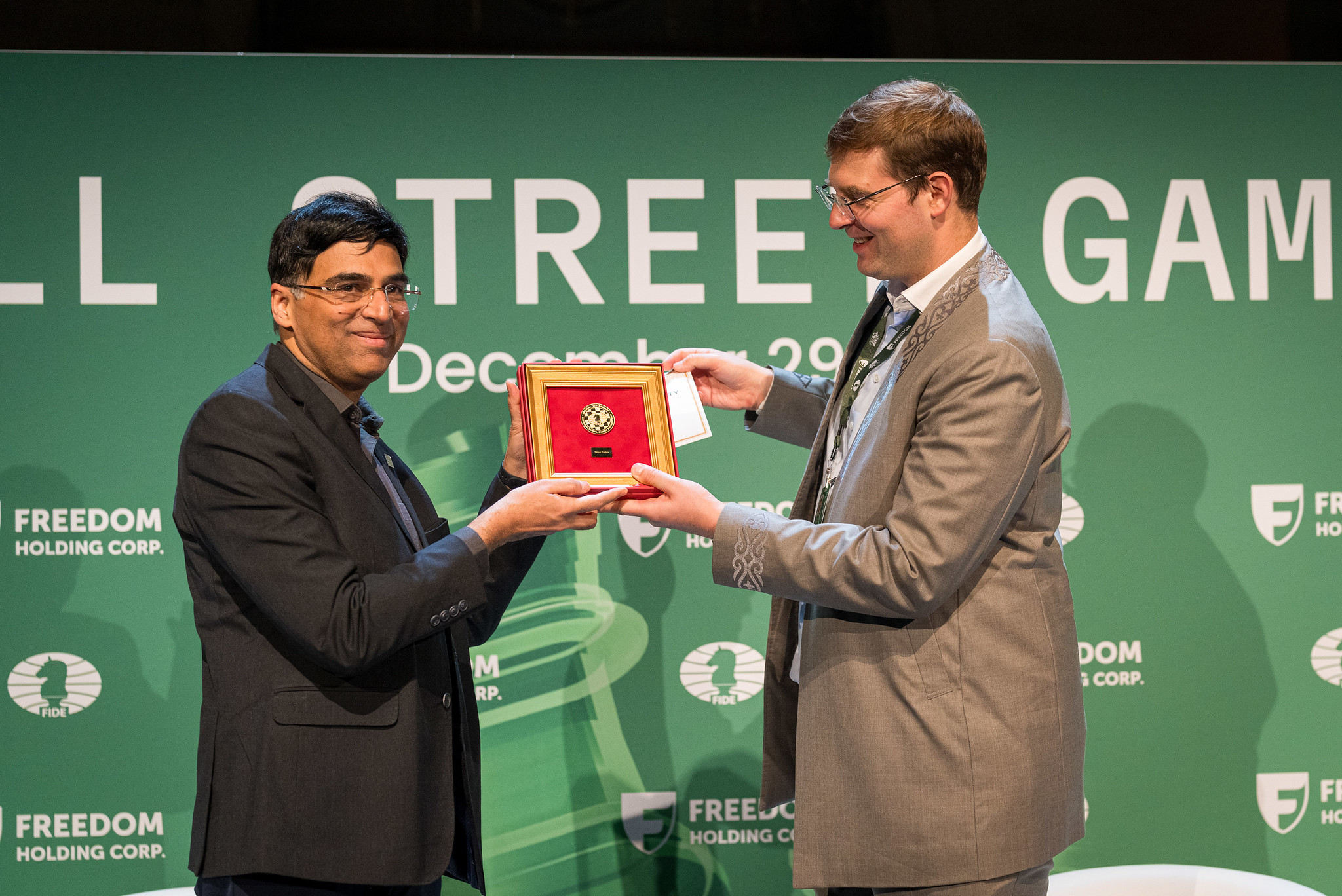
Timur Turlov has formally announced his candidacy for the presidency of the International Chess Federation, signalling an ambitious bid to reshape global chess governance ahead of a crucial electoral contest in 2026.
The Chief Executive Officer (CEO) of Freedom Holding Corp. and President of the Kazakhstan Chess Federation confirmed that he will stand for the presidency of the International Chess Federation (FIDE), with elections scheduled to take place on September 26 and September 27, 2026 in Samarkand during the organisation’s General Assembly, which will run in parallel with the 46th Chess Olympiad.
His announcement is presented as a natural extension of his active engagement at the highest levels of FIDE, where he has increasingly sought to influence strategic policy for the sport.
“A federation with a century of history now finds itself at a critical crossroads, and the progress we have achieved cannot be reversed but must instead be accelerated, given fresh momentum and carried forward,” said Turlov, adding that this conviction led him to seek the presidency of the International Chess Federation.
Turlov has led the Kazakhstan Chess Federation since 2023, overseeing an extensive modernisation of the sport in the country and investing more than 75 million dollars in its development, a level of funding which he portrays as proof of his long-term commitment to institutional growth.
Under his leadership, Kazakhstan has hosted the World Men’s Chess Championship and the World Team Rapid and Blitz Championship, while Almaty is preparing to welcome the World University Chess Championship in the near future, further entrenching the country’s role as a major organiser of top-level events.
Since 2024, he has also served as President of the International School Chess Federation, a position that has given him a broader platform in the field of chess in education and youth development.
He insisted that his decision to run for the FIDE presidency does not stem from personal ambition but from what he describes as a duty to the global chess community.
“I have numerous ventures in my life through which I can apply my abilities as a businessperson and leader, yet this decision springs from something entirely different, as I firmly believe that world chess now has a unique opportunity to take the next major step in its development, and if my experience can be useful to the international chess community it becomes my responsibility to assume this role,” he said.
Turlov’s programme centres on three main pillars, focusing on digital transformation and artificial intelligence, the expansion of school chess, and the financial sustainability of national federations, which he argues are essential for the sport’s long-term stability.
His flagship digital initiative envisages the creation of a single International Chess Federation platform through which every player would have a unified account, containing their rating history, tournament records, online competitions and educational material, with the aim of guaranteeing equal access for all federations.
The proposed system would include advanced AI tools for game analysis, support for training processes and mechanisms to control adherence to the principles of fair play, which he regards as vital for safeguarding integrity in the modern era.
This approach is based on the KazChess ID, a unified digital ecosystem that is already being completed by the Kazakhstan Chess Federation and which Turlov presents as a model for what could be replicated at global level.
“If this strategy delivers results at national level, there is absolutely no reason why it cannot be implemented on a wider scale at the level of the international federation,” he said, arguing that Kazakhstan’s digital template can be expanded to cover the entire FIDE membership.
In the field of school chess, he intends to draw on both the experience of Kazakhstan and the practices of the International School Chess Federation, aiming to strengthen the role of chess in formal education systems worldwide.
In Kazakhstan, the national programme Chess in Education already covers more than 1,500 schools and over 60,000 pupils, a network that he cites as evidence that structured policy can embed chess deeply in school curricula.
On the economic front, Turlov proposes support measures to help national federations develop stable revenue streams through strategic partnerships, sponsorship programmes and professional management of assets and commercial rights, arguing that financial robustness is indispensable for federations that wish to expand their activities.
He also confirmed that Viswanathan Anand, who has served as Deputy President of the International Chess Federation since 2022, will be a candidate for the same post on Turlov’s ticket, thereby extending his current role in the federation’s senior leadership.
“Vishy needs no introduction in the world of chess, as he is one of the greatest players in history and a figure who enjoys immense respect on every continent, and in recent years he has proved to be an exceptionally capable leader with a deep understanding of how the International Chess Federation operates,” said Turlov.
“So his presence in our team is a guarantee of continuity and of safeguarding the important work that has already been achieved, and for me personally it is a great honour that Vishy agreed to move forward with us,” he added.
The candidate placed his bid for the presidency within a broader geopolitical and institutional context, stressing the international composition of his team.
“The team seeking to lead the International Chess Federation is genuinely international, and I represent Kazakhstan, a country that functions as a middle power, within a federation that brings together around 200 national teams representing different cultures, regions and interests,” he said.
He argued that in an environment defined by such diversity it is particularly important to achieve balance and to find solutions that unite the entire chess community rather than divide it.
“I am certain that I can offer the federation values of balanced and sincere dialogue, which form a key element of my country’s diplomacy and which I want to embed in the governance of the International Chess Federation,” said Turlov, framing his candidacy as a bid to deepen consensus-building within global chess.




Click here to change your cookie preferences