
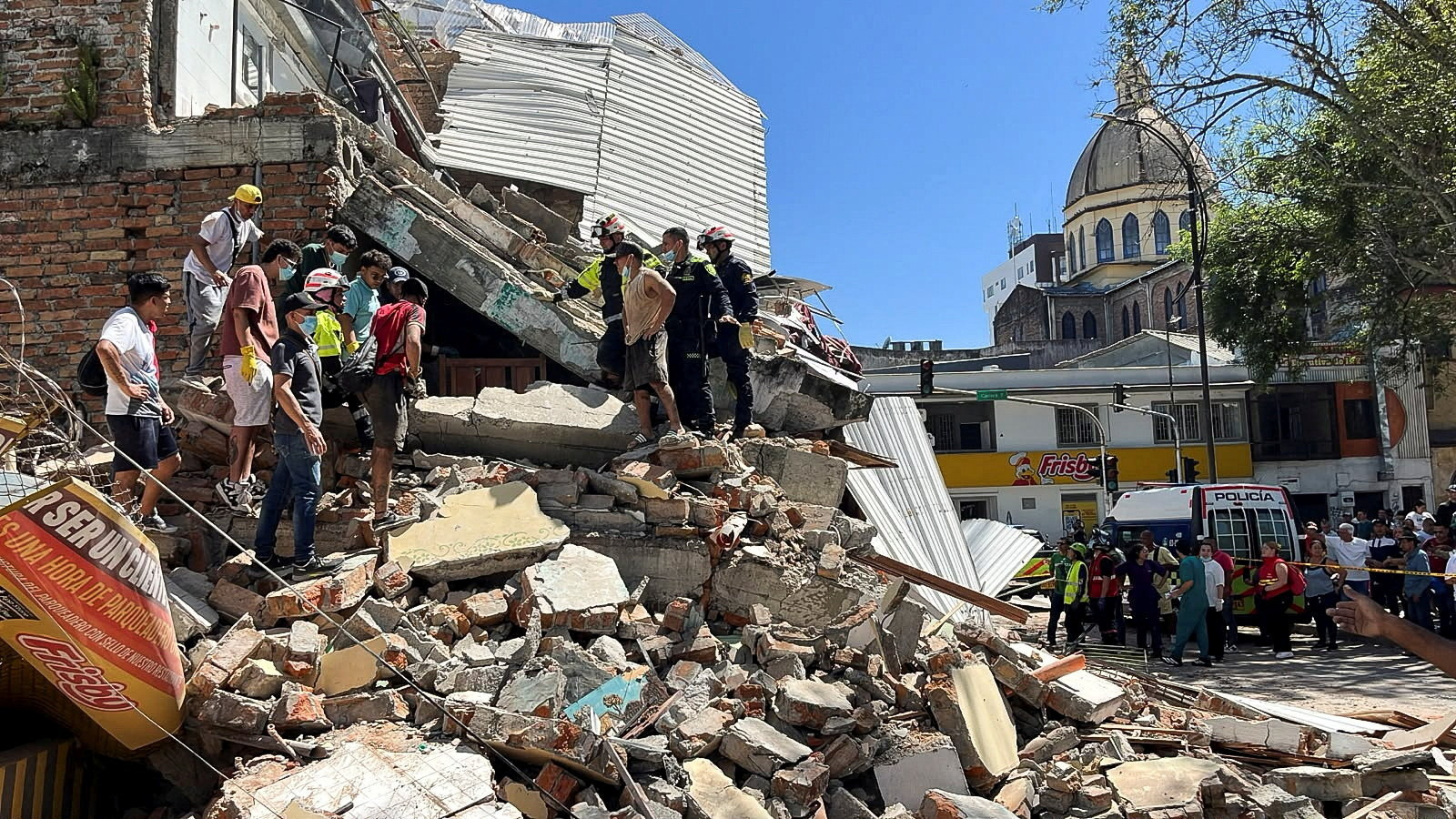
At least 111 people were killed after a powerful earthquake struck western Colombia early on Monday, collapsing buildings in several cities and trapping people under rubble.
The 7.4 magnitude earthquake, according to the US Geological Survey, struck at a depth of 107 kilometres near San Jose del Palmar in Choco province on Colombia’s Pacific coast. The tremor was felt across the country.
The US Geological Survey warned that “significant casualties and damage are likely” and that the disaster could be widespread.
The highest reported death toll was in Risaralda province, where Governor Juan Diego Patino told Caracol Television that 42 people had died.
Cali, one of Colombia’s largest cities, was also badly affected. Mayor Alejandro Eder said at least 30 buildings had collapsed and rescue teams were working at 10 of them. Firefighters and Colombian Red Cross workers were seen carrying survivors from damaged buildings.
“The building completely collapsed. It sounded like a bomb. It was horrible,” resident Juan Carlos Osorio told Caracol Television as he helped clear rubble.
“All of us neighbours are working together, forming human chains. We need heavy equipment. There are many people trapped,” he said.
In Pereira, footage showed part of a building collapsing and sending dust and debris into the street. One of the towers of a neo-Gothic cathedral in nearby Manizales was also damaged.
In Choco, the province closest to the epicentre, Governor Nubia Carolina Cordoba-Curi reported deaths, dozens of injuries and heavy damage in the provincial capital Quibdo. She also warned residents to prepare for aftershocks.
The earthquake struck just days after Abelardo De La Espriella was sworn in as president, placing his new administration in its first major crisis. He said he was suspending planned activities and travelling to Bogota to lead the emergency response.
The government declared a state of emergency to coordinate rescue operations.
Flights were suspended at airports in Pereira, Manizales, Quibdo, Armenia, Cartago and Buenaventura while inspectors assessed possible structural damage.
The US tsunami warning system said there was no tsunami threat following the earthquake, which struck at 7.34am local time and was felt in nine departments and all 32 departmental capitals.
The tremor was also felt across the border in Venezuela, including in Tachira state and Barquisimeto.
Colombia is prone to earthquakes because it lies across several geological fault systems in the Andes. The country has also experienced major disasters caused by landslides, including the 1985 Armero tragedy, which killed about 25,000 people.
The coffee region was devastated by a 6.2 magnitude earthquake in 1999, which killed more than 1,000 people.





Click here to change your cookie preferences