
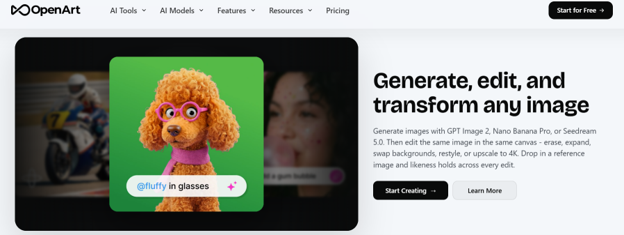
Before the AI era, almost everyone had to depend on graphic designers to make almost anything. But as you know, things have been changing rapidly in the past couple of years. Now, all one has to do is write a simple text prompt explaining the scenario, and it will generate it for you.
This is why I thought of writing an article to discuss whether AI image generators have done more good or bad to the content creation industry(Remember, some of the statements expressed below can be personal opinions)
Less dependency on designers
YouTubers, filmmakers, and businesses value designers because they are capable of bringing our ideas to life. This got messy after the rise of AI, as anyone can just ask what they want and generate the image in minutes.
Make no mistake, there are still many things that AI cannot do. It is the human expertise and context that helps generate a unique result.
Note: Businesses still prioritize professional artists to create designs that display data. AI models are known to make mistakes, especially when it comes to numbers. AI tools such as Pictory are popular among startups and businesses.
Key points to note:
- Today, the requirement to generate a simple image is just knowing a language. Just describe what you want to the AI tool, and it’ll produce the result in a minute.
- You can use available coupons at checkout to claim lower prices on subscription plans.
- Using the generated image without any manual editing is a TOTALLY BAD IDEA.
- The AI image generators are great for creating templates and not finished designs.
Opportunity for newer artists
Upcoming digital creators and artists are facing a completely different creative landscape than the ones before them. Unlike upcoming creators, the older and established designers didn’t need to worry about AI technology.
Instead of fearing AI, you can use this technology to enhance your productivity and use it to explore new ideas. Okay… so this doesn’t mean you just copy-paste the results generated by the image tool. It is important to add your unique touch or recreate the image manually by taking inspiration from the AI result.
Main highlights:
- Many upcoming artists are afraid of AI “taking” their jobs away. News platforms and random YouTube channels keep adding to these fears.
- Most experienced designers have adopted AI in their daily workflow.
Quick UI/UX prototypes
From what I have seen, UI/UX is the least talked about in these AI discussions. Before, businesses or individuals had no option but to hire a UI/UX designer for creating the most basic user interface. This has completely changed with AI, as startups can generate simple prototypes and use them until they have a budget to hire an professional.
AI models cannot think from users’ point of view and only do what’s being told to them in the prompt. This means it is only relying on one person’s point of view, who is writing the prompt(which is not good enough). This proves again that you always need a human to get the best out of AI image-generator tools.
Main highlights:
- Organizations still need UI/UX designers to improve complex website interfaces.
- AI image generator tools are meant to assist designers.
- AI Tools such as Google Stitch are popular for generating UI.
AI Slop
You might have heard this word used by many whenever they see a low-effort AI post on social media. Meme content creators are known to generate this kind of content to get views with the least amount of effort. This has helped create a growing backlash on all kinds of AI content online, especially ads and artwork.
Main highlights:
- AI slop refers to low-effort content posted by users on the internet.
- Many meme content creators use these AI tools to farm engagement.
- Adding your unique touch to AI content is a non-negotiable these days.
Know the limit for AI use
Just because you have an AI image generator doesn’t mean you should use it every single time. Now, let’s do a test. Perform two design tasks(use AI for one task & make another by yourself) and monitor the time it takes to complete each one. If you have even a little bit of experience, you’ll realize that doing it on your own is faster. I mean… sure, you can use it for getting ideas, but don’t ask it to generate a “ready-to-use” entire image.
Observations:
- When using AI for the task: Poor quality and requires more edits(which takes more time).
- Without using AI(For experienced professionals): Takes up less time after you decide what to create.
Key points to note:
- Be ready for public backlash if you’re heavily planning to use AI content. Doing so is completely fine for generating corporate content.
- Don’t use AI to copy other artists’ creative work.
- Human judgement is required not just in AI content creation but in other fields also.
Concluding thoughts
The result completely depends on the person using the AI image generators. I could give you the world’s best AI tool, and you could still create the most generic content. AI image generators are not a substitute for your hard work but just tools to assist you. OpenArt, Pictory, and Kling are some of the popular AI tools for a variety of use cases.
DISCLAIMER – “Views Expressed Disclaimer – The information provided in this content is intended for general informational purposes only and should not be considered financial, investment, legal, tax, or health advice, nor relied upon as a substitute for professional guidance tailored to your personal circumstances. The opinions expressed are solely those of the author and do not necessarily represent the views of any other individual, organization, agency, employer, or company, including NEO CYMED PUBLISHING LIMITED (operating under the name Cyprus-Mail).




Click here to change your cookie preferences