
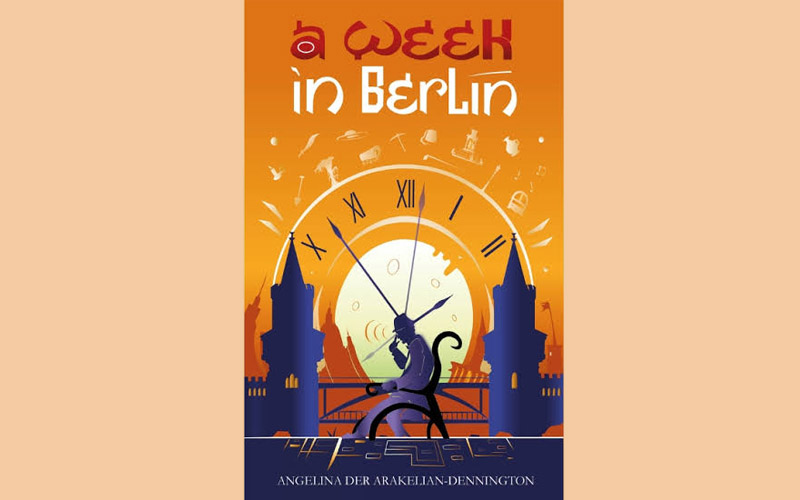
Book Review: A Week in Berlin by Angelina Der Arakelian-Dennington
I can’t tell you how happy it would make me to receive a request for a review from a self-publishing local author, to say yes, to read the book, and to be able to write a tremendous review predicting a glorious future for the author. Sadly, A Week in Berlin is not that book and Angelina Der Arakelian-Dennington, for all the well-meant ambition of her debut novel, is not that author.
Badrig Serdzovian is among the Armenians rounded up on April 24, 1915, the day marking the beginning of the Armenian Genocide. Just as he is about to be executed, a carriage drives up with a mysterious order to free Badrig – and nobody else. He is driven away while his best friends and so many others are massacred. Later, he witnesses the killing of his family, including his pregnant wife.
Needless to say, Badrig finds the trauma of survival challenging to live with.
So, he joins a resistance group and is later rescued by a French ship which takes him to a new life in Marseilles and a new name, Patrick Ser. Despite, or perhaps because of, his PTSD, sullenness, and the ‘olive skin and dark eyes’ that Der Arakelian-Dennington would have us believe made him appear exotic in Marseille, that famous port city in Southern Europe, he sleeps around a lot and takes any job that will have him. Then, one day, he gets a letter from a wealthy industrialist in Lyon offering him a managerial position in a textile factory. Despite the obvious weirdness, Badrig goes. On the first day, the same industrialist suggestively offers Badrig his daughter, Josephine. Around a week later, Badrig and the daughter get married.
Meanwhile, Badrig has been having increasingly frequent blackouts when sensory inputs arouse memories of his past that take him into vivid, spiralling visions.
Then it turns out that Badrig’s visions are actually proof that he is an ‘Intelligence’, a man with the power to traverse and disrupt the flow of time, and that Josephine and her family are part of the immortal time-police or ‘Shadows of Time’ whose job it is to keep time running in an orderly line.
Oh, and Badrig is actually the most powerful Intelligence of all time whose actions lead to the destruction of ‘The Sequence’ (a kind of malevolent personification of time) and he has a week (in Berlin) to figure out how to stop it. Oddly, despite avowedly being an opponent of ‘The Sequence’ and all it stands for, and having repeatedly wished he hadn’t survived, Badrig does try to stop the unravelling, without any rational explanation as to why he cares.
I like weird books. I enjoy historical romance. I can appreciate a bit of time-travelling fantasy. And I’ve repeatedly praised books that play with and blend generic convention.
I’m less keen on books that have huge continuity errors, way too many adjectives, overly repetitive and error-strewn psychedelic montages, and dialogue in which everyone from youthful 18th-century slaves to immortal guardians of time speak in exactly the same stilted and unrealistic language.
I wish I could say something more positive than that I am grateful to A Week in Berlin for prompting me to read more about the Armenian Genocide. In that sense, Der Arakelian-Dennington’s book has succeeded in keeping alive the memory of an event that shaped her family’s history, and that in itself is a noble objective. But as a work of literature, A Week in Berlin is sadly lacking.
A Week in Berlin by Angelina Der Arakelian-Dennington is available on Amazon




Click here to change your cookie preferences