
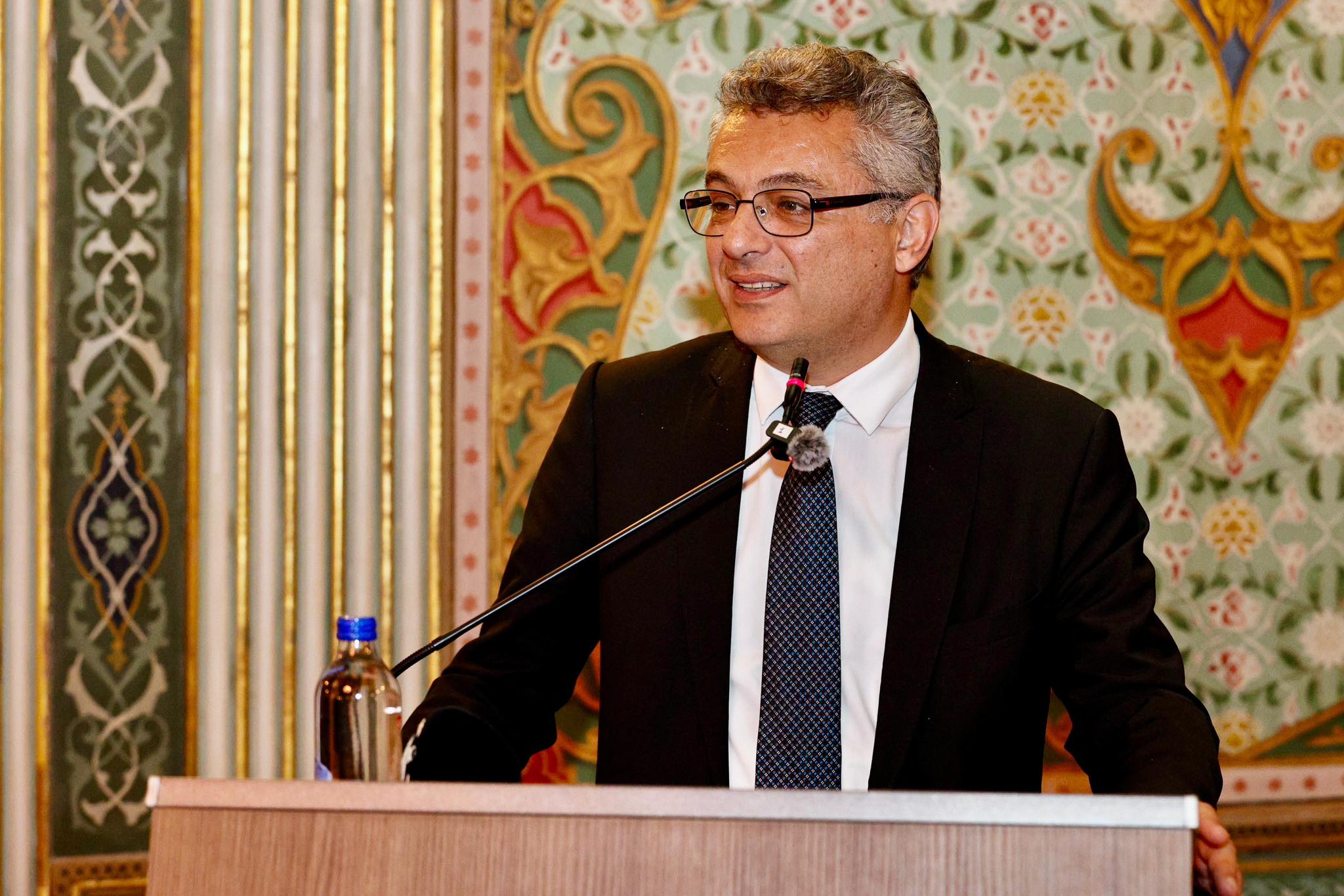
Turkish Cypriot leader Tufan Erhurman’s undersecretary Mehmet Dana’s briefing to diplomats went ahead at the Home for Cooperation on Wednesday morning, with Erhurman himself at the same time saying that “the world needs to see” the efforts made by the Greek Cypriot side to discourage diplomats from attending.
The Republic of Cyprus’ foreign ministry had in recent days been telephoning embassies to urge them not to attend Wednesday’s briefing, but diplomatic sources informed the Cyprus Mail following the briefing’s conclusion at the Home for Cooperation in Nicosia’s buffer zone that it was, despite this, “quite well attended”.
Nonetheless, Erhurman was keen to stress during an appearance on Ada TV that efforts to discourage diplomats from attending the briefing serve to undermine trust between the island’s two sides.
“We did not learn about it from the Cyprus Mail. We also knew what was being done, but it is important that it came out there, because as soon as it comes out there, of course, it gets more traction on the Greek Cypriot side,” he said.
On this front, he said that “if we said it, they would have a problem or whether to believe it or not, so we did not say anything”.
He also pointed out that Greek Cypriot chief negotiator Menelaos Menelaou had given a similar briefing to diplomats in the aftermath of United Nations Secretary-General Antonio Guterres’ visit to the island last month, and said that he is aware of “which ambassadors attended, and how many people went to Menelaou’s briefing”.
“Not everyone went, ultimately. Not everyone could have gone. It is August, as you know. August is generally the holiday month in diplomatic circles, so some will come, some will not. It is not a problem for us who went and who did not, but ultimately, we also have a perspective on this issue,” he said.
To this end, he said that the Turkish Cypriot side also intends to explain its position to the international community, and that in any case, “ambassadors already possess a great deal about the whole situation” as “they also listen to both sides”.
“Now I ask, the international community saw this, heard it, received the phone calls. I ask, is this behaviour which creates or increases trust?” he asked.
He said that he could “argue about this here, have a fight, yell and scream”, but instead said, “I am calmly asking everyone this: does this increase trust, or does it damage it?”.
“I am not saying this here to my own people, to address domestic politics. Actually, this is something the world needs to see, the United Nations, the European Union,” he said.
He pointed out that Guterres had visited the island alongside his undersecretaries-general for political and peacebuilding affairs Rosemary DiCarlo and for peace operations Jean Pierre Lacroix had visited him at his official residence, and that prior to Guterres’ visit, diplomas from the United States, Italy, France, the United Kingdom, Germany, and other countries had all visited him.
“They recognise that place as belonging to a community leader. That is no problem for me. They come and meet us. However, an obstacle was put in place to prevent ambassadors from attending a briefing in the buffer zone,” he said.
To this end, he pointed out that the European Commission’s own Cyprus problem envoy Raffaele Fitto had also met him at his official residence, but “there is somehow a problem with the ambassadors … of European Union member states attending a meeting in the buffer zone”.
“Now, this is neither logical nor reasonable, nor is it consistent with the methodology they always ask about. They ask, ‘what happened that you made political equality the first point of your methodology?’. This instance is one of the reflections of that equality issue,” he said.
To this end, he said that “the Turkish Cypriot people have much to tell the international community, and we will tell it to Fitto, to Guterres, and to all the ambassadors”.
“Now, there are some obstacles which will be put in place today. We will explain it in another setting. They will come here and we will explain it. Sometimes, we do not even need to explain. As in this example, those who want to see it will see it themselves,” he said.
Dana and Menelaou are expected to meet each other on Thursday, while Erhurman and President Nikos Christodoulides are set to meet next week, with government spokesman Konstantinos Letymbiotis having promised that Christodoulides will approach that meeting with a “constructive attitude”.
Next week’s leaders’ meeting is set to be held with the hope of later organising an enlarged meeting on the Cyprus problem, involving the island’s two sides, its three guarantor powers, Greece, Turkey, and the United Kingdom, and the United Nations.
Guterres had said during his visit to the island that a new enlarged meeting will be convened “after adequate progress” is achieved on confidence-building measures, the meeting’s methodology, and the substance of the talks.
Initially, presidential press office director Victor Papadopoulos had said that while confidence-building measures “naturally help create a climate”, they are “not a prerequisite” for an enlarged meeting to be convened.
However, UN Cyprus problem envoy Maria Angela Holguin then pushed back on this, saying that the implementation of confidence-building measures is an “indispensable condition” to be fulfilled ahead of an enlarged meeting.
“Confidence-building measures should not be seen merely as symbolic steps which improve the atmosphere between the two communities, but rather as practical tools which test the viability of a future political order,” she told Turkey’s Anka news agency.
She added that confidence-building measures are “important in demonstrating whether cooperation works in practice”, and said that “such initiatives help create the collaborative habits which a future solution will need”.
Chief among those possible confidence-building measures is the possible opening of crossing points between the island’s two sides, on which talks remained deadlocked over the question of whether to break up the package of four locations upon which the sides had agreed last year.
On this matter, the Greek Cypriot side proposed removing Louroujina, northwest of Larnaca, from the package of four, instead opening crossing points near Athienou, and in the eastern Nicosia suburbs of Mia Milia and Aglandjia, and the Turkish Cypriot side flatly refused to entertain any discussions which did not include all four agreed upon locations.
Dana had previously said that next week’s leaders’ meeting will constitute “the first step in this preparatory process” towards an enlarged meeting.
“In this meeting, within the framework outlined by the secretary-general, a process of exchanging views will being, primarily on confidence-building measures, then on methodology, and finally on some substantive issues,” he said.




Click here to change your cookie preferences