
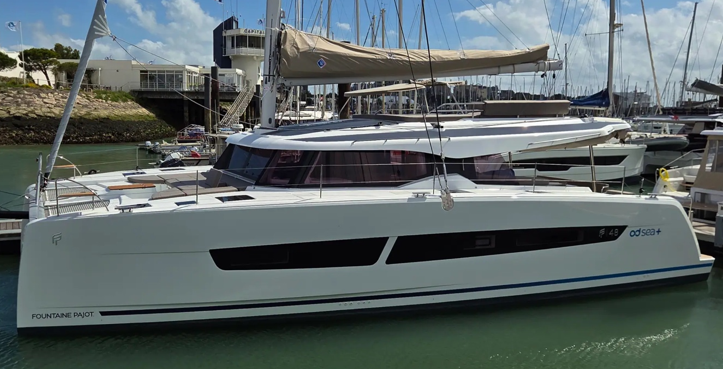
In early July, Fountaine Pajot held its landmark shipyard showcase, Fountaine Pajot Open Days 2026. The event was particularly significant thanks to the simultaneous premiere of several long-awaited novelties, with the debut of the FP55 catamaran and the FP48 catamaran taking center stage.
Fountaine Pajot’s Current Catamaran Lineup
Over the past year, the shipyard has significantly reworked its catamaran range, establishing the Fountaine Pajot Yachts sub-brand. This luxury division now includes the yard’s largest models, such as the FPY120S, FPY70, Thira 80, and Samana 59. Meanwhile, its smaller catamarans have moved into the Sailing Catamarans category and now officially carry the shipyard’s initials: simply FP.
The Sailing Catamarans category also underwent a major update. The shipyard is gradually phasing out the classical names that once referenced exotic islands and destinations – no more Isla, Tanna, or Aura. From now on, nearly every model is designated by its size instead.
In the current range, the new FP55 catamaran officially serves as the flagship, filling a previously vacant niche in the lineup. The FP48 catamaran, meanwhile, steps in to replace the legendary Tanna 47.
The FP55 Sailing Catamaran
Designed as the largest vessel in the Sailing Catamarans range, it stands out first for its handling – and second for its enlarged cabins and status as a genuine flybridge catamaran with hardtop. That flybridge houses a spacious covered lounge with an additional galley module.
Unlike smaller Fountaine Pajot models, the helm station sits right at the centre of the forward flybridge, giving engineers a clean 360-degree field of view for the skipper.
Walk-Through Architecture and Forward Cockpit
Fountaine Pajot’s key innovation here is a complete transformation of the on-board traffic flow. The deep forward cockpit, equipped with generous wind protection, a dedicated sink, and an isolated fridge, boosts comfort on its own. The real breakthrough, though, is a direct walk-through passage from the saloon to the foredeck via a watertight door in the windscreen.
This solution eliminates the need to move along narrow side decks in heavy seas. The saloon and forward lounge form a unified, secure living area with continuous cross-ventilation.
Modularity and the “Double Maestro” Concept
At 16.98 m long, 8.8 m wide, and displacing 27.7 t, this Berret-Racoupeau Yacht Design creation offers exceptional interior volume despite its shallow 1.85 m draft — enough to cruise comfortably in shallow-water grounds.
Fountaine Pajot emphasizes extensive customization for everything from private ownership to commercial charter. Its signature innovation is the “Double Maestro” layout: two identical master suites – King and Queen – set in opposite hulls, resolving the cabin-status conflict typical of family cruising.
Available configurations:
- Maestro: 1 master suite + 4 guest cabins.
- Double Maestro: 2 master suites + 2 guest cabins.
- Charter: 6 identical double cabins.
- Essential feature: every cabin includes an en-suite bathroom. The forepeaks house two independent crew cabins with private heads – underscoring this model’s high-end service orientation.
Sail Handling and Self-Sufficiency
The sail plan (110 m² main and 66 m² genoa) favours strong performance in light winds. Range comes from 1,220 L fuel tanks (2×610 L) and 800 L fresh water tanks (2×400 L), with standard twin 80 hp Yanmar diesels — or optional twin 110 hp engines.
Its energy balance rests on eliminating continuous generator runtime. As a genuine solar powered sailing catamaran, it carries a 6,300 W solar array (3,800 W on the coachroof, 2,500 W on the hardtop) — enough to run the air conditioning at anchor in silent mode.
True to Fountaine Pajot’s commitment to green innovation, the model is also available as an ODSea+ Smart Electric hybrid catamaran: an optional package with twin 50 kW electric motors, a 38 kWh battery bank, a 38 kW generator, and hydrogeneration under sail – enabling silent, zero-emission coastal passages.
The FP48 Catamaran and the Evolution of the Tanna 47
Another headline release of 2026 is the FP48 catamaran – the direct successor to the popular Tanna 47, refining and advancing its most successful design concepts.
The new model is designed to secure Fountaine Pajot’s leadership in the 48-foot segment, offering the market a comprehensive redesign of on-board ergonomics, deck logistics, and energy autonomy.
The exterior styling has been updated to match the refreshed lineup. The hull is more streamlined, while retaining the signature angular accents iconic to classic Fountaine Pajot design. The silhouette remains instantly recognizable in any marina.
| Parameter / Zone | Tanna 47 Catamaran | New FP48 Catamaran | Key Changes |
| Saloon / Cockpit Link | Standard sliding door | 3-meter open-space door | Seamless single-level spatial integration |
| Galley Layout | Corner / L-shaped | Island galley with a breakfast bar | Direct walk-through: aft cockpit ↔ saloon ↔ foredeck |
| Aft Lounge | Classic settee seating area | Waterline platform + chaise longue | Private lounge right at the water’s edge |
| Solar Generation | Surface-mounted panel options | 2,300 W seamlessly built into hardtop | Powers domestic loads & silent ODSea+ electric propulsion |
Deck Zoning and Helm Ergonomics
Fountaine Pajot’s naval architects distributed the lounge areas across multiple levels. At the stern, the aft cockpit features a dining area with a table for 8 and a secluded chaise lounge to watch the wake.
At the bow, you find the foredeck and bow area. Continuing the design evolution, the shipyard replaced traditional trampoline nets on the crossbeam with a rigid structure that is both stronger and better organized, featuring a sunbathing area with adjustable sunbeds and a walkway to the forestay.
Above, owners get another full-fledged lounge designed as a semi-flybridge, perfect for sunbathing or relaxing with friends. Dedicated guest sunpads are fitted directly onto the flybridge.
The elevated helm station is located on the port side, just a few steps down from the semi-flybridge lounge – keeping the distance between skipper and crew short and simplifying short-handed sailing.
Layout Versatility for Any Mission
The interior space adapts to three operational concepts:
- Full Maestro (3 cabins): the entire port hull is dedicated to an owner’s master suite with a private study or dressing room. An ideal layout for long-range cruising.
- Classic Maestro / Maestro + Cabin (V1/V2): retains the master suite while adding isolated bow guest cabins in the hulls.
- Quintet layout (5 cabins): four double guest cabins plus an independent crew cabin for a skipper or cook, making this 5-cabin catamaran configuration optimal for commercial charter operations.
Autonomy and Silence at Anchor
An integrated solar panel array built into the hardtop, rated at 2,300 W, combined with the optional ODSea+ propulsion system, lets the boat stay at anchor for extended periods without running a diesel generator. Unlike the Tanna 47, where eco-friendly features were optional, hybridization and silent electric cruising are now built directly into its core design.
Articles and features from our partners, providing valuable insights, expert information, and detailed perspectives on a variety of topics DISCLAIMER – “Views Expressed Disclaimer: Views and opinions expressed are those of the authors and do not reflect the official position of any other author, agency, organization, employer or company, including NEO CYMED PUBLISHING LIMITED, which is the publishing company performing under the name Cyprus-Mail…more




Click here to change your cookie preferences