
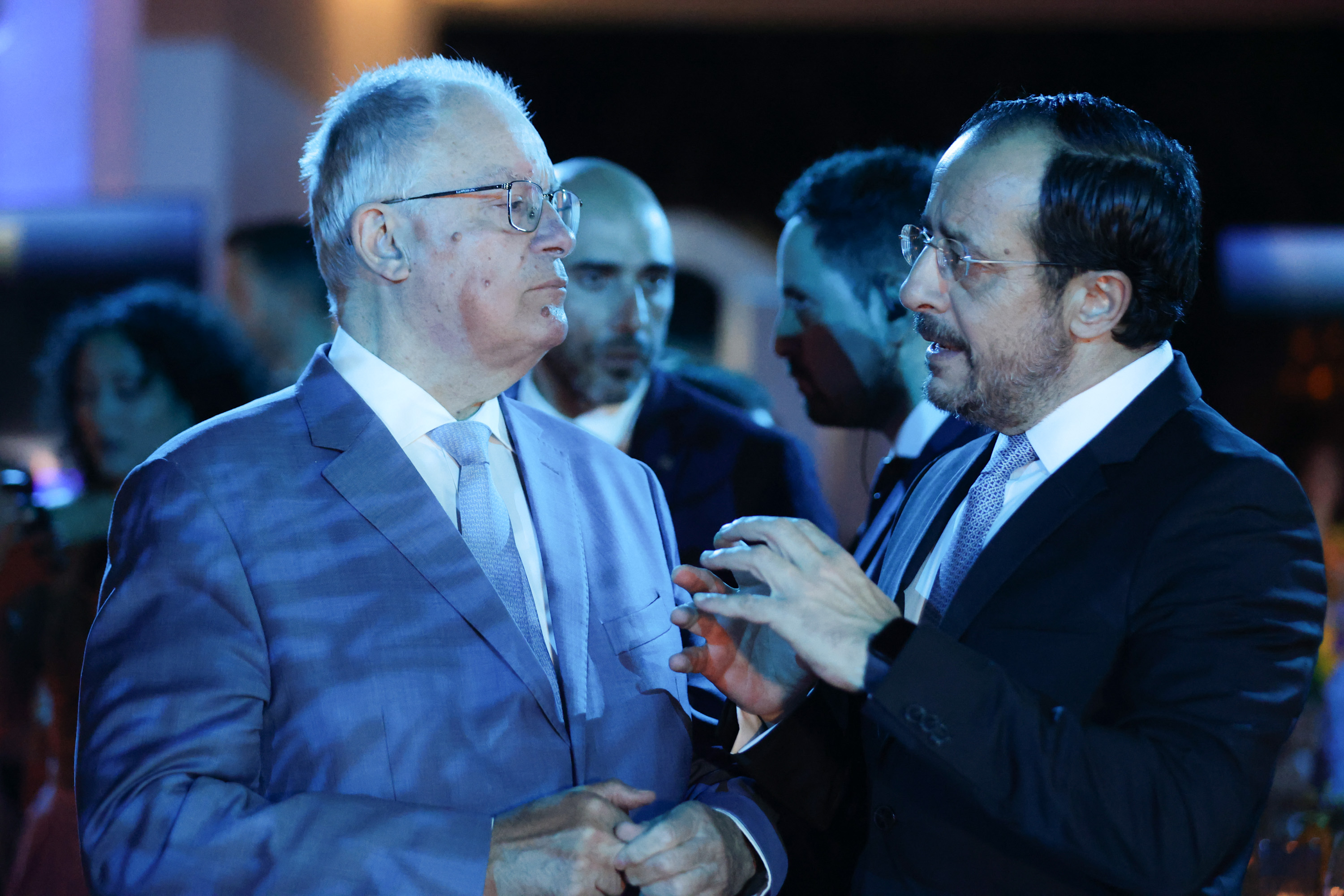
Greece is aiming for the next enlarged meeting on the Cyprus problem “to be a success”, the country’s President Constantine Tassoulas said, as he welcomed his Cypriot counterpart Nikos Christodoulides to Athens.
“Greece, in full coordination with the Republic of Cyprus, is contributing constructively to the ongoing consultations, aiming for the next enlarged meeting to be a success … Attempts to create faits accomplis on the ground, as well as discussions about two-state solution scenarios, are not acceptable,” he said.
The question of when such an enlarged meeting, which would involve the island’s two sides, its three guarantor powers, Greece, Turkey, and the United Kingdom, and the United Nations, remains open.
UN Secretary-General Antonio Guterres on Wednesday ruled out the prospect of holding such a meeting on the sidelines of the UN’s “high-level week” in New York next week, saying that “there is still a lot of work to be done, but we are determined to move things ahead”.
“We are determined to do everything possible for that to take place when conditions are met for the meeting to be successful. We cannot repeat the mistakes of the past,” he said.
He had said when he visited the island in July that an enlarged meeting would be convened “after adequate progress” is achieved on confidence-building measures, the meeting’s methodology and the substance of the talks.
However, despite Christodoulides and Turkish Cypriot leader Tufan Erhurman having met on three separate occasions since then, no concrete progress has been achieved in the two months since Guterres’ visit, with the sides still in open disagreement over the meaning of political equality, crossing points, and the methodology of the talks.
In addition, throughout the summer, initiatives had been taken by the Greek Cypriot side to cancel international events being held by the Turkish Cypriot community, including a children’s football camp organised by FC Barcelona and a music festival in Kyrenia.
Erhurman warned against initiatives which ‘undermine trust’
This prompted Erhurman to warn that such initiatives “undermine trust” between thw island’s two sides, stressing last week that “if we wish to move the process forward, it is crucial to create the ‘conducive climate’ mentioned by Guterres”.
Nonetheless, this week, Erhurman said that Guterres demanded that progress be made on seven separate topics on the Cyprus problem, and declared that the Turkish Cypriot side is ready to make progress on all seven.
Those seven topics, he said, are the issues of crossing points, mine clearance, the citizenship of children born of “mixed marriages”, sports, joint disaster response, and a joint mechanism to combat irregular migration.
He then confirmed that he will meet Guterres in New York next week, before emphasising that he remains set against the idea of holding an enlarged meeting on the Cyprus problem “which would yield no results”.
“We have no right to subject Turkish Cypriots and Greek Cypriots to what we experienced at the 2004 Annan plan referendum and in Crans-Montana in 2017. The secretary-general also came to our point of view, making it clear that he would not convene a fruitless five-plus-one meeting,” he said.
Such a meeting, he said, will not take place “without progress on confidence-building measures, methodology and substantive issues”, with “five-plus-one” another term used to describe an enlarged meeting.
Asked whether he remains hopeful that progress can be made, he said, “I said I am hopeful and I stand by this statement”.
“My hope is not because I get along very well with Christodoulides or because we have become very close. We have made contacts in ten and a half months which could not be made in the five years before. We are able to talk,” he said.
He added that after he was elected last October, “Christodoulides had said, ‘let’s start off from where we left off in Crans-Montana’, but we explained that there has been an erosion of trust for nine years, and that confidence-building measures should come first, followed by methodology, and finally, negotiations”.



Click here to change your cookie preferences