
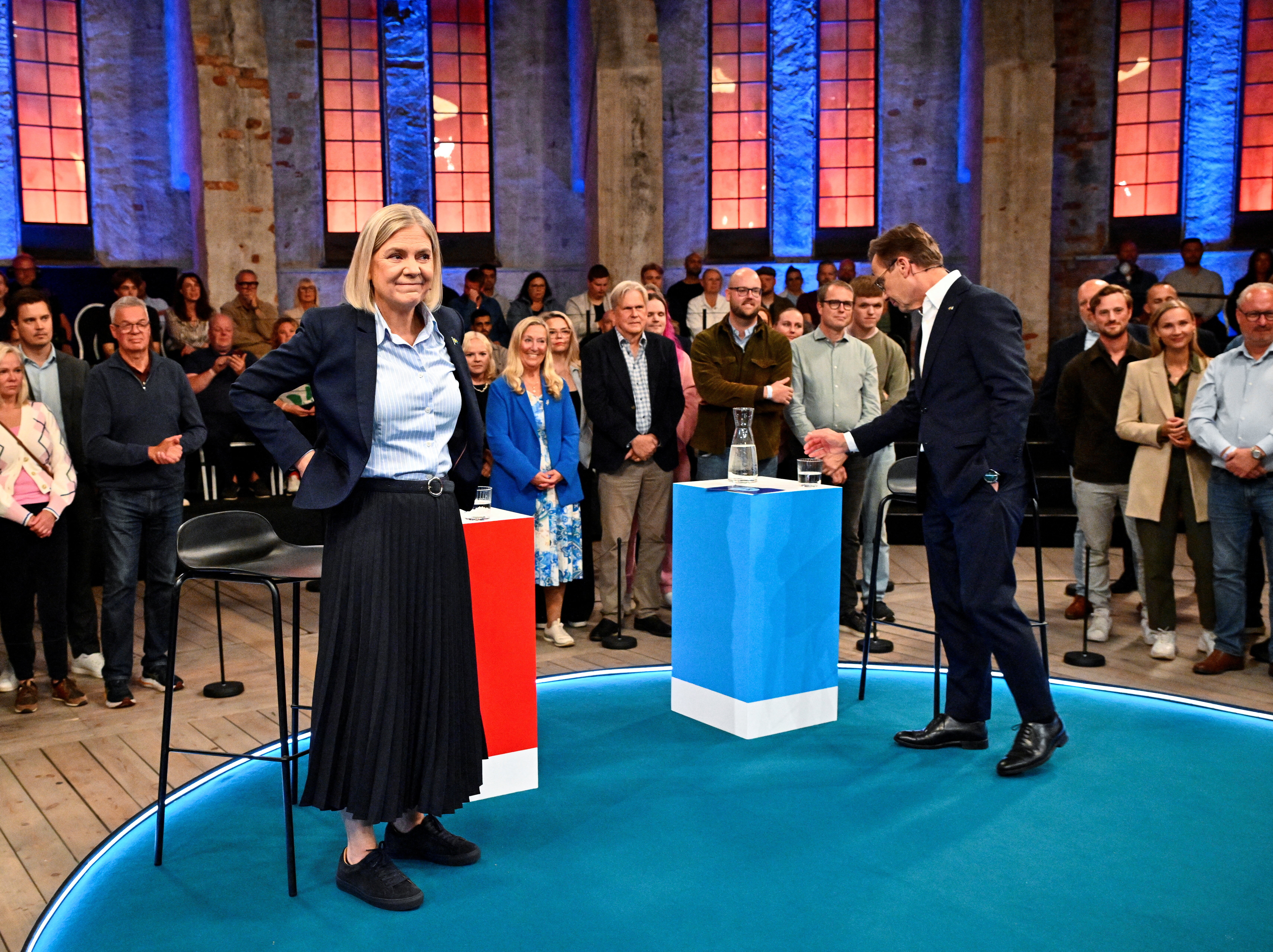
Sunday’s tight election could bring the far-right Sweden Democrats into government for the first time.
Swedes will vote on Sunday in a tight election that has effectively become a referendum on whether the far-right Sweden Democrats should join the government and cement their journey from pariahs to trusted partners in a country once seen as one of Europe’s most liberal.
The party, with roots in the neo-Nazi fringe, has around 19% of the vote, according to the latest polls, and the ruling centre-right minority coalition has vowed to bring them into its bloc to secure Prime Minister Ulf Kristersson a second term in office.
“We have agreed to campaign on a platform of building a common, majority government and that I will lead that government,” Kristersson told Reuters on the campaign trail in late August.
Factbox
WHAT’S AT STAKE?
Kristersson is seeking to form a majority government with his existing partners, the Christian Democrats and the Liberals, but this time with the addition of the Sweden Democrats, a party with roots in the neo-Nazi fringe. The Sweden Democrats have backed the government in parliament since 2022, but have demanded cabinet seats after the September election.
The centre-left opposition, led by Social Democrats’ leader Magdalena Andersson, is more loosely aligned and parties have yet to tell voters exactly how they intend to form a government.
WHAT ARE THE MAIN ISSUES?
The election is in part a referendum on the Sweden Democrats. While they have steadily grown in popularity and respectability, many voters reject the possibility of a government with far-right cabinet members.
Prime Minister Kristersson says Sweden needs a stable majority government to tackle important issues, such as national security and gang crime, and that the only way is to include the Sweden Democrats.
The centre-left warn that civil liberties may be at risk if the Sweden Democrats enter government. They also want to increase funding for welfare services and measures to combat climate change, and address growing income inequality.
WHEN DOES VOTING TAKE PLACE?
Polls are open from 0600 GMT to 1800 GMT on election day, though voting has been possible since late last month.
WHAT HAPPENS NEXT?
If the four right-wing parties win a majority, forming a government looks to be straightforward, as they all have pledged an alliance.
However, if the centre-left opposition parties win, Andersson will face difficult negotiations to either form a majority government with all four parties, or a minority government alone, or with one or two partners.
WHO ARE THE KEY PARTIES AND WHAT ARE THEIR PLEDGES?
* CENTRE-LEFT BLOC *
Social Democrats (S) – leader Magdalena Andersson
Sweden’s largest political party is campaigning on a pledge to protect the welfare system and boost economic growth, while backing the green transition and higher defence spending.
Green Party (MP) – leaders Amanda Lind and Daniel Hellden
The party champions environmental protection and wants to cut carbon emissions, expand renewable energy, invest in railways and green infrastructure. It opposes nuclear power.
Left Party (V) – leader Nooshi Dadgostar
Wants greater investment in healthcare, education and other welfare services, financed in part through higher taxes on the wealthy.
Centre Party (C) – leader Elisabeth Thand Ringqvist
It is campaigning on job creation, climate action and stronger public services, also in rural areas. It wants lower taxes and has refused to cooperate with both the Left Party and the Sweden Democrats.
* RIGHT-WING BLOC * Moderates (M) – leader Ulf Kristersson
The Moderates have led the right wing of Swedish politics in recent decades, although the Sweden Democrats became the larger party in 2022. Their campaign centres on a tougher stance on crime and lower taxes.
Sweden Democrats (SD) – leader Jimmie Akesson
With immigration numbers historically low, the focus of their campaign has been on preserving Swedish values, language and customs, and incentives for immigrants to leave the country.
Christian Democrats (KD) – leader Ebba Busch
They emphasize family and welfare policies along with broadly right-wing economic policy.
Liberals (L) – leader Simona Mohamsson
The Liberals have centered their campaign around the economy and education, focusing on smaller class sizes.
The election will show whether Swedish voters want to deepen a political shift that has already upended decades of consensus on immigration and national identity, and turned one of Europe’s most open societies into a testing ground for tougher policies on integration, citizenship and border controls.
Kristersson has credited his cooperation in parliament with the Sweden Democrat leader Jimmie Akesson, since 2022, for delivering growth, lower prices for energy and food, reducing gang crime and shootings and cutting asylum numbers to record lows. He has promised to deepen ties after the Sept. 13 vote and give the party cabinet positions.
Immigration reshapes Swedish politics
Over the last four years, the government has abolished permanent residency for refugees, tightened welfare rules and boosted expulsions of those without a right to stay.
Asylum numbers have dropped to a 40-year low and while Kristersson says the focus will now be on integration, the Sweden Democrats want to go further.
“In Sweden it is Swedish culture, the Swedish language, Swedish laws, Swedish norms, Swedish morals and Swedish traditions that apply,” Mattias Karlsson, Sweden Democrat lawmaker and one of Akesson’s closest allies, told Reuters.
“If you can’t accept that, you have to find somewhere else to live.”
Despite a consensus over tight immigration policies, many Swedes still feel a deep unease about the far right and polls point to a knife-edge vote with the centre-left opposition, which is backing Social Democrats leader Magdalena Andersson for prime minister, holding a small but narrowing lead.
“If the Sweden Democrats enter government, that would have an enormously negative impact on the liberal ideals of our country,” said Birgitta Ohlsson, European Affairs minister from 2010 to 2014, and now a Center Party lawmaker.
“We’ve already seen the effects while they’ve been outside government, and it would be ten times worse.”
A new political landscape
The rise of the far right has reshaped Europe’s political landscape, with such parties already sharing power in countries including Finland, Italy, Croatia and the Czech Republic, while posing growing challenges in France and Germany.
Akesson’s Sweden Democrats have spent the last four years as Kristersson’s main parliamentary backers and some analysts say the election may be less a watershed than a recognition of Akesson’s success in shedding the party’s extremist baggage. The party apologised in 2025 for past neo-Nazi and antisemitic views.
“The election is a referendum on the Sweden Democrats; whether we continue to go down a far-right path,” Jan Guillou, author and political commentator, told Reuters.
Policies that a decade ago many Swedes would have viewed as a rejection of the country’s liberal values have gained acceptance across much of the political spectrum.
The blocs have also converged in several areas of key concern to voters with both promising stronger welfare, continued support for Ukraine, rearmament and measures to ease a cost-of-living crisis that has hit many households hard.
“I think you’ll see a continued normalization of the Sweden Democrats,” said Lars Tragardh, a historian and author who led work on a government cultural heritage list criticised at the time by some as too narrow and exclusionary.
“It’s time to tone down the hysteria.”
Could Sweden shift further right?
Critics, however, fear the Sweden Democrats’ promises to end multiculturalism, restore traditional Swedish values and ban some forms of Muslim dress could deepen social divisions and shift the political centre of gravity even further right.
“I’m afraid more people will be expelled. I’m worried about the press, free speech and the freedom to demonstrate,” said Kurdo Baksi, an author and anti-racism campaigner, speaking on the sidelines of a pro-immigration demonstration in Stockholm.
Andersson faces coalition challenge
In a Facebook campaign message, Andersson said voters’ choice was not whether she or the incumbent Kristersson would become prime minister, but whether the Sweden Democrats would shape policy on defence, schools, culture and finance.
“That would be a very different Sweden,” she said.
Even if she wins, Andersson faces a daunting task in building a stable coalition.
The four opposition parties, the Social Democrats, Greens, Left Party and Centre Party, broadly agree on increasing welfare and public spending.
But they differ on key policies, from a tax on billionaires to whether Sweden should build new nuclear reactors, and the Centre Party refuses to sit in the same government as the Left Party.





Click here to change your cookie preferences