
Airline eyes further Cyprus expansion after Madrid launch
Low-cost airline Wizz Air launched its new Larnaca-Madrid route in September as part of its wider effort to expand its Cyprus network, with network director Andras Szabo saying the airline sees considerable potential for year-round travel between Cyprus and Spain.
In an exclusive interview with the Cyprus Mail, Szabo said the new connection was an important addition to Wizz Air’s Larnaca network and reflected the airline’s broader strategy of strengthening Cyprus’ links with European destinations.
“We are very excited about the launch of Madrid,” Szabo said.
“It is an important addition to our network from Larnaca and another step in strengthening the connectivity between Cyprus and Spain,” he added.
Szabo said the route would give passengers in Cyprus direct access to Madrid while also making Cyprus more accessible to Spanish travellers throughout the year.
“Madrid gives passengers in Cyprus affordable, direct access to one of Europe’s major capitals, while giving Spanish travellers a convenient way to discover Cyprus, as an all-year destination,” he said.
He said the Madrid service also built on what Wizz Air regarded as the positive development of its Larnaca-Barcelona route, with the airline seeing further potential in the Spanish market.
“It also builds on the positive development we have seen with Barcelona,” Szabo stated.
“We see good potential in the Spanish market, and Madrid is a very strong addition to our network from Larnaca,” he noted.
Szabo said Wizz Air’s decision to add a route was primarily driven by passenger demand, with the airline assessing where people wanted to travel, whether sufficient demand existed and whether it could provide affordable and reliable connectivity.
“When we look at a new route, we always start with demand,” he explained.
“We analyse where passengers want to travel, where there is sufficient demand and where we can provide affordable and reliable connectivity,” he added.
He pointed out that both Cyprus and Madrid were attractive markets to each other from that perspective, while the successful launch of Barcelona had made Madrid a natural opportunity for further developing the Spanish market from Cyprus.
Airport charges were another factor in Wizz Air’s route decisions, according to Szabo, who said keeping costs low was central to the airline’s ability to offer competitive fares.
“Furthermore, we put significant emphasis on airport charges,” he said.
“Keeping our overall costs low allows us to offer affordable fares,” Szabo added, explaining that the airline could develop new routes more quickly at airports offering lower fees and incentives for new route development.
The Madrid service is also intended to strengthen Larnaca’s position within Wizz Air’s wider European network, with Szabo pointing to destinations including Budapest, London, Prague, Rome, Milan, Tel Aviv and Warsaw among the airline’s almost 40 destinations from Larnaca.
“Connectivity is at the heart of what we are doing in Cyprus,” he stressed.
“Madrid adds another major western European capital to the destinations available directly from Larnaca, giving passengers more choice and flexibility,” Szabo added.
He mentioned that the benefits of greater connectivity extended beyond tourism, with direct links also supporting business travel, family visits and shorter leisure trips.
“Connectivity is not only about tourism,” he said.
“It supports business travel, family visits, and shorter leisure trips,” Szabo added.
“Our aim is to continue building a network that responds to the different needs of passengers in Cyprus,” the Wizz Air network director continued.

Tourism and business links
Szabo stated Wizz Air expected the new route to generate benefits for both the Cypriot and Spanish markets by making travel between the two countries easier.
He mentioned that direct connectivity could support inbound tourism to Cyprus by making the island more accessible to Spanish travellers, while giving Cypriot residents an affordable way to travel to Spain.
“Direct connectivity creates opportunities on both sides,” Szabo said.
“For Cyprus, the route can support inbound tourism by making the island more accessible to Spanish travellers, all year,” he added.
“At the same time, it gives Cypriot residents an affordable and convenient way to travel to Spain,” Szabo continud.
He also pointed to potential wider effects on tourism spending, business travel, trade and cultural and family links.
“There are also wider benefits,” he said. “Better connectivity supports tourism spending, business travel, trade and cultural and family links.”
The network director said the route could also contribute to efforts to broaden Cyprus’ tourism season, rather than concentrating air travel and visitor demand in the traditional summer months.
He said Wizz Air did not view Cyprus simply as a summer destination and believed there was considerable potential for travel during the shoulder and winter periods.
“This is an important point,” Szabo said. “Cyprus has traditionally had a strong summer season, but we believe there is considerable potential to develop travel during the shoulder and winter periods as well.”
“We do not see Cyprus simply as a summer destination,” he stressed.
He said a broad network of year-round connections could support travel throughout the year and cater for different passenger groups, making Madrid an example of the type of route that could contribute to connectivity outside the traditional peak season.
Further growth from Larnaca
Szabo explained that Madrid formed part of a broader effort to strengthen Wizz Air’s Larnaca network and maintain connectivity throughout the year.
“Cyprus is a very important and long-established market for Wizz Air, and we continue to see considerable potential here,” he said.
“Madrid is part of that broader effort to strengthen the Larnaca network and provide connectivity throughout the year, rather than looking at Cyprus only as a summer destination,” Szabo added.
Alongside Madrid, Wizz Air has confirmed the return of its Larnaca-Athens service with a double-daily schedule, while increasing frequencies on its Barcelona, Thessaloniki and Yerevan routes.
Szabo said these changes reflected the airline’s confidence in continued growth in Cyprus as both an inbound and outbound travel market.
He pointed out that the airline had also added 57,500 seats from Larnaca for August and September, announced in June, as part of its response to the market’s development.
“Cyprus is one of our key markets in the Mediterranean region, and Larnaca is an important base for Wizz Air,” Szabo said.
“We have steadily expanded our presence here, and the recent years’ increase in capacity demonstrates our confidence in the market,” he added.
He also underlined that the importance of Larnaca for Wizz Air lay partly in its ability to serve a broad range of markets and passenger needs.
“For us, the important point is that Larnaca serves a broad range of markets and passenger needs,” Szabo said.
“We will continue to look at opportunities to strengthen the network where we see sustainable demand,” he added.
Demand will determine Madrid capacity
What is more, Wizz Air is optimistic about the performance of the Madrid route, although Szabo said the airline would wait to see how passenger demand develops before considering additional capacity.
“We are optimistic about Madrid,” he said. “Our experience from the Barcelona route is encouraging.”
He stated that the airline would monitor bookings and passenger demand closely once the service was operating and would assess additional capacity if the market supported it.
“If the market supports additional capacity, we will assess the opportunity,” Szabo said.
He stopped short of making a specific commitment on additional frequencies, saying the airline would consider extra capacity only if the route demonstrated sustainable demand.
“If Madrid performs strongly, we will assess whether additional frequency or capacity makes commercial sense,” he said.
“It is too early to make a specific commitment, but where we see sustainable demand, we will look at the opportunities,” Szabo added.
The same approach applies to other potential destinations from Cyprus, with Wizz Air continuously assessing where passenger demand exists.
“We continuously assess opportunities,” Szabo said.
“Our approach is straightforward,” he added. “We look at where people want to travel from Cyprus and where there is demand for people to visit Cyprus.”
He mentioned that the airline did not normally comment on specific destinations before they were officially announced.
“What I can say is that Cyprus remains an important market for us and we will continue looking for opportunities to strengthen the network,” Szabo said.
Keeping fares competitive
Szabo said Wizz Air’s ability to maintain competitive fares depended on its low-cost operating model, including aircraft utilisation and a disciplined cost structure.
“Our business model is fundamentally based on efficiency,” he said.
“We operate a modern and highly efficient fleet, maximise aircraft utilisation and maintain a disciplined cost structure,” he added.
He said the Airbus A321neo was particularly important to the airline’s approach because of its fuel and seat efficiency.
“We also believe that affordable fares stimulate higher demand,” Szabo said. “When more people can afford to fly, it supports strong load factors and makes more routes viable.”
Moreover, Szabo said Wizz Air had received a positive response from airport and tourism stakeholders in Cyprus to its network expansion.
He described cooperation with airports and tourism authorities as an important part of developing new routes, particularly given the challenging conditions facing the aviation and tourism sectors.
“We have a strong relationship with the airport and tourism stakeholders in Cyprus, and the response to our expansion has been very positive,” Szabo said.
“Our partners recognise the importance of strengthening connectivity, particularly at a time when the aviation and tourism sectors are operating in a challenging environment,” he added.
“For us, cooperation with airports and tourism authorities is very important when developing new routes,” Szabo continued.
He further stated that “successful route development is a partnership, and we are pleased with the support we have received in Larnaca.”
Szabo said the airline’s approach to Cyprus was intended to be long-term, with the Madrid route forming part of a wider expansion rather than a standalone development.
“Cyprus is a very important market to Wizz Air,” he said.
“We have continued to invest in our Larnaca network, launch new destinations and increase frequencies where we see strong demand,” Szabo added.
“We want to give passengers in Cyprus more choice, more destinations and affordable fares,” he stressed.
“When we see sustainable demand in Cyprus, we put capacity behind it,” Szabo continued. “We will continue to listen to our customers and look for commercially viable opportunities to strengthen our presence here.”
Madrid route adds new link to Spain
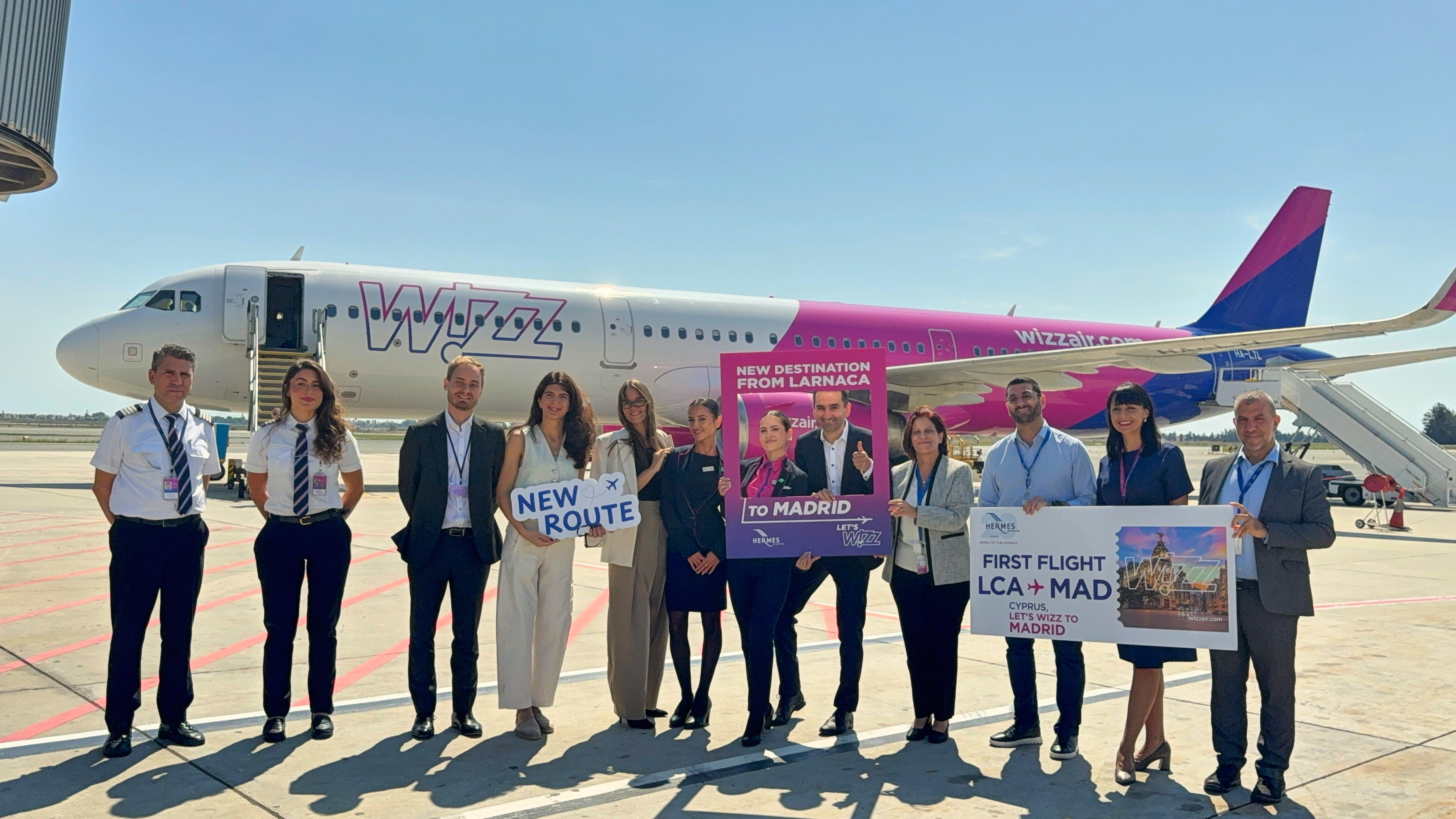
Wizz Air operated the inaugural Larnaca-Madrid flight on September 24, opening a direct connection between Cyprus and the Spanish capital after the airline had already established its Larnaca-Barcelona service.
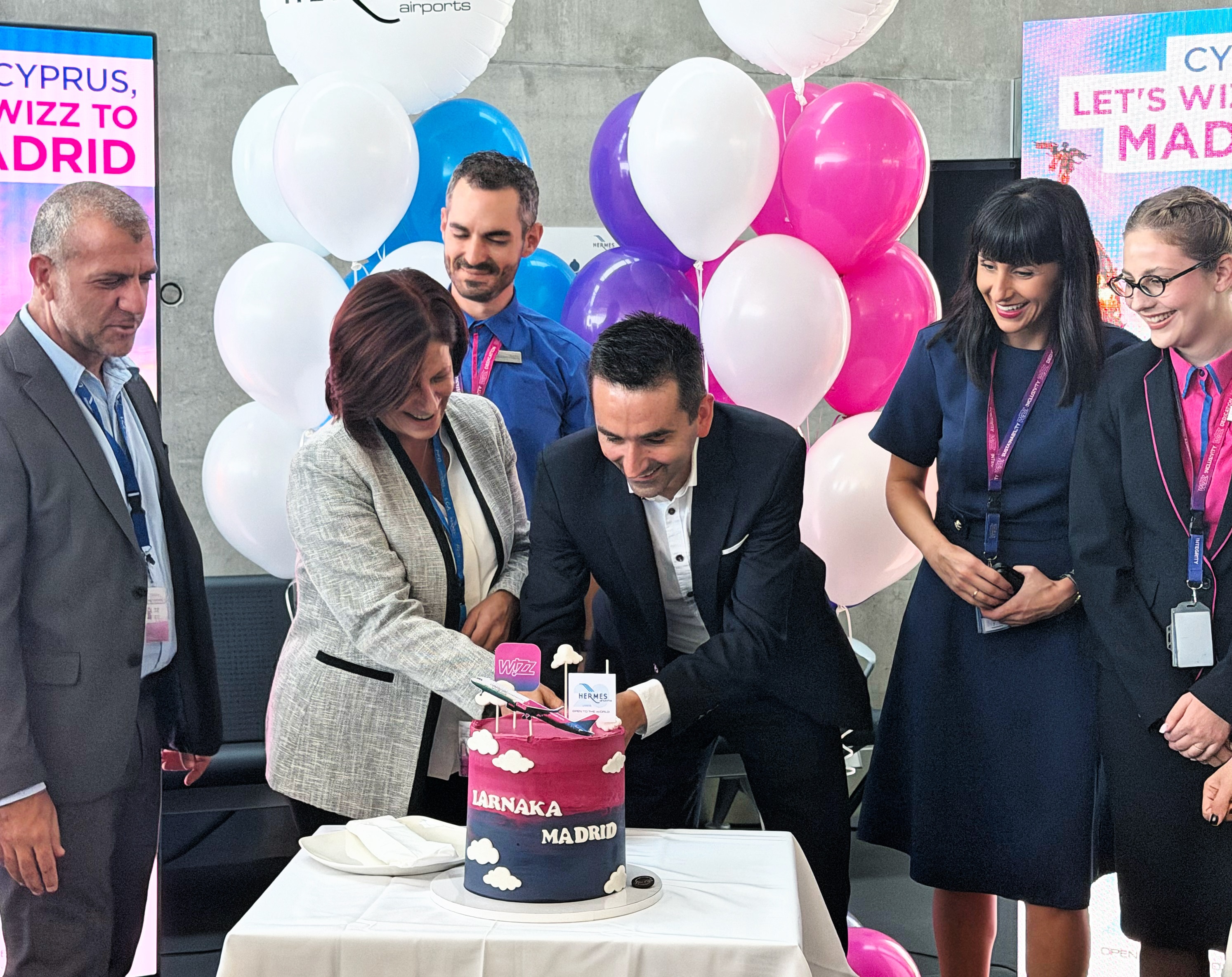
The Madrid route operates three times a week and was launched with an event at Larnaca Airport hosted by Hermes Airports, where passengers on the inaugural flight were offered refreshments before departure.
The new service was presented as a further expansion of travel options between Cyprus and Spain, with the route intended to support tourism, trade and business travel while adding to Larnaca’s European connectivity.
Maria Kouroupi, Director Aviation Development, Marketing & Communication at Hermes Airports, said that “the launch of the direct connection between Larnaca and Madrid is an important addition to our route network, further expanding the travel options available to passengers”.
“This new connection is the result of our consistent efforts and close cooperation with Wizz Air, a long-standing partner of Hermes Airports,” she added.
She further stated that the airport operator is “very happy to continue working together on the development of new routes and the further expansion of Cyprus’ air connectivity”.

Wizz Air opens Pilot Academy to Cyprus
Wizz Air has also extended its Wizz Air Pilot Academy to candidates in Cyprus, with a recent open day in Nicosia attracting dozens of participants interested in pursuing careers as pilots.
Szabo said the airline had been encouraged by the response and confirmed that some successful applicants would begin their training in October.
“We offer a clear, guided pathway to a career in aviation, from the very first application all the way to the flight deck through high-quality training and a defined employment prospect at Wizz Air,” he said.
He said the initiative was part of Wizz Air’s longer-term commitment to Cyprus and its aim of developing local aviation talent.
“Our plans with Cyprus are long-term,” Szabo said.
“We are committed to nurture local talent and to build a sustainable pipeline of future pilots in the region,” he added.
Finally, Wizz Air has also supported local initiatives including TELETHON’s Wings of Hope and sports activities aimed at promoting tourism.





Click here to change your cookie preferences