
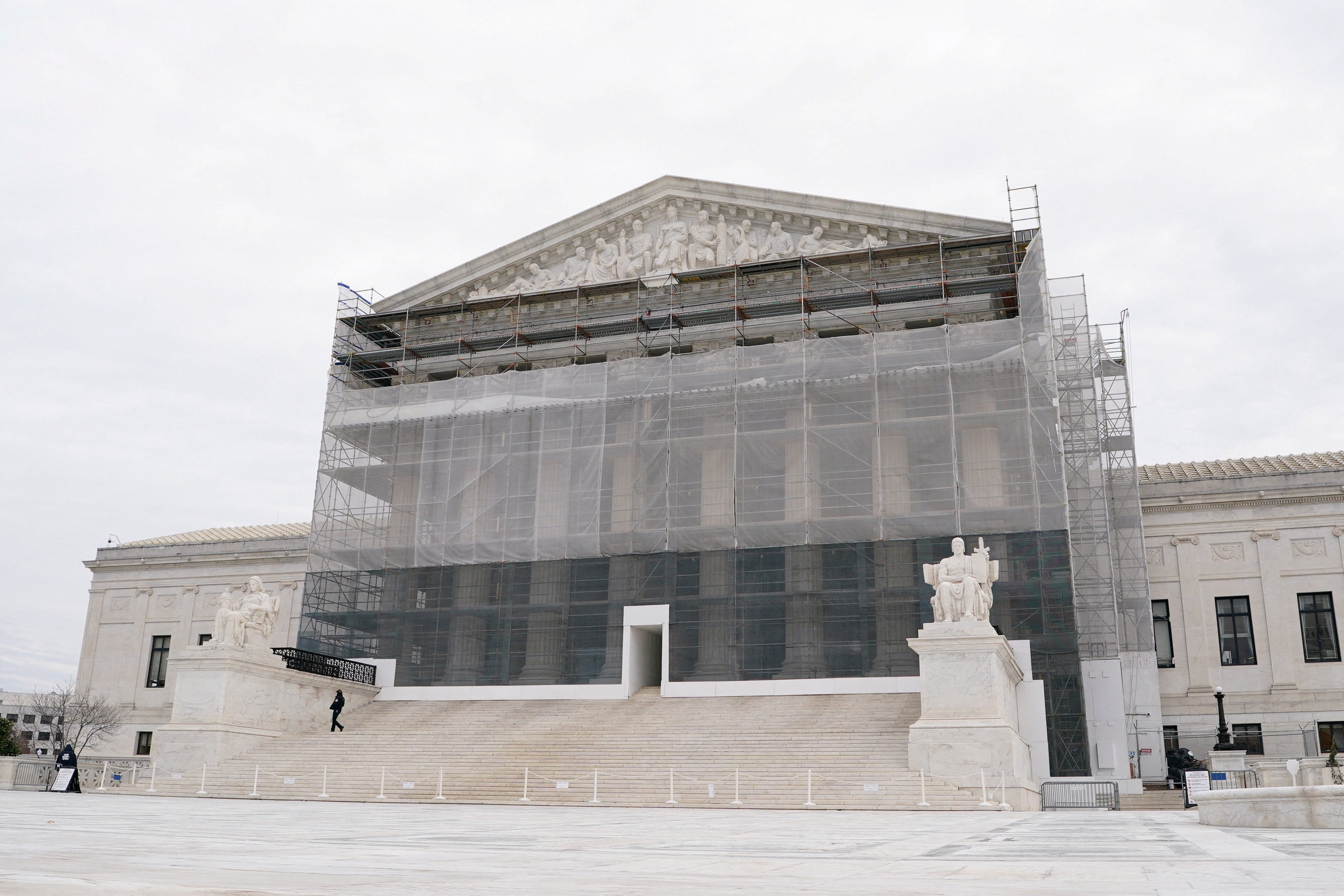
The US Supreme Court grappled on Wednesday with a bid by Alabama officials to pursue the execution of an inmate convicted of a 1997 murder who a lower court found to be intellectually disabled and thus ineligible for the death penalty.
The court heard arguments in the Republican-led state’s appeal of the lower court’s determination that Joseph Clifton Smith is intellectually disabled based on intelligence quotient, or IQ, test scores and expert testimony. Republican President Donald Trump’s administration is backing the state in the case.
Smith, now 55, was convicted and sentenced to death for the 1997 murder of a man named Durk Van Dam in Alabama’s Mobile County. Smith fatally beat the man with a hammer and saw in order to steal his boots, tools and $140, according to evidence in the case. The victim’s body was found in his mud-bound Ford Ranger truck in an isolated, wooded area.
Under a 2002 Supreme Court precedent, executing an intellectually disabled person violates the US Constitution’s Eighth Amendment prohibition of cruel and unusual punishment. The current case centers on whether and how courts may consider the cumulative effect of multiple IQ scores in assessing a death row inmate’s intellectual disability.
Robert Overing, a lawyer for Alabama, said the lower courts too readily accepted defense evidence seeking to downplay the fact that at least some of Smith’s IQ test scores were above the threshold for finding an intellectual disability.
“Here, every identified method of handling multiple IQ scores favors the conclusion that Smith is not intellectually disabled,” Overing told the justices, emphasizing that “IQ is the fruit of a multi-century enterprise to figure out the best possible estimate of intelligence.”
Overing faced pushback from some members of the court, which has a 6-3 conservative majority.
“I think what you’ve done is shift this to be all about the IQ test in a way that is not supported by our case law,” liberal Justice Ketanji Brown Jackson told Overing.
Like many states, Alabama considers evidence of IQ test scores of 70 or below as part of the standard for determining intellectual disability. Supreme Court rulings in 2014 and 2017 allowed courts to consider IQ score ranges that are close to 70 along with other evidence of intellectual disability, such as testimony of “adaptive deficits.”
Smith had five IQ test scores, ranging from a high of 78 to a low of 72.
A federal judge noted that Smith’s lowest score could in fact be as low as 69, given the standard error of measurement, or SEM, of roughly plus or minus three IQ points.
The judge then found that Smith had significant deficits from an early age in social and interpersonal skills, independent living and academics.
INTELLECTUAL FUNCTIONING
Seth Waxman, a lawyer for Smith, said the way the lower court determined the defendant’s intellectual capacity generally aligned with the approach taken by other US states with the death penalty.
“If there are multiple scores whose SEM ranges individually reach 70 or below, you consider other evidence that is relevant to intellectual functioning,” Waxman said. “That is a consensus.”
Conservative Justice Samuel Alito expressed skepticism at Waxman’s suggestion of a clear consensus view.
“How are we to determine what the national consensus is based on state court decisions that have struggled, that are struggling, to understand what this court has said” in prior decisions related to this issue, Alito asked.
The Atlanta-based 11th US Circuit Court of Appeals upheld the judge’s conclusions in 2023, setting aside Smith’s death sentence. This prompted Alabama officials to file the first of two appeals to the Supreme Court in the case.
The justices last year threw out the 11th Circuit’s decision, saying that the lower court’s evaluation of Smith’s IQ scores can be read two ways, and required clarification.
The 11th Circuit responded with an opinion clarifying that its evaluation was based on “a holistic approach to multiple IQ scores” that also considered additional relevant evidence, including expert testimony. This prompted the current appeal by Alabama officials to the Supreme Court.
Harry Graver, representing Trump’s administration, argued that the lower court erred by failing to properly weigh the competing evidence.
“Even if you look at other evidence (beyond IQ scores), you still need to circle back and see how that weighs against the evidence on the other side of the scale. And in this context, that is going to be the multiple consistent IQ scores together,” Graver said in response to questioning by liberal Justice Sonia Sotomayor.
The Supreme Court is expected to rule by the end of June.





Click here to change your cookie preferences