
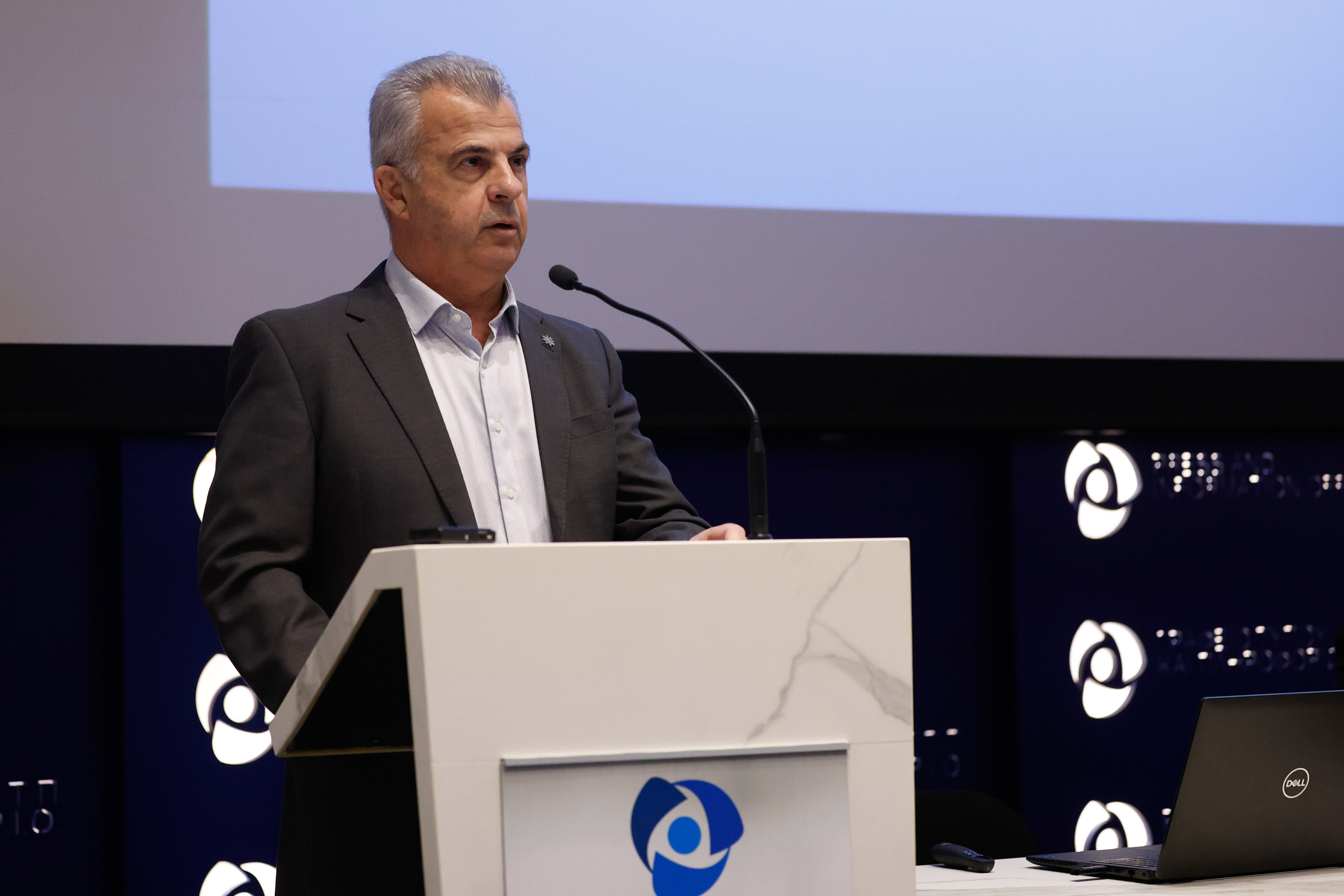
Justice Minister Costas Fitiris rejected claims that he threatened the Isotita union spokesman, Nikos Loizides, in a phone call last week with his union’s president, Prodromos Christofis.
Speaking during a press conference on Monday regarding organised crime and justice reform, Fitiris was asked to comment on Loizides’ public allegation that a senior cabinet figure threatened to “behead” him because of his trade union activity.
The minister declined to engage directly with the accusation.
“I do not wish to lower the level of conversation,” Fitiris remarked.
“This is a very serious press conference. Too much noise causes disturbance, and disturbance often causes disruption.”
He added pointedly that he would welcome clarification from police leadership.
“I would be very happy if the police-chief tells me that Loizides asked to be transferred to a front-line unit,” he said, referring to Loizides’ current posting as a spokesman.
Loizides has alleged that he was threatened by a high-ranking political figure in the cabinet, an allegation he has publicly linked to his union activities.
Speaking earlier this month, he said he received a phone call during which he was told “we will behead you”.
“Some people live in other times,” Loizides said in a recent television interview on Sigma.
“Times of ‘we stand against the wall’, we kill, we behead, we shoot. They ought to know that the junta is over”.
He added that the person involved “would do well to apologise”.
Loizides insisted that police officers have the right to trade union representation.
“For the public interest, there must be unionisation in the police,” he said, adding that he was prepared to give further details to EuroCOP.
The allegations have prompted sharp criticism from the union itself, with Isotita describing the alleged remarks as “absolutely condemnable” and calling on the justice minister to provide “clear explanations”.
The union stressed that police officers “are not soldiers of the state but workers with rights”.
Fitiris has neither confirmed nor directly denied the specific wording attributed to him, instead framing his response as an appeal for seriousness and institutional order.
His comments came as he unveiled a broad package of measures aimed at tackling organised crime and corruption.
“We have a duty to turn announcements into action, after almost 65 days at the justice ministry,” he said.
He stressed that “only through security, can freedom be ensured”.
Among the measures announced were the confiscation of assets linked to organised crime, the construction of new prison facilites on the outskirts of Nicosia, and the creation of an independent coast guard.
“The country needs to be freed from organised crime and corruption,” Fitiris insisted.
He outlined plans for a new prison complex on state land of around 500,000 square metres, with a capacity of 1,250 inmates.
The facility would be built with modern infrastructure and have an emphasis on reintegration of offenders back into society.
He affirmed that staffing procedures for correctional officers are already under way.
On policing, Fitiris said contracts supporting the force would be modernised ahead of Cyprus’ EU council presidency, while the fire brigade are to be reinforced with drones and modern equipment for improved fire management.
Addressing criticism that the state is failing to confront organised crime decisively, following revelations released on Sunday regarding alleged torture being committed by gang members, he said investigations require evidence.
“The state operates with laws and rules. We want testimonies that justify arrests,” he remarked, adding that without formal complaints and documentation, prosecutors cannot proceed.
On maritime security, Fitiris argued that threats are increasingly originating at sea.
“We must be prepared for terrorist activity, which often occurs by sea,” he said, defending the need for an independent coast guard.
Speaking separately on the same day, Fitiris was also asked to respond to allegations raised by Ioanna Fotiou, known publicly as Annie Alexui, whose social media posts have accused organised crime networks of operating unchecked and questioned the handling of complaints by the police.
“If there are rotten apples, we want to eliminate them,” Fitiris assured.
He said that videos circulating online must be assessed carefully.
“All the videos that are posted have two perspectives. One is the human aspect, what she has been through and narrates, and the complaints she makes about organised crime and even the internal affairs of the police,” he said.
Fitiris stressed that investigations depend on formal procedure.
“What needs to be done is to evaluate all the information and for the police and the prosecutor’s office to proceed with the necessary investigations,” he said.
“Without testimonies and without written statements, things will remain in the air.”
Asked whether authorities had sought testimony from Fotiou abroad, he said arrests had already been made in some cases, while others were released.
“The state operates with laws and rules, even when we do not like them,” he admitted.
He denounced any suggestion of political interference in investigations.
“Neither the political leadership nor anyone else can intervene in investigations,” he said, warning that bypassing legal safeguards would lead to “anarchy”.
Fitiris acknowledged shortcomings in existing legislation but said they must be addressed within the legal framework.
“Many times, the laws do not cover us and perhaps they should be corrected, but as long as they are in force, they must be respected,” he said.
On whether a police team would travel abroad to take a statement, he said states operate within regulatory frameworks and that the fight against organised crime “takes patience, planning and perseverance”.
“A lot is written on social media,” he added.
“There is political direction for issues to be examined, the police see certain things but I cannot say now whether it will work or not.”
He reiterated that the government remains committed to dismantling organised crime networks while preserving the rule of law, concluding that accountability must apply “to everyone, without exception”.
Shortly after Fitiris’ press conference, Nikos Loizides reiterated his allegations on state television, clarifying that the threat was not directed at him personally but at the president of Isotita, Prodromos Christofis, before being relayed to him.
“He told Christofis verbatim, ‘If I were Arnaoutis, I would behead Loizides tomorrow morning,’” Loizides insisted.
Regarding Fitiris’ retort that he be transferred to the front line, Loizides remarked that “the police-chief can transfer me to wherever he wants tomorrow morning. I will still be a union member. Whether my badge is on the front line in drugs or in the rapid response unit (MAAD), where I served for 14 years, I have seen loaded pistols in front of me. Some others who criticise me have not.”





Click here to change your cookie preferences