
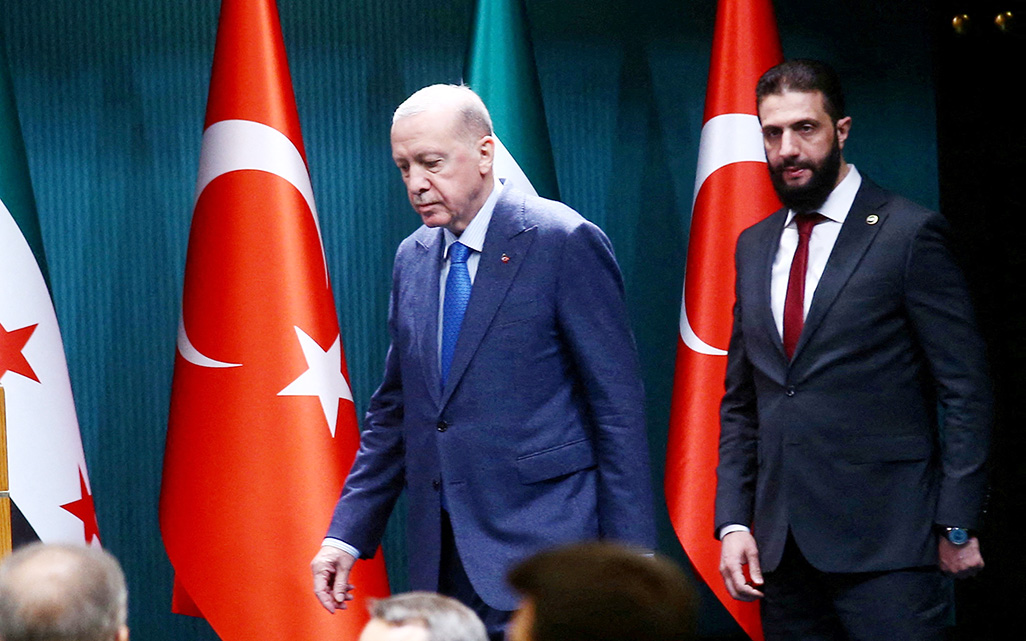
Turkey’s intelligence agency asked its British counterpart MI6 last month to take a larger role in protecting Syrian President Ahmed al-Sharaa after recent assassination plots, according to five people familiar with the matter.
The request highlights efforts by foreign allies to shore up a country still shaken by sporadic violence 15 months after the overthrow of president Bashar al-Assad, with the U.S.-Israeli war on Iran now rattling the wider region.
Those allies see Sharaa as crucial to preventing a relapse into sectarian fighting or civil war, after 14 years of civil conflict drove millions of refugees abroad and allowed Islamic State to control swathes of Syria.
The militants last month stepped up attacks on military and security personnel across Syria and declared Sharaa, a former rebel, their “number one foe”.
It was unclear what specifically Turkey’s National Intelligence Organization, or MIT, had asked of MI6, or what new role, if any, MI6 had taken up.
ANXIETY RISES IN SYRIA OVER ISLAMIC STATE
Turkey, Britain and the U.S. last year threw their backing behind Sharaa to try to reunite and rebuild his country of 26 million. London and Washington have scrapped most sanctions on Syria and on Hayat Tahrir al-Sham (HTS), the Islamist group he once led.
The sources who spoke to Reuters requested anonymity owing to the sensitivity of the matter.
MIT, the Turkish foreign ministry, Britain’s foreign office and Syria’s defence and interior ministries did not respond to requests for comment.
The sources, including Syrian and foreign officials, all cited rising anxiety over a series of reported Islamic State plots to kill Sharaa.
A Turkish source said that MIT, which has played a key role in helping the new government to establish itself, appealed to MI6 for more support after one such incident last month. A senior Syrian security source said the request came after a “high-risk assassination plot”, adding that MIT, MI6 and Syrian authorities were constantly sharing intelligence.
Details of the plot were unclear.
A separate Western intelligence source briefed on the matter believed Turkey wanted to introduce a Western presence in Damascus to provide something of a buffer between the agencies of Turkey and Israel, currently at loggerheads.
REPORTED ASSASSINATION ATTEMPTS AGAINST SHARAA
Last year, Sharaa and two senior cabinet ministers were targeted by Islamic State in five foiled assassination attempts, according to the U.N. Office of Counter-Terrorism. In November, Reuters reported that Syrian authorities had foiled two of the attempts.
Describing Sharaa as a “watchdog” of the global anti-Islamic State coalition, the group mounted six attacks on Syrian authorities last month in what it called a “new phase”.
On Thursday, Damascus openly acknowledged for the first time that it coordinates with MIT, saying they had cooperated to foil an Islamic State attack in the capital.
Turkish security sources said MIT had identified a team of three preparing remote bomb attacks, enabling Syrian counterparts to prevent an “imminent assault”.
A U.S. diplomat briefed on the matter said MIT’s request to MI6 had been prompted by the Islamic State resurgence.
The Western intelligence source said the two agencies could intensify joint planning and technical operations, but that no decision had been made on whether to send British personnel to Damascus.
A Syrian security source said a physical British presence would be “highly risky”. They said MI6 had been discussed at a meeting in Damascus on February 26 between a delegation headed by Britain’s special envoy for Syria, Ann Snow, and Syria’s deputy interior minister, Major General Abdulqader Tahan.
Sharaa was a commander of Al Qaeda’s Nusra Front in Syria before cutting ties with the group in 2016, then led a coalition of Islamist rebel factions in late 2024 to topple Assad.





Click here to change your cookie preferences