
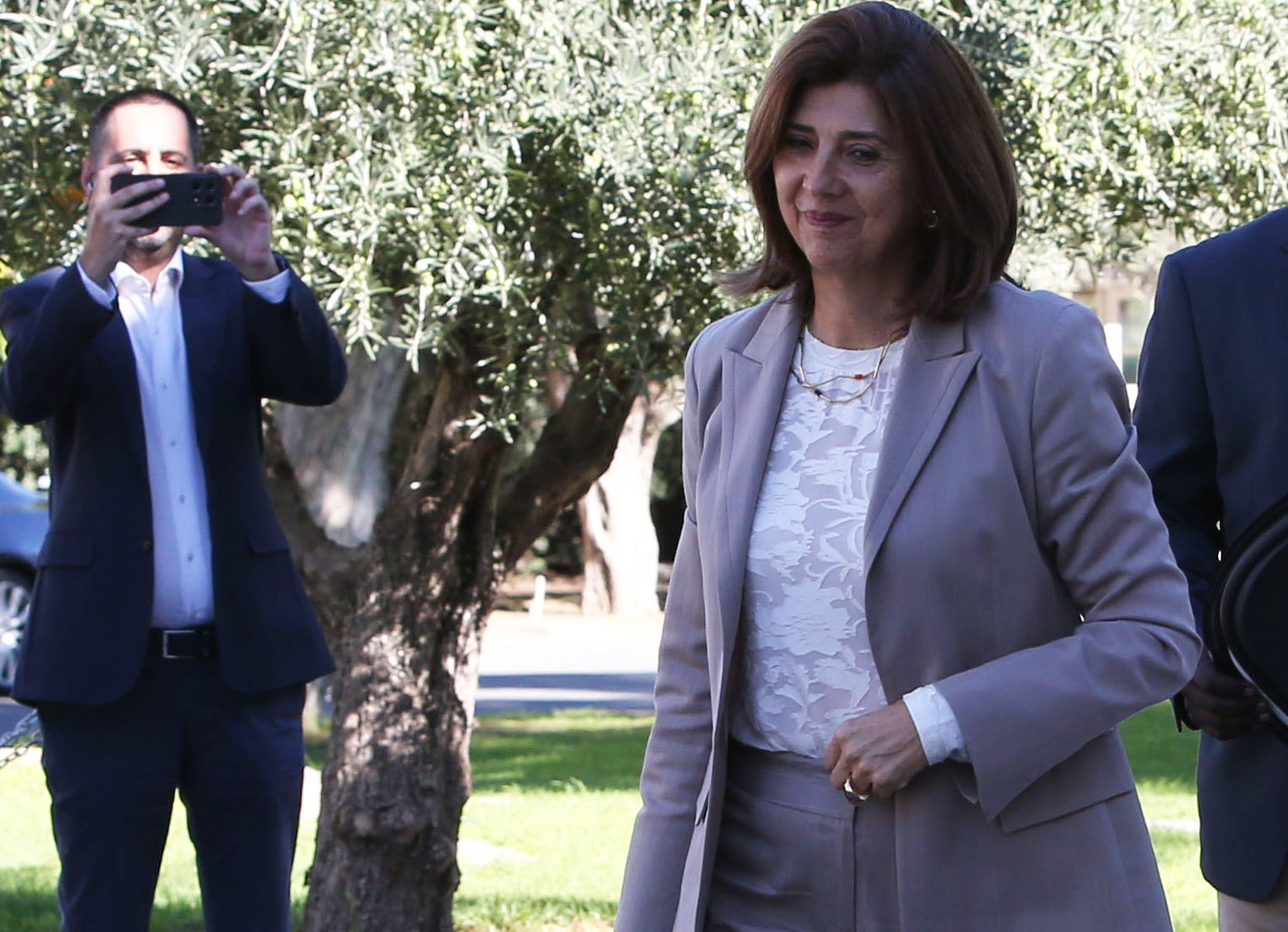
In Cyprus Mail interview, UN envoy Maria Angela Holguin questions president’s 19 points
United Nations Cyprus problem envoy Maria Angela Holguin has proposed that the island’s two sides commence negotiations in earnest without any preconditions.
In an interview with the Cyprus Mail, Holguin said the first issue addressed by President Nikos Christodoulides and Turkish Cypriot leader Tufan Erhurman should be the much-debated question of whether a post-solution Cyprus should have a rotating presidency, as a possible way to break the almost decade-long deadlock in the talks.
The Turkish Cypriot side has maintained that the premise of a rotating presidency must be accepted by all before negotiations begin, while the Greek Cypriot side’s position is that the matter should be decided during negotiations.
When asked by the Cyprus Mail whether that gap can be bridged, she said that the two leaders will “have to sit with each other and discuss” the issue, “because this is one thing which can block any effort. This is fundamental”.
“Maybe, why not think that you start negotiations without preconditions, but with the compromise that you are going to do it, the first point is that one, and so it is not like there would be months and months [of negotiations] and the last day is this one. On the contrary, start with this, and if it’s fine, continue, and if not, it’s over,” she said.
Starting negotiations with a matter of this magnitude would provide clarity regarding the sides’ intentions.
“We would agree on something that is very substantial, that is, to share power for this process. Before the negotiations, it is not so clear. It is not so easy to understand. But if there is an understanding that that is the first point of the agenda and if it is not [agreed], it is impossible, it’s over,” she said.
Asked whether she had put the idea to the leaders, she answered in the negative, but then added, “maybe on Monday”, when she is due to meet both Erhurman and Christodoulides.
‘Huge damage’ if current initiative fails
Nonetheless, she said, beginning negotiations is risky in and of itself. She warned that if the current initiative with the aim of bringing about a resumption of negotiations in earnest fails, “there is going to be huge damage”.
“This is why [UN Secretary-General Antonio Guterres] doesn’t want to go to a five-plus-one without being well prepared, and this is why he said this time has to be different, because the feeling is that each bad meeting divided the sides more,” she said.
The term “five-plus-one” is used to describe an enlarged meeting on the Cyprus problem, involving the island’s two sides, its three guarantor powers, Greece, Turkey, and the United Kingdom, and the UN. Holguin used the example of the most recent such meeting, held in New York in July last year, as evidence that a meeting which ends badly causes more damage than no meeting at all.
“It was a very bad meeting that, I think, divided [them] and took more time to put them together. More than that, in that meeting there was the first possibility of a crossing point, and today, we hope that they are agreed. It’s a year and a half, and I think that it was not a good meeting and it divided more,” she said.
On this front, she hinted that the question of where the next crossing points may be opened could be resolved at Monday’s trilateral meeting, saying that she would consider it a success if a “package of confidence-building measures” were agreed.
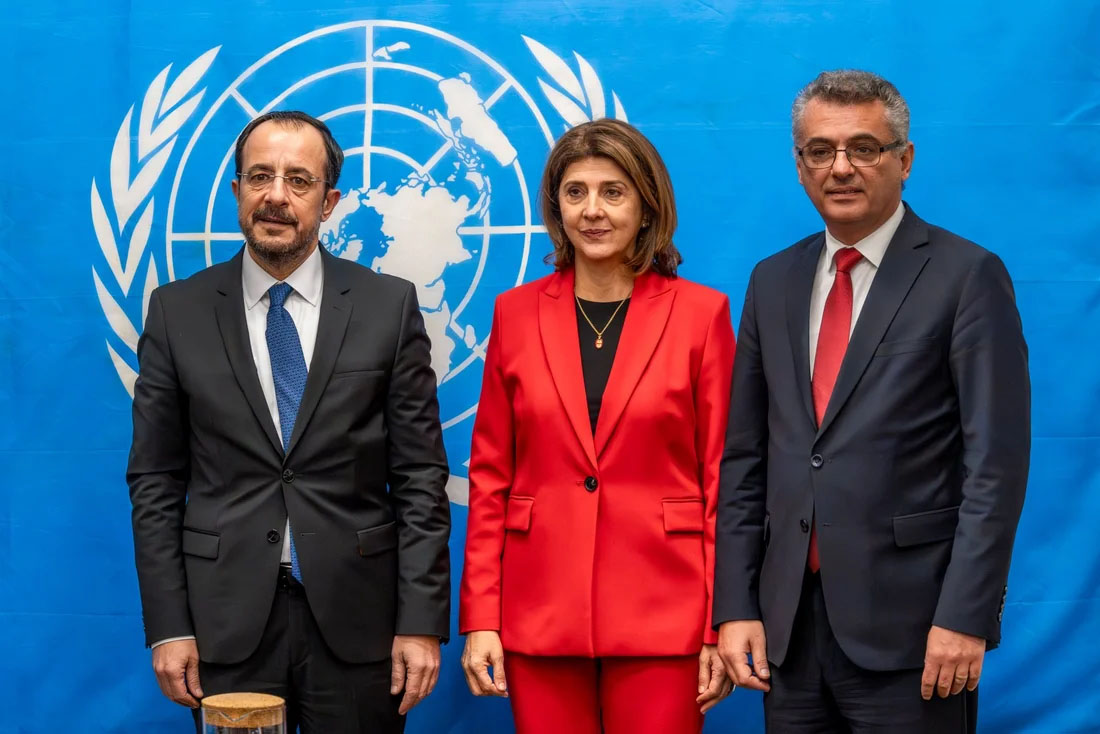
‘It is like time is not so important’ to Cyprus’ leaders
At the enlarged meeting which took place in March last year in Geneva, Guterres had announced plans to open four new crossing points, and Holguin told the Cyprus Mail that “this package is just to move it until now”.
“We spent almost a year and a half, but I think this is what is here. It is like time is not so important,” she said of the almost 20 months which have passed since the Geneva meeting.
Asked about the 19 points for discussion which Christodoulides put forward in September, Holguin said the president had not provided her with a written document setting them out.
“Do you know, he never just gave us a paper?” she said.
“He just mentioned, I cannot repeat how many, but it is like different things, like a big confidence-building measure like Varosha and Famagusta or trade, but small ones, that he’s going to the Pyla festival … Things big, small, or not a confidence-building measure at all,” she said.
Then beginning to count what is publicly known of the 19 points, she said that to her knowledge, three of the points were his and Erhurman’s recent joint meetings with the bicommunal technical committees on youth and cultural heritage, and the civil society steering committee.
“The Pyla festival makes four. To seeing the mayors of Nicosia’s project, this is five. You know, nothing, really, is a confidence-building measure,” she said.
Christodoulides’ ideas ‘could be good, but we have to finish other ones’
To this end, she stressed that a confidence-building measure would be “crossings, projects, something more which came from the meeting with the secretary-general in March in Geneva”.
“In that meeting, they decided, they agreed on four crossings, on a solar farm – that is over – environmental projects, cultural artefacts, the youth committee, the committee for civil society in supporting the process, and demining was the last one. So this is what they decided in Geneva, and this is what we are trying to push since,” she said.
As such, she said, “these new ideas Christodoulides has could be good, but we have to finish the other ones”.
Work on methodology will follow Monday agreement
However, she said, even if an agreement on confidence-building measures is reached on Monday, the work will not stop.
“After Monday, if we can get a package of confidence-building measures, we have to work on methodology,” she said.
On this aspect, she was critical of Erhurman, saying that “what Tufan calls methodology is not a methodology”, in reference to his own four points which he says must be fulfilled for negotiations to begin.
“The methodology of an agreement is like the procedural steps, a time frame, an agenda, what happens if it is blocked,” she said.
She then acknowledged that her hopes for progress to be made after Monday could be dashed by electoral politics.
“I think the campaign of the next year could make things more difficult and more complicated,” she said, referring to the fact that the 2028 presidential election campaign has effectively already begun.
In addition, she warned that should Monday’s meeting end without an agreement, “it is just a report to the new secretary-general that [Guterres] is going to give, and it is for the new secretary-general to decide”.
‘I don’t know’ if UN will ‘repeat’ Cyprus efforts after another failure
“It is going to depend on the leaders, but what I do not know is if for the UN, the UN has called for a solution and called for help and called for an envoy to come, and after years, nothing happened. I do not know if they are going to repeat it,” she said.
This, she said, “is why I tried so hard for something to happen on Monday”, because “if something happens, the process is alive”.
“It is the process of trying to get a process, but the effort is alive, so it’s easy for the next secretary-general to continue working on that, but if nothing happens on Monday, it’s like it’s over. I think I am optimistic that something could happen on Monday and maintain the process so it can arrive to the new secretary-general alive,” she said.
If nothing happens on Monday, “I am leaving”, but she said that, if an agreement on confidence-building measures is reached, there may still be time for an enlarged meeting to be organised before Guterres’ term in office draws to a close at the end of next month.
At the very least, she said, it could be “organised for the next secretary-general to do it”.
“I know that [Guterres] is out of New York, in Europe, and in many places this month, but maybe he can have time at the beginning of December and he could decide to call a meeting, but he has to be sure that it’s because there are really things decided.”
UN ‘learnt’ from ‘big mess’ of publishing 2013 convergences
Should the two sides reach a point at which negotiations can resume in earnest, they will be presented with a document listing the convergences reached in negotiations up to now, though the Greek Cypriot side had asked for that document to be made available immediately instead.
Asked why the document was held back, Holguin made reference to the convergences document prepared by former UN envoy Alexander Downer in 2013, which was presented to the leaders of the day, Nicos Anastasiades and Dervish Eroglu, before talks could begin.
“They did, they showed the parties, and it was a big mess, because they started to blame [one another]. ‘When did I do this?’, ‘When did I do that?’, ‘This is not true’. So, in the end, you divide more than you unify. This is not what the UN wants this time. We learned,” she said.
She added that “we did the document because they asked for the document, especially the Greek Cypriots, and we have it, for when they start negotiations”.
“The paper is going to be useful for the process. We put it there, but not so it can be leaked and they can start blaming [one another],” she said.
Cyprus’ region ‘more complicated’ than before
She also spoke on the matter of Cyprus’ guarantor powers, and stressed that they are there to “support” any process.
“This is why the five-plus-one is like a compromise, for them to accompany the leaders’ decisions. The problem is also with this new regional situation. We had for a moment, especially in 2024, very good relations between Turkey and Greece. Now, it’s not the case. Now, it’s a little bit more complicated,” she said.
Additionally, she said, “we now have this regional issue with Israel, so it’s a little bit more complicated, the situation of asking the support of some guarantor powers for the Cyprus issue.”
Then asked whether these more strained relations in the region are making matters more difficult for a potential Cyprus solution, she said that “I’ll take it from the other side – with the guarantor powers closer, it could be easier”.
Click here to change your cookie preferences