
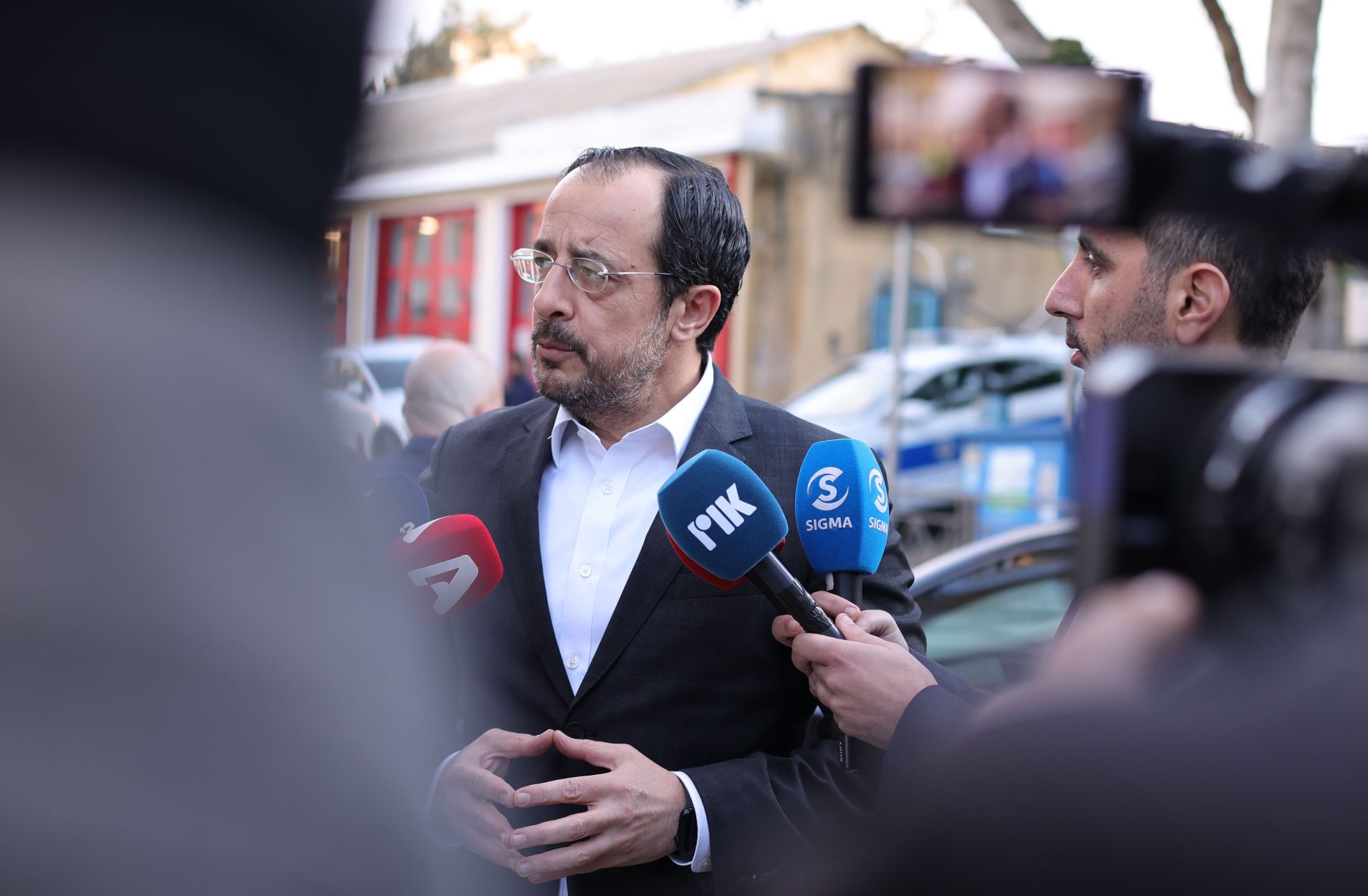
President Nikos Christodoulides will tell the leaders of other European Union member states of a need for the bloc to achieve further strategic autonomy when the European Council convenes later this week, government spokesman Konstantinos Letymbiotis said on Tuesday.
“He will highlight the imperative need to strengthen the union’s strategic autonomy, to strengthen European security and defence, and to highlight the importance of a Europe which operates with unity, speed and efficiency,” he said.
He added that Christodoulides will also “underline the role of the Republic of Cyprus as a reliable partner and a pillar of stability in the eastern Mediterranean and the Middle East”.
This call will come with multiple EU member states, including including Greece, France, Italy, Spain and the Netherlands, having deployed military assets to Cyprus and its vicinity in the aftermath of an Iranian-made drone hitting the island’s British Akrotiri air force base.
On this matter, Letymbiotis said on Tuesday that “the practical mobilisation and the immediate reflexes demonstrated highlight, in the most substantial way, European unity in practice, and confirm that Cyprus is at the forefront of Europe”.
He added that “in this context, a strong political message with particular symbolism clearly emerges”.
“Cyprus is not on the edge of Europe, but at the point at which Europe proves its role. Europe is the decision to stand together, and the support for Cyprus was a reminder of what Europe means,” he said.
Following the drone strike, Cypriot member of the European parliament Costas Mavrides, of Diko, had called for a permanent stationing of EU military force on the island.
“The last few years, we have seen the war in Ukraine, and now the war in Iran. We need to go beyond national armies. We need [an] EU defence mechanism to protect Europe; a regional EU defence. A permanent representation of EU forces in Cyprus is the first concrete step,” he said.
Meanwhile, Cypriot European Affairs Deputy Minister Marilena Raouna had told a European parliament plenary session that “for Cyprus, the situation is not theoretical”.
“Our geography connects us directly to the region, and it connects Europe to this region. From the corner of our union, it is abundantly clear what is at stake,” she said, before adding that last week’s drone strike “demonstrates how quickly and indiscriminately [conflict] can spread”.
Even before the drone strike and the outbreak of the conflict in the Middle East, the Cypriot government had championed the idea of a more autonomous EU, particularly with regard to its defence sector.
Commerce Minister Michael Damianos had last month called for a stronger European single market with the aim, among other things, of using its benefits to bolster the EU’s defence sector.
Following an informal European competitiveness council (Compet) in Nicosia, he said that he and his counterparts had “underlined the growing strategic importance of the defence sector for Europe’s security and resilience”.
“A key priority is to bridge the gap between research and production on an industrial scale. The smooth functioning of the single market is essential in this regard, especially for small and medium-sized businesses in the defence sector,” he said.



Click here to change your cookie preferences