
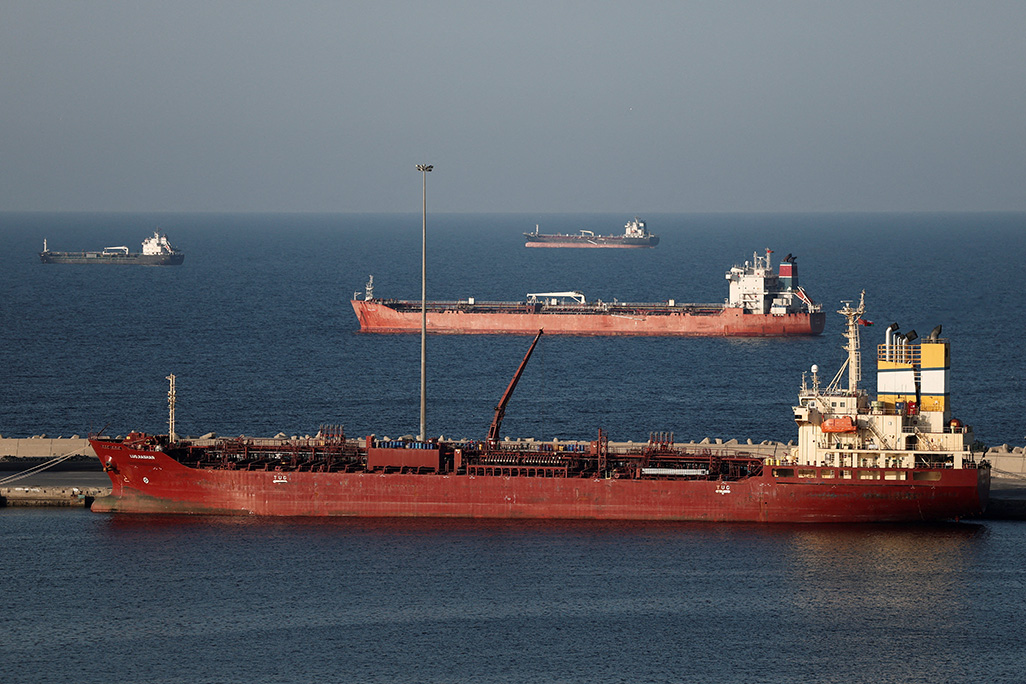
Foreign ministers from more than 40 countries were updated on the International Maritime Organisation’s (IMO) response to the situation in the Strait of Hormuz during a virtual meeting hosted by the United Kingdom’s Foreign, Commonwealth and Development Office (FCDO).
During the meeting, IMO Secretary-General Arsenio Dominguez urged States to support diplomatic efforts aimed at securing the evacuation of around 20,000 seafarers still stranded in the Persian Gulf and enabling humanitarian corridors for urgent assistance.
At the same time, he called on all parties to respect the rights and freedoms of navigation and stressed the paramount importance of the safety and wellbeing of seafarers.
He also made clear that de-escalation and operational maritime solutions were needed, rather than purely military approaches.
“Fragmented responses are no longer sufficient to resolve this crisis,” he said following the meeting, adding that “what is urgently required is diplomatic engagement, practical and neutral solutions, and coordinated international action.”
In this context, he added that “IMO is advancing a maritime evacuation framework built on coastal State cooperation, security guarantees and operational coordination,” with the clear objective of releasing stranded vessels, enabling safe crew rotations and preventing an environmental disaster.
Since the beginning of the conflict on February 28, 2026, IMO has confirmed 21 attacks on commercial shipping, resulting in the deaths of 10 seafarers, while several more have been severely injured.
Meanwhile, around 20,000 civilian seafarers remain aboard vessels in the Persian Gulf, facing dwindling supplies, fatigue and severe psychological stress.
Following an extraordinary session of the IMO Council on March 18 and 19, 2026, the organisation has undertaken a number of key actions.
As regards safe passage for seafarers, ongoing discussions are being held by the IMO Secretary-General and representatives of the relevant States on the development of a safe passage framework to evacuate seafarers currently stranded in the Persian Gulf.
In parallel, IMO is engaging with States in the region that have stepped forward to secure supply lines to ships and facilitate humanitarian access for seafarers. Focal point information is available on IMO’s dedicated webpage.
Moreover, the IMO website now features an online hub containing verified information on ship attacks, guidance from key industry bodies and international partners, contacts for stranded seafarers, as well as resources related to the global economic impact.
Alongside this, IMO is maintaining close communication with industry bodies including BIMCO, ICS, ITF, INTERTANKO and WSC, among others, in order to share information and coordinate action where necessary.
In addition, IMO is a member of a new dedicated task force established by the UN Secretary-General to work on technical mechanisms specifically designed to meet humanitarian needs in the Strait of Hormuz.
The task force is led by Under-Secretary-General Jorge Moreira da Silva, executive director of the United Nations Office for Project Services (UNOPS), and includes representatives from the UN Conference on Trade and Development (UNCTAD), the International Chamber of Commerce (ICC) and others, alongside IMO.




Click here to change your cookie preferences