
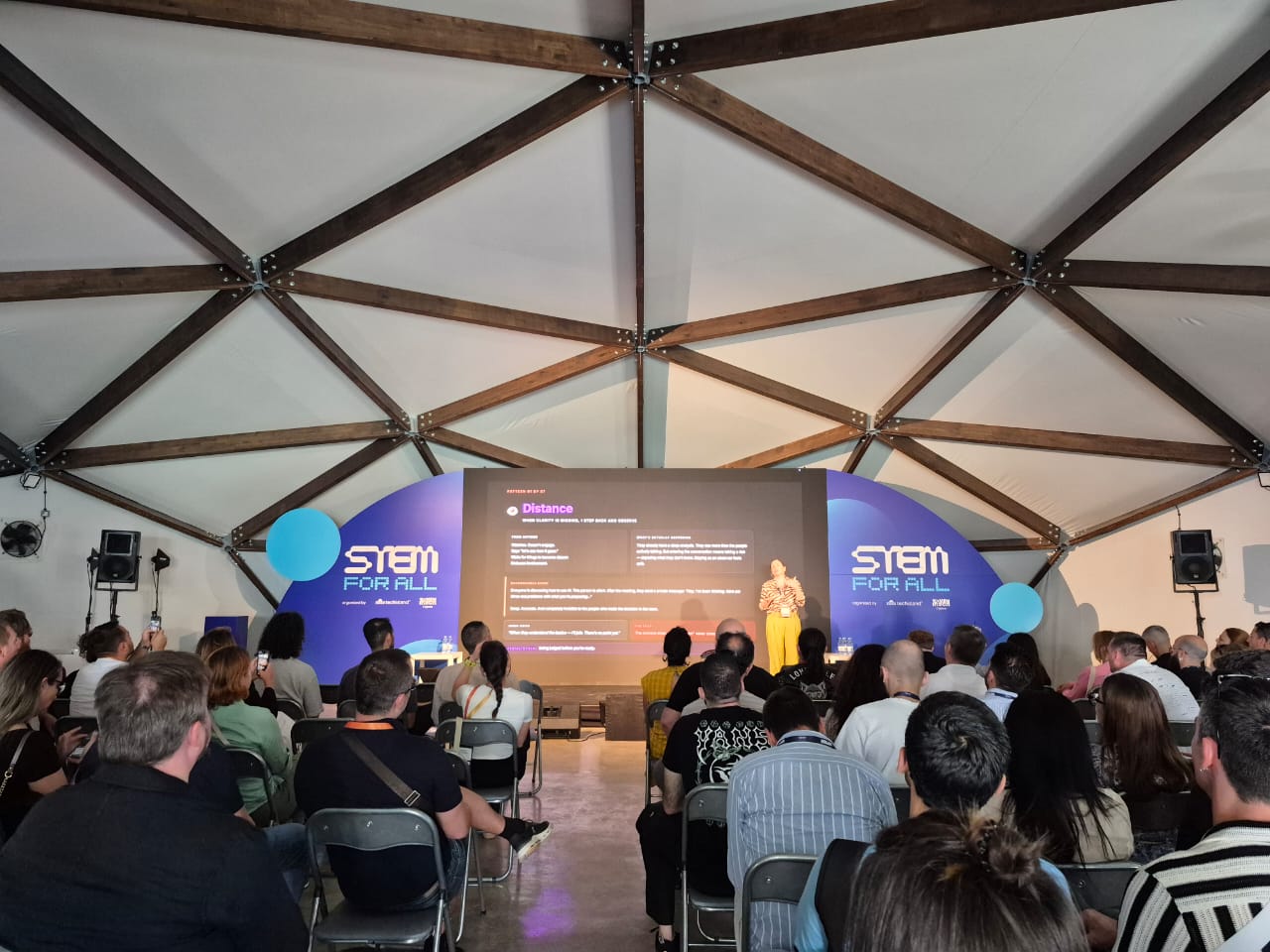
Aleksandra Sulimko, COO of TheSoul Group, said organisations do not get stuck because they lack tools, strategies or technology, but because of how people react when uncertainty becomes uncomfortable.
Speaking during a keynote speech titled ‘Mindset Is Not What You Think’ at the Doers Summit in Limassol, Sulimko said the real challenge in business transformation, particularly in the age of artificial intelligence, is not only whether companies can adopt new tools, but whether people can recognise their automatic reactions when they do not know what to do.
For Sulimko, mindset is not about attitude, beliefs or motivational slogans. It is about behaviour under pressure.
Drawing on what she described as three worlds, the emergency room, psychotherapy and corporate leadership, Sulimko said one conclusion had become clear across all of them. “We don’t get stuck because we lack tools. We get stuck because of how we react,” she said.
That idea shaped the rest of her keynote, as she linked AI transformation not only to systems, strategy or technology, but to how people behave when pressure, ambiguity and fear arrive at the same time.
Sulimko also referred to the scale of TheSoul Group, which she said has 5 billion subscribers across the group, 10 billion monthly views, 45 media awards, 15,000 influencers, 15,000 videos produced and published daily by in-house teams, and 60 platforms. She also pointed to the group’s YouTube awards, including 34 Diamond Buttons, 303 Golden Buttons and 646 Silver Buttons.
For Sulimko, leading transformation at that scale is not only about having the right strategy or technology. It is also about understanding how people respond when the pace of change becomes faster than their sense of safety.
Turning to artificial intelligence, she said AI has made every individual 10 times more productive, but most organisations have not become 10 times more valuable. The question, she said, is where that productivity has gone.
According to Sulimko, it disappears into the gap between individual speed and collective reaction. That gap, she said, is made of human behaviour, not technology. This, she argued, is why many companies are misreading the AI challenge. “You don’t have an AI problem. You have a reaction problem,” her presentation said.
Technology itself is not what slows organisations down, Sulimko said. The real issue is how people behave when they do not know the answer. In practice, she said, even when the tools are available, organisations can still freeze, overanalyse, delay decisions, protect old habits or move in ways that look busy without creating real progress.
The deeper tension, according to Sulimko, is that companies are accelerating systems faster than people can find their place in them. Companies may tell employees “We are going into AI,” “We need speed,” and “Think differently.” However, Sulimko said people often hear something very different: “You will be replaced,” “You are already behind,” and “You are not valuable enough.”
That gap between what companies say and what people hear, she said, helps explain why AI transformation can create fear instead of movement. Sulimko described this anxiety as FOBO, or the fear of becoming obsolete. It is, she said, the feeling of falling behind in real time, while the window to stay relevant appears to be closing, even as people are still trying to understand what “relevant” means.
For organisations, this fear matters because people who feel replaceable do not necessarily become faster, braver or more creative. Often, they try to protect themselves. Sulimko then returned to the central message of her keynote. “Mindset is not what you think,” her presentation said. She defined mindset as “how you behave when you don’t know what to do.”
Mindset, she said, is not attitude and not beliefs, but behaviour in a specific moment of uncertainty. Crucially, that behaviour is observable, predictable, and can be changed. Using the emergency room as an example, Sulimko said there is “no pause button” when pressure is immediate. In that environment, she said, the quality of a person’s reaction under pressure is not talent, but a trained skill.
Everyone, she said, has a pain threshold for uncertainty. Once people cross it, their reaction fires automatically. That pattern, she added, is not a choice, but a release valve. From there, Sulimko outlined the automatic patterns people fall into when clarity is missing, beginning with distance.
Sulimko said distance appears when a person steps back and observes. From the outside, this may look like disengagement, delayed answers, waiting for things to become clearer and reduced involvement. Underneath, however, she said something else may be happening.
The person may already have a deep analysis, see more than others, and fear exposing what they do not know. The inner voice behind this pattern, according to her presentation, is “When they understand the basics, then there’s no point yet.” The trap, Sulimko said, is that the moment when there “is a point” never comes.
The second pattern is control, which appears when clarity is missing and a person responds by looking for more data. From the outside, this may look like asking for more information, building comparison tables, delaying decisions and double-checking everything.
Underneath, however, anxiety is being converted into activity. Gathering information makes people feel less out of control, while data becomes something they can do when emotions feel frozen. The inner voice behind this pattern is “When I have enough information, I will make the right decision. Just a little more.” The trap, Sulimko said, is that enough never comes, and information becomes a replacement for action.
The third pattern is responsibility, which appears when clarity is missing and a person takes everything on themselves. From the outside, it may look like hard work, stabilising others, refusing to delegate and suppressing personal needs. But underneath, she said, being needed can feel safe.
Taking on more proves value, while a quiet fear remains that if the person stops being indispensable, they may not be chosen. The inner voice behind this pattern is “If not me, who? Nobody else here can do it.” The trap, she added, is that someone else can do it, just not in the same way.
Sulimko also pointed to four more patterns: power, connection, vigilance and dependence. Power, she said, appears through fast decisions, confidence and the downplaying of uncertainty. It can protect people from the appearance of weakness, but its trap is blind spots.
Connection creates energy, starts workshops and pulls people in. It protects against isolation and irrelevance, but its trap is form over outcome. Vigilance scans for risk and sharpens analysis. It protects people from being caught off guard, but can leave them isolated in what her presentation described as a lonely zone.
Dependence waits for a signal, agrees and does not initiate. It protects people from the risk of being wrong, but its trap is the absence of autonomous action.
Together, Sulimko said, these reactions show why people in the same organisation can respond to the same uncertainty in completely different ways.
However, she stressed that these patterns are not personality types. “They are survival strategies,” her presentation said. They are not good or bad, she said. They once worked and protected people. The question is whether they still help.
For Sulimko, this is where real change begins. If people know their first reaction, they can choose their second. She then connected individual reactions to organisational speed. “A company doesn’t move at the speed of strategy,” she said, adding that “It moves at the speed of its reactions.”
Every automatic reaction, she added, teaches the company “how fast to move, what feels safe, and what to avoid.” This, she said, explains why organisations can have ambitious strategies, powerful tools and clear priorities, but still move slowly.
The strategy may call for change, yet the reactions inside the company may teach people to wait, protect themselves, avoid risk or look for more certainty before acting.
Sulimko said the mechanism for change begins with awareness. Her presentation showed the sequence reaction, awareness, choice, action. Awareness, she said, does not remove the reaction, it adds a pause, and that pause, according to Sulimko, is where choice lives.
Closing her keynote, Sulimko said awareness creates choice, and choice breaks the pattern. She said the speed of people’s reactions to uncertainty decides the speed of change. Before leaving, she asked people to notice their first reaction this week when something about AI feels unclear.




Click here to change your cookie preferences