
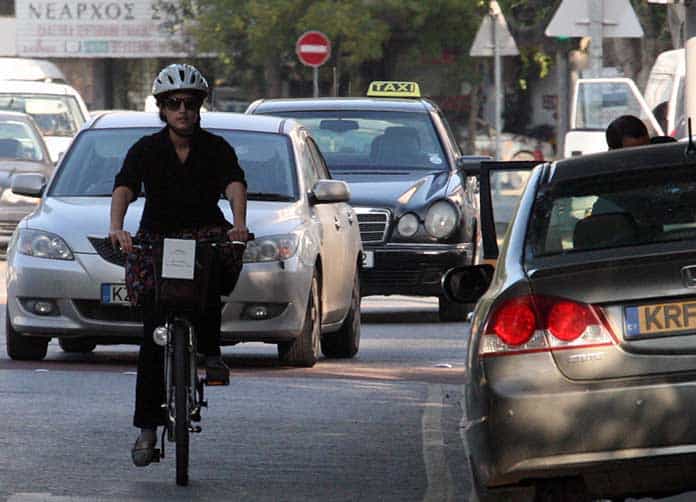
Limassol’s mayor Yiannis Armeftis acknowledged that the city’s new cycle lanes may look “unsightly” but are essential for promoting alternative transport.
He stated that the municipality will address issues and suggest improvements.
The project, overseen by the department of public works, follows a sustainable urban mobility plan approved by both past and current councils.
This addresses residents’ complaints about the protective barriers along cycle lanes on streets such as Thekla Lysiotis, Emmanouel Roidis, Nikos Pattihis and near the court, where concerns about aesthetics and road impact have been noted.
Armeftis said the aim of the project is to promote safer cycling and reduce reliance on private cars.
“The city’s traffic problem cannot be solved when 90 per cent of the people travel in private cars,” he said.
He added that the protective barriers, often described as “pasalakia”, were installed to ensure cyclist safety, even if they affect the visual character of the streets.
However, he acknowledged public concern over aesthetics.
“There is certainly an issue of unattractiveness,” he said, adding that the municipality would assess how the infrastructure could be improved or adjusted.
“We will see how this can be made more attractive and, if there are excesses, we will try to change them or even remove them where necessary,” he said.
He stressed that once the department of public works completes its interventions, the municipality will evaluate the situation on the ground and implement corrective measures.
These could include widening pavements, adjusting street layouts, or creating short-term parking spaces to ease pressure on local businesses.
“We listen to the public, we take their concerns into account, and we are here to help shopkeepers,” he said, adding that transition projects inevitably come with difficulties.
Armeftis stated that the cycle lane network should be part of a wider mobility strategy, which includes planned one-way systems and pedestrianisation south of Makarios avenue.
He claimed some critics politicise the issue, with reactions often coming from groups resistant to changes in the city centre, unfairly targeting municipal leadership.
Despite the criticism, he said, the municipality remains committed to delivering practical solutions.
He said 23 proposals have already been submitted to the authorities, with additional plans under preparation for wider improvements to the road network.
“Our goal is not theory but solutions,” he said, adding that traffic congestion in Limassol requires structured planning and coordinated action with state authorities.





Click here to change your cookie preferences