
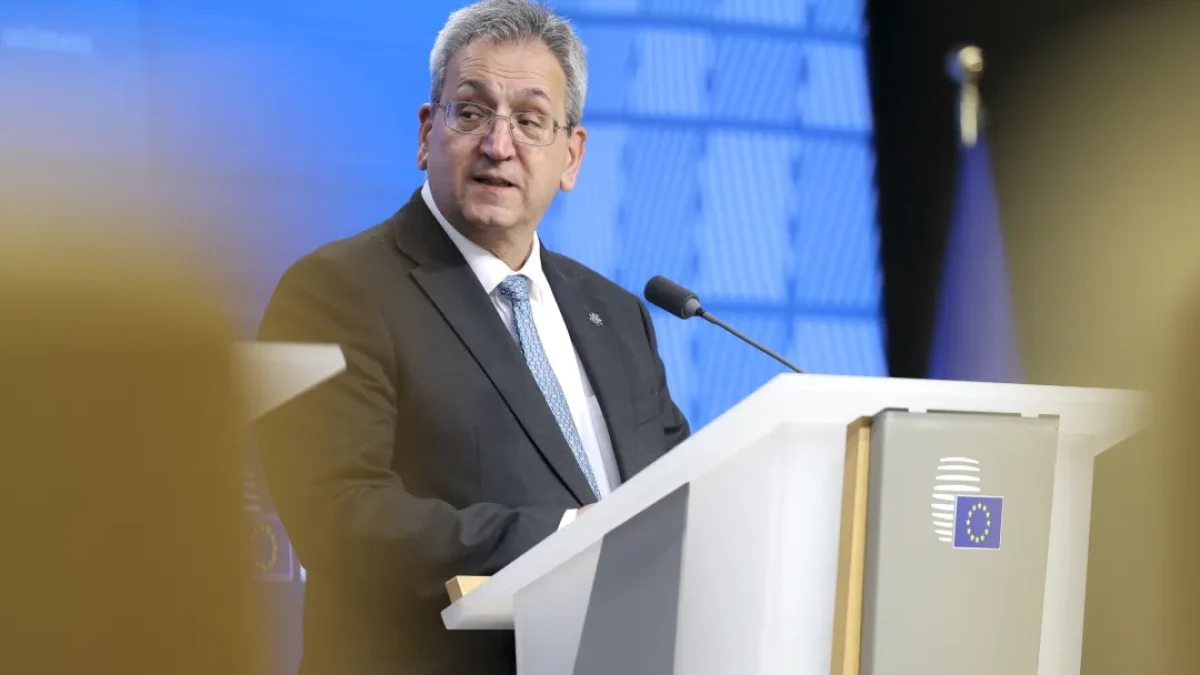
The government’s long-awaited pension reform bill will be submitted to the House of Representatives on September 20 regardless of whether an agreement is reached with social partners, Labour and Social Insurance Minister Marinos Mousiouttas said on Wednesday.
Speaking at an event organised by the Achilleas Kaimakli sports association on the future of the Social Insurance Fund and pension reform, Mousiouttas described the overhaul of the first pillar of the pension system as “the most important and emblematic priority” of the government for 2026 and “a conscious act of social justice”.
The reform package is expected to come into effect on January 1, 2027.
“Regardless of whether a final agreement is reached with everyone before September, the legislation will be submitted to parliament so that discussions can begin with the legislative branch, because parliament has the final say,” Mousiouttas said.
The minister said he would soon begin a round of meetings with parliamentary parties to explain the technical aspects of the proposed legislation, with the support of the government’s actuary.
The aim, he said, is for political parties to fully understand the advantages, disadvantages and implications of the reform package before the legislation is formally tabled in September.
Mousiouttas said it would be preferable for social partners to reach broad agreement before discussions begin in parliament.
“It would be much better for everyone if the social partners agree, or at least reach consensus on most issues, so that we can speak with one voice when discussing the matter with parliamentary parties. If that does not happen, we will proceed and everyone will have to assume their responsibilities,” he said.
Regarding the ongoing dialogue with employers and trade unions, the minister said there was broad agreement that the current system required reform.
“There is a system that everyone, absolutely everyone, agrees needs to change. The differences concern how much we will give and to whom we will give it,” he said.
Outlining the main features of the proposed reform, Mousiouttas said the government’s priority was to improve pension adequacy and reduce the risk of poverty.
“Our goal is to increase the basic pension to the maximum extent possible without affecting the capabilities and sustainability of the Social Insurance Fund,” he said.
According to the minister, the largest increases will benefit low and middle-income pensioners.
“In several of the lowest pension categories, the increase will approach 50 per cent of the current pension, while middle-range pensions will also see double-digit increases,” he said.
The increases will be introduced gradually over five years, with 60 per cent of the increase being paid during the first two years following implementation.
Responding to reports circulating publicly, Mousiouttas said minimum pensions would not reach figures such as €1,088, €1,100 or €1,200.
“I wish I could tell you that pensions would reach €1,500 or €2,000,” he said. “But when you have a fund where contributions by employees, employers and the state remain unchanged, and the retirement age also remains unchanged, then the benefits that can be provided are specific.”
He added that the government remained open to proposals from employers and trade unions, provided they were properly documented financially and conceptually.
Mousiouttas said the retirement age would remain unchanged at 65, but individuals would be given the option of continuing to contribute until the age of 67 in order to increase their future pension entitlements.
The government is also proposing a substantial reduction in the actuarial penalty applied to those retiring before the age of 65, which, according to the minister, would benefit both current and future pensioners during the transition period.
Referring to proposals to abolish the existing 12 per cent reduction, he said such a move would effectively lower the retirement age from 65 to 63.
“In no European country is the retirement age being reduced; on the contrary, it is increasing. We have said that it should remain stable at 65. Every proposal must be accompanied by the corresponding financial and philosophical justification,” he said.
The reform would also extend coverage to new entrants to the labour market, informal carers, women who dedicated their lives to caring for their children and persons with disabilities through the recognition of subsidised contributions.
Measures aimed at supporting families and vulnerable groups would include increases in most disability and widow’s pensions, calculated on the basis of the new basic pension, improvements to allowances for dependent children and higher orphan benefits.
In addition, entitlement to sickness and unemployment benefits would be extended beyond the age of 63.
Mousiouttas also highlighted changes concerning the management of the Social Insurance Fund’s reserves, which currently amount to €12 billion.
“One of the most important decisions taken by the government is that state borrowing from the fund will stop,” he said, adding that the gradual repayment of existing borrowing would begin.
He also announced the creation of an independent supervisory authority, fully aligned with European requirements, which would oversee the management and investment of the fund’s reserves.
The Social Insurance Fund, he said, would evolve into “a strong investment fund working for the benefit of the insured themselves”.
On reforms to the second pillar of the pension system, which concerns occupational pension schemes and provident funds, the minister said discussions were continuing but acknowledged that implementation would require a further three to four years.
“Trade unions want participation to be mandatory, while employers want it to remain voluntary, as it is today. The state must find the golden mean between the two so that agreement can be reached,” he said.
Despite the complexity of the issue, Mousiouttas expressed optimism that consensus would eventually be achieved.
“The effort is focused on reaching agreement, which does not mean immediate implementation,” he said. “It has been accepted that implementation will take place after three to four years. There is a clear understanding that agreement on the system must come first, followed by the legislation, the supervisory authority and all the necessary preparations.”





Click here to change your cookie preferences