
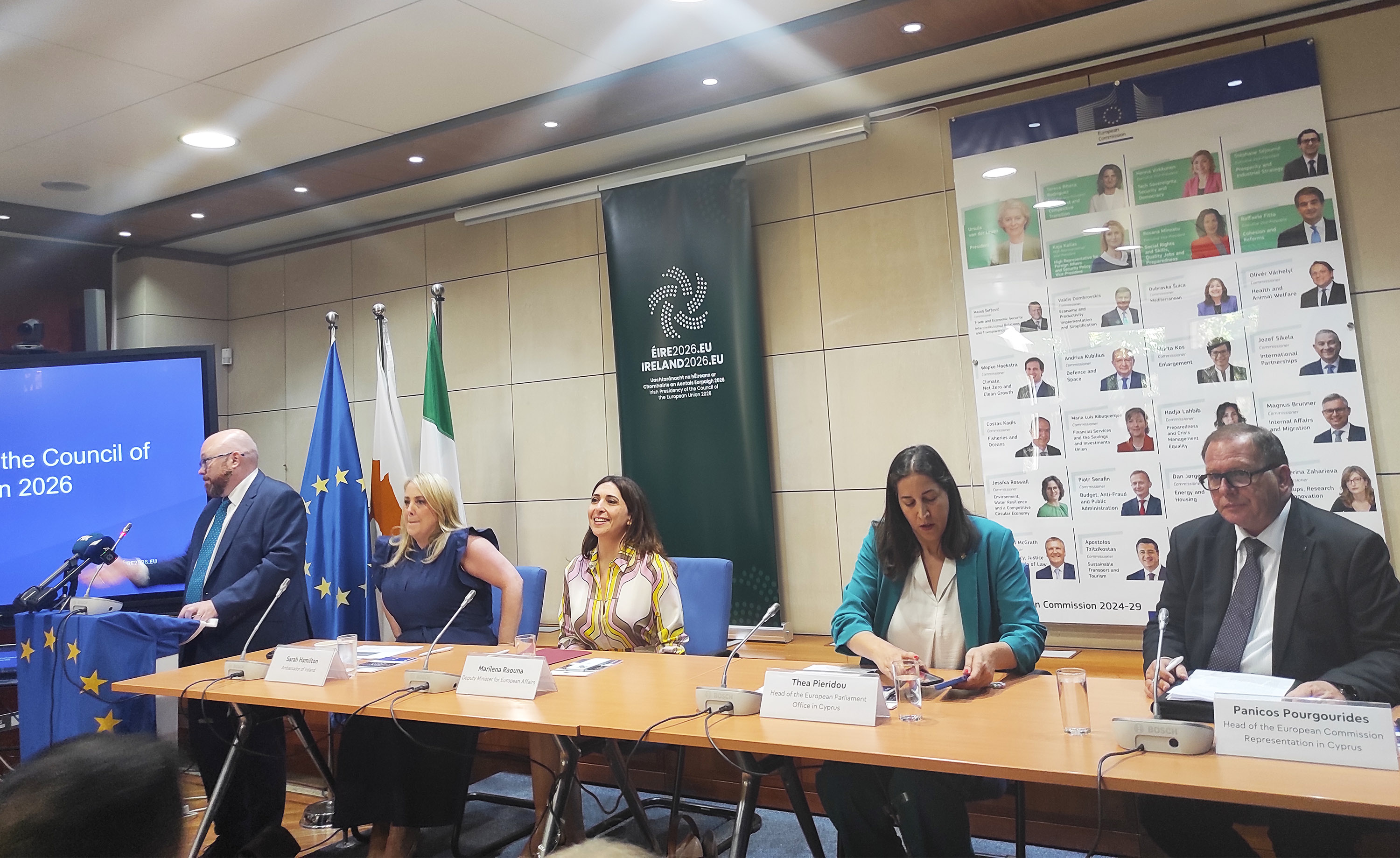
European Affairs Deputy Minister Marilena Raouna on Thursday spoke of the “particular joy” Cyprus takes in being succeeded by Ireland as the holder of the Council of the European Union’s rotating presidency, as she addressed an event held at Nicosia’s EU House to launch Ireland’s six-month term.
“Cyprus and Ireland stand at opposite ends of our continent, yet Ireland and Cyprus are united by so much more than meets the eye – island countries, with common historical references,” she said.
She said that both countries “have endured division” and “know the value of peace”, and are also “united as members of our large European family”.
“While the order of the rotating presidency is, of course, set by the council, we take particular joy in being succeeded by Ireland at the helm, confident that you will carry forward our shared commitment for a stronger union, a more autonomous union,” she said.
Thursday’s event saw Irish ambassador in Nicosia Sarah Hamilton present Ireland’s priorities for its forthcoming six-month term, with those priorities based upon three axes: competitiveness, values, and security.
On the matter of competitiveness, the Irish government has said that “to deliver a secure economic future, which meets the needs and expectations of its people, Europe must act urgently to enhance its competitiveness and productivity”.
It made reference to the “One Europe, One Market” roadmap, signed in April by Cypriot President Nikos Christodoulides and the presidents of the European Parliament and European Commission, Roberta Metsola and Ursula von der Leyen, saying that it “provides a blueprint to achieve decisive progress in 2026”.
As such, it said its work in the field of competitiveness will be “guided” by five “building blocks”: simplifying rules, a more integrated single market, championing strong trade, the energy transition, and the digital and artificial intelligence sector.
Regarding values, it said that the EU is “founded on the values of respect for human dignity, freedom, democracy, equality, the rule of law and respect for human rights, including the rights of persons belonging to minorities”.
“Now more than ever, the EU needs to defend and vindicate those values within Europe and globally,” it said, making reference to the ongoing Russian invasion of Ukraine, the rights of LGBT persons, and efforts to achieve peace in the Middle East.
It said to this end that it intends to build on “the experience of peacebuilding on the island of Ireland” where a power-sharing agreement struck in the 1990s between the Catholic and Protestant communities in the island’s north brought to an end decades of armed intercommunal conflict.
On security, it once again highlighted the war in Ukraine and conflicts in the Middle East, pledging that “active support for Ukraine will be a defining priority” of its six-month term.
It also said that it would “advance work on the measures set out in the white paper on the future of European defence”, which was published last year, while also aiming to “support collaboration to address critical capability gaps and build resilience, including in the face of hybrid threats”.
Ireland will hold the Council of the EU’s rotating presidency until the end of the year, when it will be succeeded by Lithuania.




Click here to change your cookie preferences