
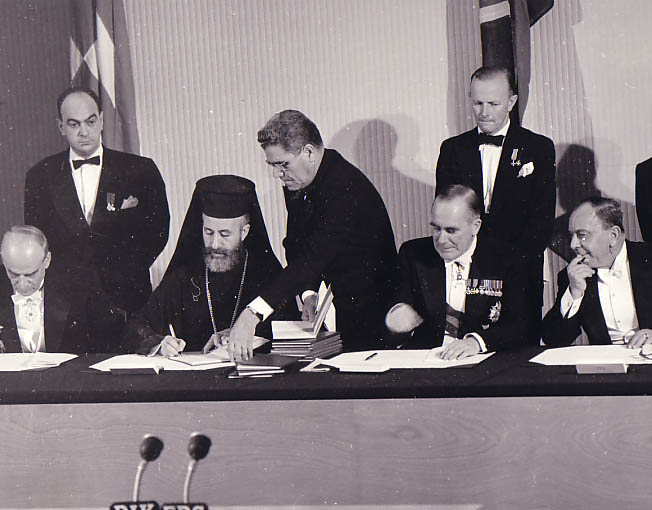
Cyprus marks 66 years of independence today, with the establishment of the Republic on August 16, 1960, ending 82 years of British colonial rule.
The republic was formed under the Zurich and London agreements, signed in 1959 by Britain, Greece, Turkey and representatives of both Greek and Turkish Cypriot communities.
Archbishop Makarios became the first president, while Turkish Cypriot leader Fazil Kucuk became vice-president.
The settlement was reached amid the ongoing armed struggle led by Eoka against British rule.
Eoka, led by Georgios Grivas, sought to end British rule and achieve enosis (union) with Greece.
For the Turkish Cypriots, the prospect of enosis was opposed as a threat to their security, with Turkey increasingly advocating for taksim (partition).
Britain itself sought a settlement that would end the insurgency while preserving its strategic interests on the island.
The Zurich and London Agreements established Cyprus as an independent bi-communal republic.
The agreement was reached in Zurich in February 1959 before being finalised through negotiations in London.
Makarios initially held reservations regarding elements of the proposed settlement yet against the advice of his counsel and Grivas himself, ultimately accepted it as the basis for independence.
Sir Dick White, former spymaster of both MI5 and MI6, alleged that British officials presented Makarios with a dossier containing compromising information on the Ethnarch, which was reportedly obtained through Operation Sunshine, a British intelligence operation targeting Eoka.
According to the account, Makarios withdrew his remaining objections the following day and accepted the settlement.
Kucuk, a prominent advocate himself for the island’s division, also reluctantly accepted the agreement.
The constitutional arrangements were unusually detailed and were supposedly designed to prevent either community from dominating the other.
The president was to be a Greek Cypriot elected by Greek Cypriots, while the vice-president was to be a Turkish Cypriot elected by Turkish Cypriots, with each granted a veto over certain decisions.
The cabinet was to contain seven Greek Cypriots and three Turkish Cypriots, members of the House were to be elected separately by the two communities, while important legislation required separate communal majorities.
The constitution also entrenched a series of provisions that could not easily be altered by a simple parliamentary majority.
The intention was to ensure that the new state could not be transformed unilaterally by either community.
Under the Treaty of Establishment, Britain retained ‘sovereignty’ over Akrotiri and Dhekelia for their military bases.
The Treaty of Alliance established a defence relationship between Cyprus, Greece and Turkey.
Greece was permitted to station 950 military personnel in Cyprus and Turkey 650, while the treaty also provided for cooperation between the three countries in the defence of the new republic.
The Treaty of Guarantee placed the independence and territorial integrity of Cyprus under the protection of Britain, Greece and Turkey.
It also prohibited Cyprus from pursuing either union with another state or partition of the island.
The transition from colonial rule was completed on August 16, 1960. At the independence ceremony, held at the House, Sir Hugh Foot, the last British governor, read the declaration proclaiming Cyprus an independent republic.
The British flag was lowered on Government House, and the flag of the new Republic of Cyprus was subsequently raised over the present presidential palace.
The formal anniversary remains August 16, although Cyprus celebrates its national Independence Day on October 1.





Click here to change your cookie preferences