
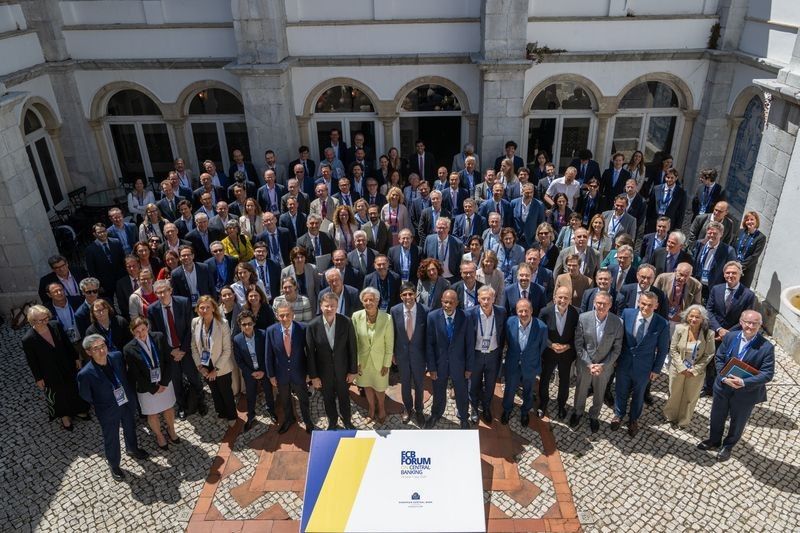
Central Bank of Cyprus (CBC) governor Christodoulos Patsalides this week participated in the European Central Bank (ECB) Forum on Central Banking in Sintra, Portugal, an annual gathering focused on monetary policy, financial stability, innovation and Europe’s economic future.
The CBC said the forum, held under the theme ‘Shaping Europe’s future: innovation, growth and stability’, brought together central bank governors, policymakers, academics, economists and journalists from across Europe and beyond to exchange views on the principal challenges and opportunities facing the European economy.
The central bank described the event as the ECB’s flagship annual forum, providing a platform for dialogue on monetary policy, financial stability, innovation and the future of economic growth in an increasingly complex global environment.
In her opening address, European Central Bank President Christine Lagarde said the ECB had effectively gone “back to basics” after years of relying on extraordinary monetary policy measures in response to successive crises.
“We can now focus on stabilising inflation with policy rates as our primary tool,” Lagarde said.
She explained that stronger European institutions and a more resilient economy had reduced the need for unconventional measures such as large-scale asset purchases and extensive forward guidance.
In addition, the ECB chief said that policymakers could now make measured interest rate adjustments based on incoming data and assess conditions at each meeting rather than committing to a predetermined policy path.
At the same time, Lagarde stressed that today’s geopolitical environment remained highly uncertain, with supply-side shocks, trade tensions, energy security and geopolitical conflicts creating new challenges for central banks.
“The basics have not changed. But what it takes to apply them has changed,” she said.
Lagarde argued that the ECB had strengthened its decision-making by improving its inflation indicators, producing more accurate projections and incorporating scenario analysis into policy deliberations to test whether decisions remained appropriate under different economic outcomes.
She also rejected suggestions that the ECB’s latest interest rate increase had been merely precautionary.
“This was a decision based on what we saw in front of us,” she said.
She added that the move reflected forecasts showing inflation remaining above the ECB’s 2 per cent target without further policy action and was supported across all the scenarios examined by the Governing Council.





Click here to change your cookie preferences