
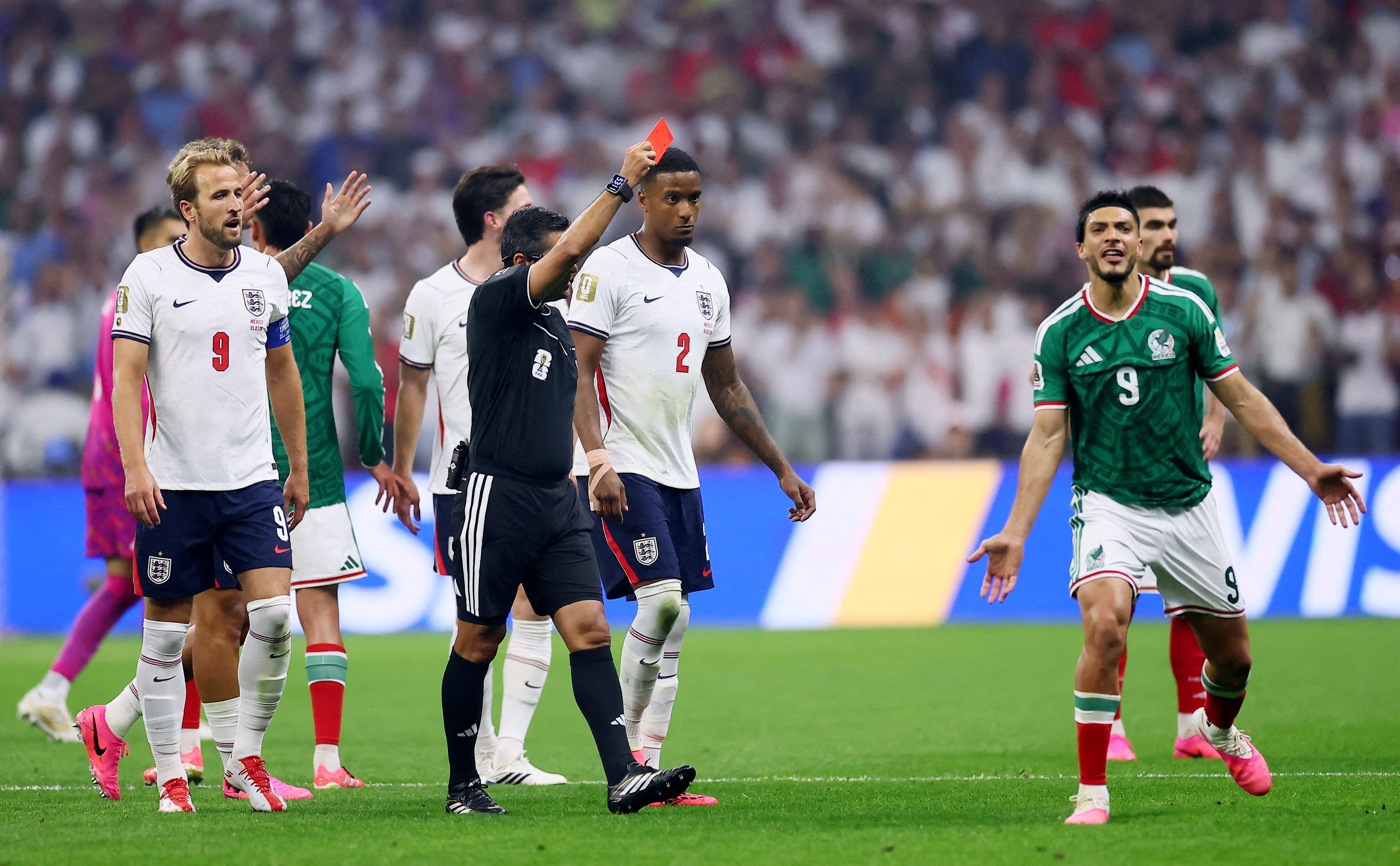
FIFA’s handling of disciplinary decisions at the World Cup has come under renewed scrutiny after England defender Jarell Quansah received a two-match suspension while United States striker Folarin Balogun escaped an immediate ban for what former international referees have described as broadly comparable offences.
The contrasting outcomes have left England frustrated ahead of Saturday’s World Cup quarter-final against Norway, with Bukayo Saka admitting the squad were disappointed to lose Quansah for the remainder of a potential run to the final.
Quansah was sent off during England’s last-16 victory over Mexico after a VAR review upgraded his sliding studs-up tackle to serious foul play. FIFA subsequently imposed a two-match suspension, ruling him out of the quarter-final and any potential semi-final.
Balogun, meanwhile, was dismissed during the United States’ round-of-32 victory over Bosnia and initially received a one-match suspension. FIFA later suspended that ban on probation for one year under Article 27 of its disciplinary code, allowing the striker to continue playing, although world football’s governing body has not publicly explained the reasoning behind the decision.
The issue attracted further attention after President Trump publicly urged FIFA President Gianni Infantino to review Balogun’s case. FIFA has maintained that the conversation played no role in its decision.
Former FIFA referee Keith Hackett criticised the governing body on social media.
“FIFA have failed in their duty towards the game after they delayed the ban for Balogun. They allowed outside interference by the president,” Hackett wrote.
“FIFA the major lawmaker are at fault. But both players committed Serious Foul Play challenges sanctioned by a red card.”
Former FIFA referee Jonas Eriksson also questioned the apparent inconsistency.
“If Balogun got a one-match suspension, Quansah should have as well, seeing their two on-field incidents were roughly equal in terms of intensity and aggression,” Eriksson told Reuters.
“What everyone wants from referees is consistency. Player A gets the same sanction as player B. Team A gets the same sanction as team B. This is not the case when it comes to Quansah and Balogun.”
Eriksson added that FIFA’s failure to explain why Balogun’s suspension was lifted had only fuelled the controversy.
“If you’re not able to communicate how they interpret the situation – was it an incorrect decision of the referee or was it the wrong application of the laws of the game – we don’t know,” he said.
“It’s just for you and me and for everybody else to guess. But with that in mind, the red card for Quansah and the suspension is, for me, just a mystery.”
England had explored the possibility of appealing Quansah’s suspension after Balogun’s reprieve, but the Football Association said FIFA’s disciplinary regulations did not permit an appeal in this case.
Speaking on Thursday, Saka said the squad had only recently learned that Quansah would receive a two-match ban.
“I just found out that it’s a two-match ban, which is incredibly frustrating for us and for him,” Saka said.
“But it’s the way it is. We’re not here to complain, we just need to adapt and pick a team that’s ready to beat Norway.”
Asked whether the squad felt the differing treatment of the two cases was unfair, Saka declined to be drawn into the debate.
“I don’t really know what to say. I have no comment on that. It was FIFA’s decision,” he said. “This decision for us, focusing on ourselves, is frustrating. But we have to adapt and deal with it.”
The suspension further depletes England manager Thomas Tuchel’s defensive options, with injuries already limiting his choices at the back.
Defender Nico O’Reilly admitted Quansah’s absence was a significant setback but insisted England had to move forward.
“Yeah, of course, it’s sad,” O’Reilly said. “It can’t get appealed or anything, so we’ve just got to get on with it now. Obviously, I feel bad for him as well.”
O’Reilly enters Saturday’s match one booking away from suspension but said he would not change his approach despite the risk of missing a possible semi-final.
“I think I approach it the same as every other game,” he said. “Of course, if we win and I get a yellow card, I miss the next game. But I’m not focused on that. I’m focused on playing my game and doing what I need to do.”
England have at least received a boost through Saka’s improving fitness after the Arsenal winger arrived at the tournament still managing an Achilles problem that limited his preparation.
“I think across the tournament, my minutes have been building and building,” Saka said. “Of course, I would love to come to this tournament 100%, but that wasn’t the case, and everyone’s realised that and they’ve managed me in the best way possible.
“But right now, I’m feeling great and I’m ready to go.”
Standing between England and a place in the semi-finals is a Norway side making its first World Cup quarter-final appearance, spearheaded by Manchester City striker Erling Haaland, who has scored seven goals during the tournament.
O’Reilly, Haaland’s club teammate, warned England against focusing solely on containing the prolific striker.
“They’ve got great players all around the pitch who can cause a lot of danger,” O’Reilly said. “But of course, if we can keep him quiet, it would be a huge factor.”





Click here to change your cookie preferences