

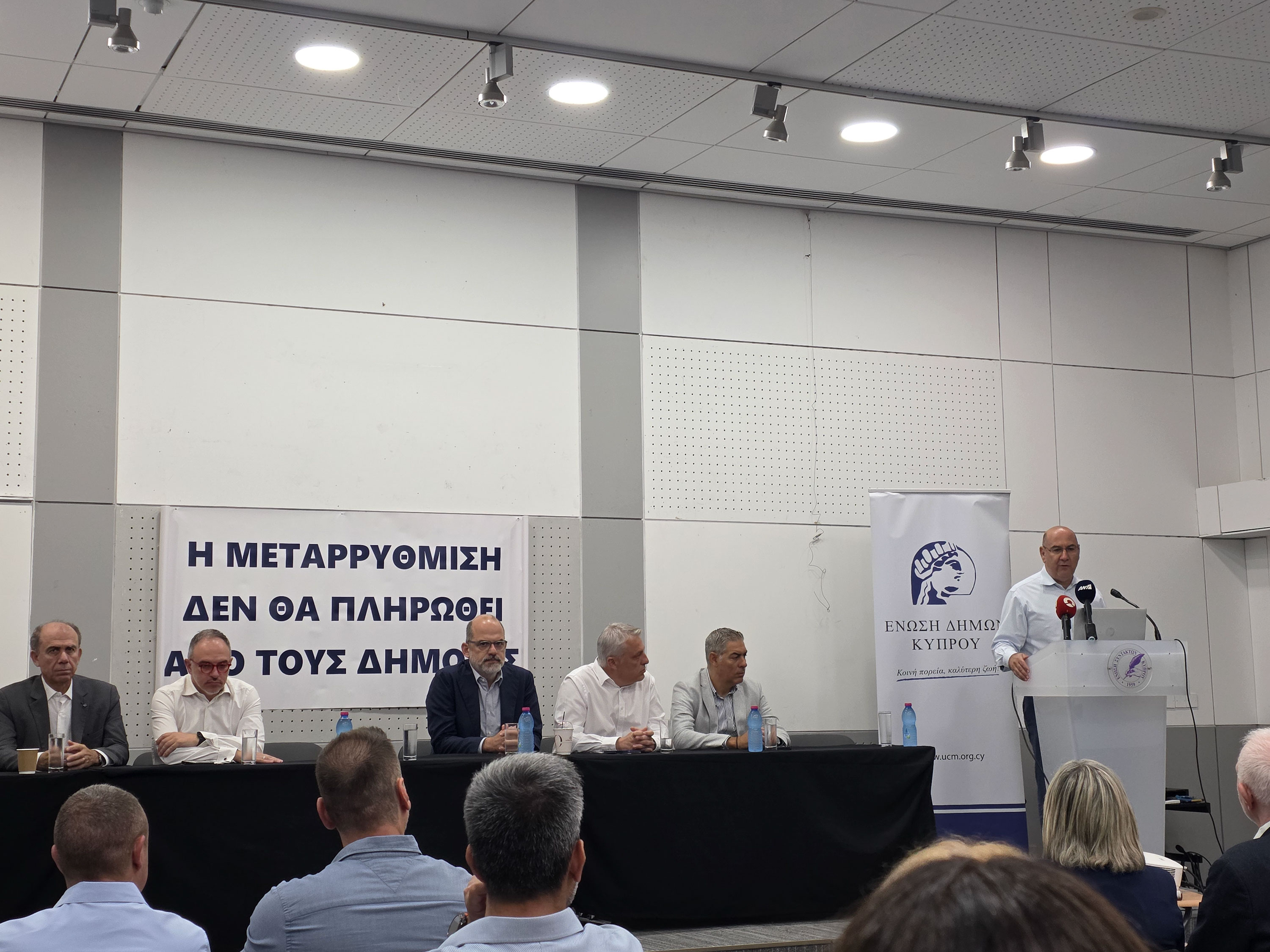
The public should not be forced to pay for the reform of local government, president of the Union of Cyprus Municipalities Andreas Vyras said on Friday.
Cyprus’ municipalities are asking the state for the financial resources “that correspond to the increased responsibilities transferred to them” Vyras said.
He was speaking at a news conference in Nicosia to announce a protest for August 3 from 9am to 12 noon in all districts.
On Friday, Vyras said that state financing for local government was in reality only €117 million, and not €144 million as presented by the state as “additional funding” for municipalities.
The amount of €117 million, agreed in 2019 but adjusted for inflation, should today be closer to €139 million, he said.
Vyras said that amounts presented by the state as “additional funding” were in reality transferred responsibilities and existing legislative obligations of the state itself such as the maintenance of the road network.
Out of the touted €144 million, he said, €15 million related to the maintenance of “hundreds of kilometres of roads”, a responsibility that was transferred from the central government to the municipalities.
“This specific amount does not constitute additional financial support, but funding for the exercise of a new responsibility, which may not be sufficient to cover the actual cost,” he said.
The cost of maintaining roads had shot up since 2019 when the financing was agreed, he said and this has not been taken into account by the government. He mentioned fuel, electricity, materials, labour and services.
According to Vyras’ data, state tax revenues increased from €4.65 billion in 2010 to €10.8 billion in 2024, while state funding to municipalities remained “essentially stagnant”.
At the same time, he said, state funding per citizen to local government decreased from €188.35 in 2010 to approximately €155 today despite the fact that municipalities had assumed increased responsibilities, incorporated 63 communities and assumed new financial and operational obligations.
Vyras said the finance ministry recognised the fact that state grants should not remain constant but at the same time was telling municipalities they must find new sources of revenue for themselves.
“It is not reasonable to tell the local government ‘whatever you lost, you lost’ and then instruct them to impose new taxes on citizens,” he said. The reform of local government was necessary, he acknowledged, but it also required “fair and adequate funding”.
“The reform did not fail because of its philosophy. It is undermined by chronic underfunding. When the state transfers responsibilities without the corresponding financial resources, either the services to citizens become limited or an attempt is made to shift the costs to the citizens. We will not let this happen,” Vyras said.
The union was in favour of the institutionalisation of state funding as a fixed percentage of the state budget in accordance with the principles of the European Charter and the practices applied in most European countries, he added.
Vyras said he would be launching a series of contacts with political parties, mayors, workers and trade unions, with the aim of seeking a fair and sustainable financing model.
“Municipalities are not asking for privileges or special treatment. They are asking for the resources that correspond to the responsibilities transferred to them. State funding is not an expense, it is an investment in local communities, in the functioning of municipalities and in the quality of life of citizens. The citizens will not pay the cost of the reforms,” said.
Meanwhile, trade unions also weighed in on Friday echoing the sentiment that it was the state’s obligation to financially support local government and the public should not be forced to do so.
“The main objectives of the reform were clear. Through the merger of municipalities while ensuring financial and administrative autonomy, policies were to be developed to improve services to citizens at the lowest cost,” Sek union said.
“After two years of reform, the formula for the financial support of municipalities set out in the law is not sufficient, dynamic and adaptable,” it added.
This was negatively affecting both the services provided to the public and their ability to respond to new additional responsibilities and obligations assigned to them.
It warned that the risk of financial difficulties would result in patchwork arrangements and policies and transfer the financial problems to the public with an increase in fees and taxes. The union called on the government to reconsider is position and enter a dialogue.
Also calling for dialogue was Sidikek-Peo, which said the whole point of local government reform was to lower costs to the public and improve services but the opposite was occurring.





Click here to change your cookie preferences