
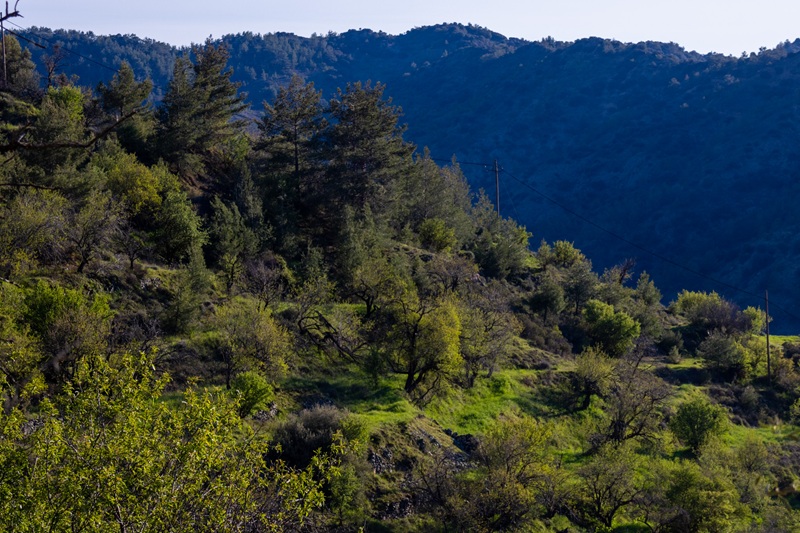
For the first time, Cyprus has a nationwide inventory of the biomass and carbon stored by its trees. Developed by researchers at The Cyprus Institute, the new study provides the first tree-level inventory of biomass and carbon stocks across the island, creating a new tool for monitoring forests and supporting climate adaptation.
The inventory was developed using a new artificial intelligence-based methodology, combined with field measurements collected by the Cyprus Department of Forests. Unlike previous approaches, it enables the systematic and repeatable monitoring of changes in tree biomass and carbon stocks over time, providing valuable scientific evidence to support forest management, post-fire restoration and climate adaptation.
The role of trees
Trees absorb carbon dioxide from the atmosphere and store carbon in their biomass, helping mitigate climate change. They also provide important ecosystem services, including cooling cities, improving air quality and supporting biodiversity.
The study found that nearly one-third of Cyprus’s tree cover lies outside forests. A representative example is Athalassa National Forest Park in Aglantzia, where the inventory identified a high density of large trees within an urban environment, highlighting the important contribution of urban green spaces and trees outside traditional forest areas.
The impact of wildfires
The inventory also reveals that, during the past seven years, gains in forest carbon storage have been offset by recurrent wildfires and drought-related tree mortality.
The study estimates that since 2014, more than 360,000 trees have been affected by wildfires, resulting in losses exceeding 300,000 tonnes of biomass and 140,000 tonnes of stored carbon.
These estimates were made possible through the new inventory, which captures losses that could not be quantified with the same accuracy using previous approaches, particularly those associated with smaller and isolated wildfires.
A new tool for forest monitoring, climate adaptation
Beyond its scientific findings, the new inventory provides Cyprus with a framework for the systematic monitoring of its forest and tree resources. It establishes a stronger scientific basis for assessing the impacts of wildfires and drought, evaluating restoration efforts and supporting evidence-based forest management and climate adaptation.
“For the first time, we can monitor Cyprus’s trees with a level of detail that was not previously possible,” said Anna Zenonos, Graduate Research Fellow at the Climate and Atmosphere Research Centre (CARE-C) of The Cyprus Institute and first author of the study. “In the Eastern Mediterranean, one of the regions most affected by climate change, increasing pressure from drought and wildfires makes reliable data more important than ever. This new capability helps us better understand how our trees and ecosystems are changing and provides a strong scientific basis for planning measures to protect and manage our natural resources.”





Click here to change your cookie preferences