
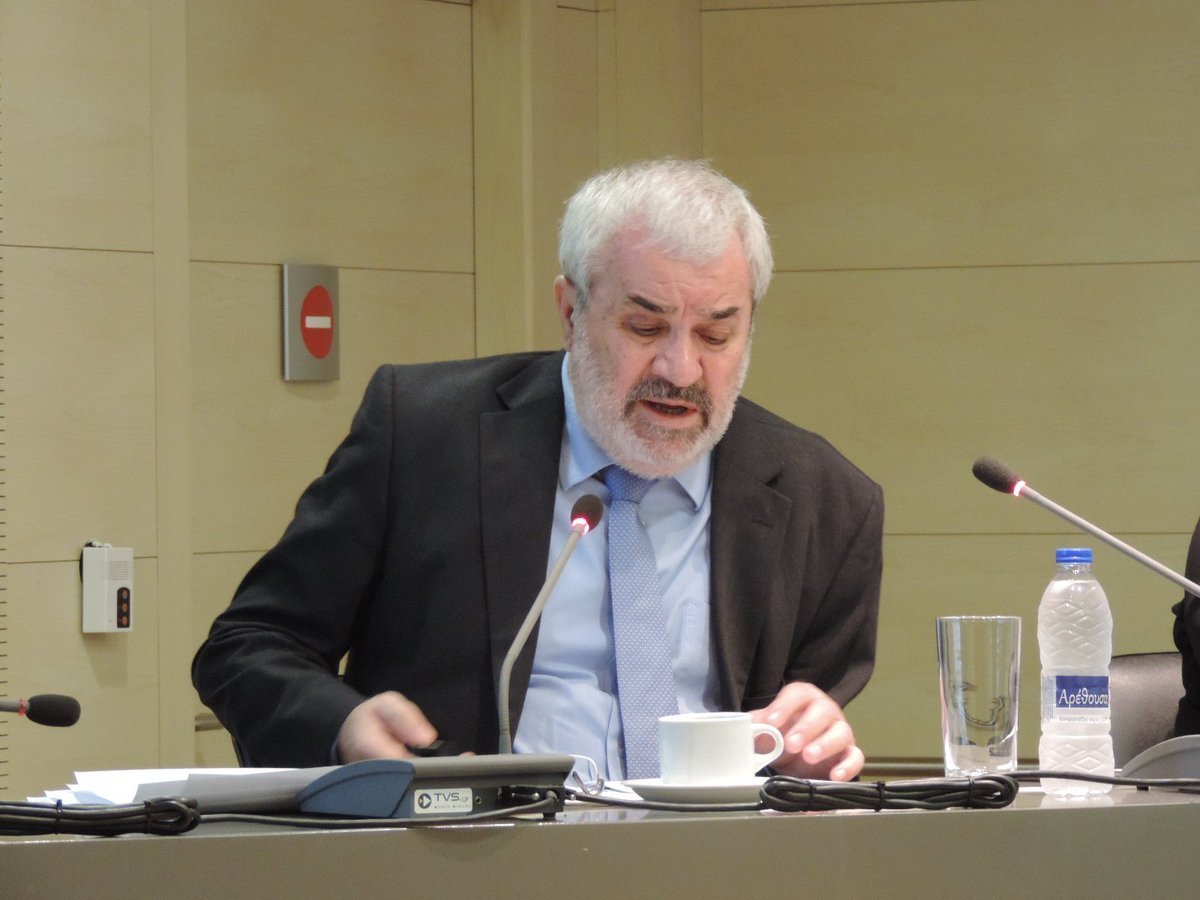
Cypriot intelligence service chief Tasos Tzionis did travel to Lebanon in June, the government confirmed on Monday, though the exact purpose and details of his trip remain officially undisclosed following reports that he met members of Lebanese insurgent group Hezbollah.
The Cyprus News Agency quoted government sources as having said that he held “a series of contacts”, without making further comment.
Lebanese newspaper Al-Akhbar had reported on Monday that Tzionis had met Lebanese army commander Rodolphe Haykal, the Lebanese army’s intelligence director Tony Kahwaji, and “the leadership of Hezbollah”.
It also reported that Tzionis “carried files related to bilateral relations” during his trip to Lebanon, but that “his primary focus was on the maritime border and the exclusive economic zone”.
On this front, Tzionis reportedly “stressed to Lebanese officials the necessity of not backtracking on the agreement” regarding the mutual delimitation of Cyprus’ and Lebanon’s exclusive economic zones (EEZ) signed in November last year.
That request, the newspaper stated, “came against the backdrop of escalating tensions of Turkey, which opposes Nicosia’s actions regarding maritime border demarcation and gas pipelines, accusing it of infringing on the rights of the Turkish Cypriots”.
It quoted Tzionis as having said on this matter that the dispute regarding ownership of the seas in the area “is between Ankara and Nicosia and has no bearing on Lebanon”, and that therefore “there is no basis for reconsidering the agreement” on Lebanon’s part.
Turkey’s position is that the sea west of Lebanon’s EEZ, which it agreed to delimit with the Republic of Cyprus, is part of its “Blue Homeland”, known as the “Mavi Vatan” in Turkish, which outlines Turkey’s maritime claims in the Aegean, Black, and Mediterranean seas.
In the case of the eastern Mediterranean, the doctrine is based on the continental shelf and the idea that islands should only be entitled to an EEZ stretching 12 nautical miles from their coastlines. According to the doctrine, therefore, beyond the 12-nautical-mile limit, the sea off Cyprus is Turkish.
Al-Akhbar reported on Monday that the matter was “discussed prior to President Joseph Aoun’s visit to Turkey a few days ago, given Turkey’s stance rejecting Lebanon’s involvement in regional oil and gas arrangements which disregard partnership with Syria or place Beirut within axes hostile to Turkey”.
However, when Aoun travelled to Ankara and met Turkish President Recep Tayyip Erdogan last week, no public mention of EEZs or maritime rights was made by either leader.
June’s trip to Beirut is reportedly not the first Tzionis has made this year, with Lebanese newspaper the Beirut Time having reported in March that he “contacted Hezbollah’s leadership and asked them to convey a message of reassurance to Iran that the British base at Akrotiri … would not be used to launch an attack on Tehran”.
“Tzionis requested Hezbollah’s mediation due to the good relations between them and the fact that they have ties with Iran,” the newspaper stated, adding that “the aim of the message is to prevent attacks from spreading to Cyprus”.
It added that this message was sent “given the island’s current paralysis and the fear of losing investments … from Israel, Russia and China”.
March’s reported visit had come with Cyprus’ British Akrotiri air force base having been hit by an Iranian-made drone fired from within Lebanese territory earlier that month amid a conflict between Iran, Israel, and the United States, and with fears arising that that conflict may rekindle, the British Cyprus bases have once again been in Iran’s focus.
Iranian Foreign Minister Abbas Araghchi held a telephone conversation with his Cypriot counterpart Constantinos Kombos on Thursday last week, in which, according to the Iranian government, Araghchi “stressed that foreign bases in Cyperus must not be used for hostile acts against Iran”.
In response, the Iranian government quoted Kombos as having said that he had “received UK assurances the bases won’t be used against Iran”.
Likewise, Araghchi and his British counterpart held a telephone conversation on Saturday, during which Araghchi, according to the Iranian government, “criticised the UK’s recent measures against Iran’s armed forces and its role in the US-Israeli wars against Iran, urging London to revise its approach”.
In this, he was referring to the UK’s decision to last month declare Iran’s Islamic revolutionary guards a terrorist organisation. The European Union had made a similar declaration in February, prompting the Iranian government to declare the air force and navy of every EU member state, including Cyprus, a terrorist organisation.





Click here to change your cookie preferences