
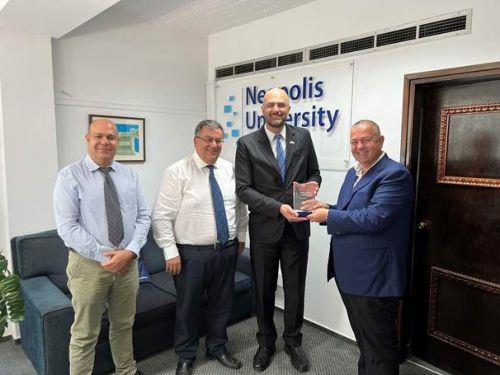
Neapolis University Paphos will lead a three-year European research partnership with University College London (UCL), the University of Barcelona and Greece’s KMOP, after securing Horizon Europe funding in a Twinning call that attracted nearly 2,000 proposals.
The project, GENDRIVE – Gender Equality as a Driver of Research Excellence and Careers in Research and Innovation Institutions, is intended to strengthen the Paphos university’s research and innovation capacity by treating gender equality as part of research quality and institutional reform, rather than simply an administrative obligation.
According to Neapolis University, the institution will coordinate the international consortium under the Twinning action of Horizon Europe’s Widening Participation and Spreading Excellence programme, known as WIDERA.
The competition was considerable. The 2026 Twinning call attracted 1,905 proposals before closing on April 9, while the EU work programme envisaged funding about 210 projects.
The call was allocated €223 million in 2026 and a further €41.5m in 2027, with an expected EU contribution of between €800,000 and €1.5m per project, although applicants were allowed to request different amounts.
Neapolis has not disclosed the value of the grant awarded to GENDRIVE. EU funding rules show that Cyprus is among the countries eligible to coordinate Widening projects.
Twinning is not primarily a conventional research grant. Its purpose is to connect institutions in countries with less advanced research systems to leading European counterparts, transferring expertise and improving their ability to compete.
Under the call, the research and innovation component may account for no more than 30 per cent of the total grant. The main work instead centres on staff exchanges, expert visits, training, workshops, research management and longer-term institutional links.
In that context, GENDRIVE will carry out joint research, staff exchanges, training and mentoring, while strengthening research management and international networking.
The project will run for 36 months under the scientific leadership of Neapolis’ Department of History, Politics and International Studies, working with academic and administrative units across the university. It is also linked to the objectives of EMERGE, the European university alliance of which Neapolis is a full member.
For Cyprus, the coordinating role comes at a revealing point in its innovation story. The European Commission’s 2026 scoreboard ranks the country 16th in the EU and classifies it as a moderate innovator, performing at 92.1 per cent of the EU average.
However, domestic research investment remains thin. Cyprus spent 0.65 per cent of GDP, or €224.9m, on research and development in 2024, compared with an EU average of 2.24 per cent.
At the same time, the country attracted €49,482.80 in Horizon Europe funding per researcher, more than ten times the EU average of €4,851.90.
The Commission said this reflected Cyprus’ strong integration into European research networks, even as its research system remained heavily dependent on competitive project funding and international partnerships.
The gender figures explain why GENDRIVE’s institutional focus matters. According to the Commission’s She Figures, women accounted for 66 per cent of doctoral graduates in Cyprus in 2021, the highest proportion in the EU.
However, women held only 14 per cent of the most senior research posts and represented 11 per cent of heads of higher education institutions in the latest available data.
They also made up 39 per cent of researchers overall and just 32 per cent in the business sector.
Neapolis said the selection “emphasises the university’s research and academic excellence, its institutional capacity, and the high level of confidence placed in its ability to lead major international research initiatives”.





Click here to change your cookie preferences