
French asset management firm Meridiam took a majority share in the Great Sea Interconnector on Wednesday, buying Greece’s independent transmission system operator (Admie) out of its controlling stake.
The deal puts Meridiam, which prior to Wednesday’s signing boasted a portfolio of assets worth around $23 billion (€19.9bn), in the project’s driving seat, ending Admie’s almost three-year tenure as the project’s majority shareholder.
Reacting to the news, former Cypriot energy minister George Papanastasiou said that Meridiam’s taking of a controlling stake in the company will “of course help” the project’s future.
“It is very good news. This is a fund which is viable joining a project which was looking for financiers,” he told the Cyprus Mail, before adding that it may also help the governments of Greece and Cyprus’ quest to secure funding from the European Investment Bank.
The two governments had in April jointly penned a letter to the European Investment Bank to request a new diligence study for the project, with a view to possibly requesting funding for the project’s completion may be provided by the Luxembourg-based bank in due course.
Admie had taken over the running of the project from Cypriot-owned firm EuroAsia Interconnector Ltd in October 2023, with the company then being wound down.
Meridiam describes itself as a “transformational infrastructure specialist” which “delivers sustainable and resilient infrastructure over the long term”.
Among the projects it currently manages is Sofia airport, for which it holds a 99-per-cent share in the rights to its operation until 2055, while it also undertook a 33-year project for the maintenance of the United Kingdom’s M8 motorway, and undertook a project to build five hospitals in Turkey – in Adana, in Bursa, in Gaziantep, in Elazig, and in Yozgat.
Progress on the interconnector, which, if completed, will connect the electricity grids of Cyprus, Greece, and Israel, has been slow thus far, with the most recent development being the joint letter to the European Investment Bank.
Previously, the governments of Greece and Cyprus had announced in November last year that the “economic and technical parameters” of the project would be “updated” with a view to attracting more investors to the project.
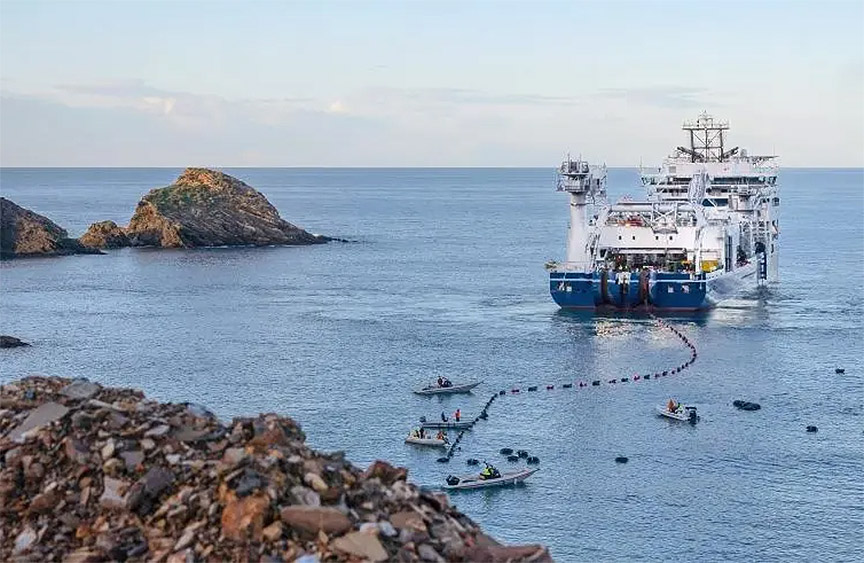
Meanwhile, French cable manufacturer Nexans had announced in March that an undersea trial of the type of cable to be used to form the interconnector had been completed successfully.
The project has also won the endorsement of the European Commission, with Energy Commissioner Dan Jorgensen telling the Cyprus Mail that it constitutes a “key strategic link” which will end Cyprus’ energy isolation”, “secure the stability of the electrical network throughout the entire island”, and “fundamentally, lower energy prices”.
Additionally, the European Commission had provided €658 million worth of grants for the project, though the European public prosecutor’s office (EPPO) announced last September that it had launched an investigation into the project, with a “politically exposed person” having allegedly used their position and connections to seek and secure those grants.
It was reported that the EPPO’s investigation concerns a company which was partially owned by Greek Foreign Minister Giorgos Gerapetritis’ father-in-law Michael Gourzis. Gerapetritis has denied this.
The new economic and technical parameters which the governments of Greece and Cyprus had planned to outline last November were to come alongside a new feasibility study, Papanastasiou, who was energy minister at the time, having said then that the project “must undergo an update, even in the financial aspect”.
“The most important parameter of this study is to attract strong investors, who will have the ability to implement the project, so that the challenges surrounding the financial and possibly the technical aspects are sustainable,” he said.
It has been hoped that efforts to open the project to further investment may soothe a rift which opened last year between the governments of Cyprus and Greece over the Cypriot government’s initial agreement to make five annual payments of €25 million to Admie for the project.
Those payments were to be made in advance of the project’s completion, so as to ensure that Admie would have a stable income while investing in the project before it turns a profit.
However, the Cypriot government withheld the funds, citing a lack of tangible progress on the project and differences in opinion regarding how the money should be sourced as its reasons behind not paying the money.
Papanastasiou said last September that the Republic of Cyprus would pay the first €25m instalment when the project is being “implemented in its entirety”, and that the construction of cables alone is “not enough” to meet this criterion.
Differences between the two governments became further entrenched Cypriot Finance Minister Makis Keravnos accused Greek Energy Minister Stavros Papastavrou of “fake news” over the matter, with Gerapetritis calling for clarity regarding Cyprus’ position the following day.
Keravnos’ comments had come after Papastavrou had said that he “does not show” the studies which he claimed demonstrate the project is not sustainable.
In response, he said the studies had been commissioned by Papanastasiou, that they were “properly delivered” to the Greek energy ministry, and that they had even been sent to Papastavrou’s predecessor Theodoros Skylakakis.
Additionally, the Greek government took offence at President Nikos Christodoulides’ remark that Cyprus “will not be blackmailed by any head of Admie”, with Papastavrou saying that “51 per cent of Admie belongs to the Hellenic Republic” and that “the Hellenic Republic does not engage in blackmail”.





Click here to change your cookie preferences