
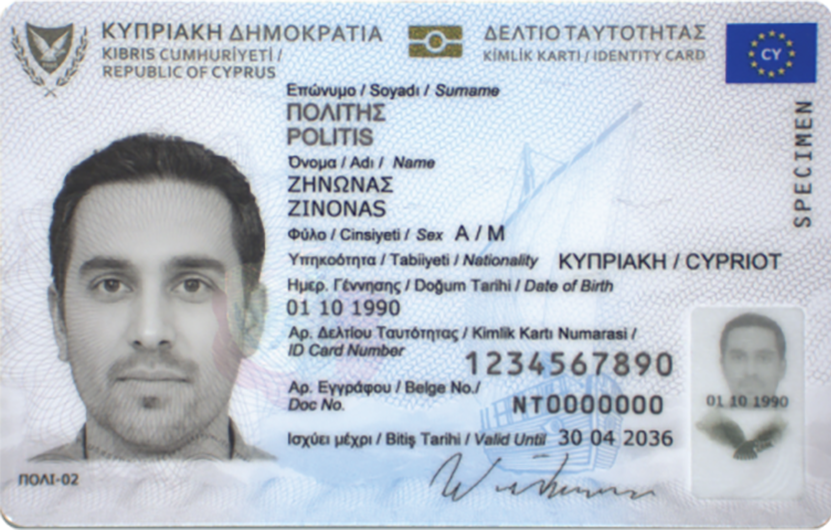
The debate over whether the names of the father and mother should be included on a person’s ID card was re-kindled last week after the interior ministry announced that the fields of the names of parents had been removed from biometric ID cards issued in July. The decision had been taken by the Civil Registry and was in line with the EU Regulation 2025/1208 which sets out a standardised format for ID cards in member countries.
This change was incorporated in the amended contract with the company that was printing the cards said the ministry last week. It was presumably a way of making it clear that there was no turning back, although the EU Regulation does not explicitly prohibit the inclusion of the names of the bearer’s parents’ names. An opening was left for opponents of the move to demand that Cyprus did not follow the practice of other EU states.
Predictably, Elam, which likes to pose as the defender of the family, prepared a bill that would make the inclusion of the parents’ names mandatory. The government’s decision was “an unacceptable attempt to undermine the sacred institution of the family,” it said. Disy, meanwhile prepared its own bill, by which a citizen would have the right to choose whether their parents’ names would be included. It was proposing a la carte ID cards, which seemed quite absurd, although the party presented this as a matter of free choice.
The interior ministry defended its decision, citing the advice of the Commissioner for the Protection of Children’s Rights, who pointed out that having a dash to signify unknown paternity or a single mother amounted to stigmatising a child. Most parties accepted this line when the matter was discussed at House committee, said the ministry, so when the new contract was agreed with the company printing the biometric cards, in 2025, the field for parents’ name was removed.
Funnily enough, the interior ministry bowed to the political pressure and last Friday announced that a citizen would be given the option of including parents’ names. It had consulted the contractor printing the cards and was told that producing two types of ID cards, in line with the bearer’s preference, was feasible. So, the rational arguments the interior ministry put forward for not including parents’ names were forgotten, in order to satisfy Elam and Disy. There was no longer an issue of personal data protection, it seemed.
But there is, however, another issue. The ID card exists to identify citizens in their dealings with the state authorities and as a travel document within the EU. It is not a document for providing an individual’s family background or their support for family values as Elam seems to think. It is the state’s exclusive prerogative to decide what information has to be included and the interior ministry has made a big mistake in offering a choice. It could still go back to its original decision and preserve some credibility.





Click here to change your cookie preferences