

Talks aimed at bringing about a resumption of negotiations in earnest towards the solution of the Cyprus problem are at a “crucially critical point”, presidential press office director Victor Papadopoulos said on Friday, with a meeting of the island’s two leaders and United Nations envoy Maria Angela Holguin set to take place on Monday.
He said the Greek Cypriot side believes that a list of proposals made by President Nikos Christodoulides to Turkish Cypriot leader Tufan Erhurman “provide a way out for all three issues which the UN secretary-general requested to be discussed”, with those matters being confidence-building measures, the methodology of the talks, and the substance of the Cyprus problem itself.
On the matter of methodology, he said that the issue had been discussed “so that we can reach talks” which are “effective” and provide a way towards a solution to the Cyprus problem.
“In essence, the persistence and the proposals of our side to secure the convergences of previous negotiations has been crowned with success as the United Nations has moved forward with recording the convergences,” he said.
He also made reference to the European Union’s involvement in the efforts, linking the issue to the European Council conclusions of April 2024, which stated that “the European Union attaches particular importance to resumption of and progress in the Cyprus settlement talks in further enhancing EU-Turkey cooperation”.
“We believe that all of this can create, and is creating, the guarantees for the resumption of talks if and as long as there is political will on the other side, and with this spirit and willingness to overcome the problems, and with the many proposals the president has made, we believe that Monday’s meeting will bear fruit,” he said.
To this end, he said that he believes that on Monday, “we will have positive developments which will lead us to an enlarged meeting where the resumption of talks will be decided”.
An enlarged meeting would involve the island’s two sides, its three guarantor powers, Greece, Turkey, and the United Kingdom, and the UN, and on Friday, the interest of two of the island’s guarantor powers appeared to have been piqued.
Fidan visits Cyprus, meets Erhurman, Ustel, Ertugruloglu
Turkish Foreign Minister Hakan Fidan paid a visit to Cyprus on Friday afternoon, meeting Erhurman, Turkish Cypriot ‘prime minister’ Unal Ustel, and Turkish Cypriot ‘foreign minister’ Tahsin Ertugruloglu. No statements were made after any of those three meetings.
While Greek Foreign Minister Giorgos Gerapetritis did not join his Turkish counterpart on the island, he did hold a telephone call with Cypriot Foreign Minister Constantinos Kombos, with the Greek ministry saying after the call that it had taken place “in the context of the close cooperation between the two countries”.
Kombos’ ministry, meanwhile, condemned Fidan’s visit, saying that it “constitutes yet another provocation, adding to Turkey’s ongoing violations of the sovereignty, independence, and territorial integrity of the Republic of Cyprus”.
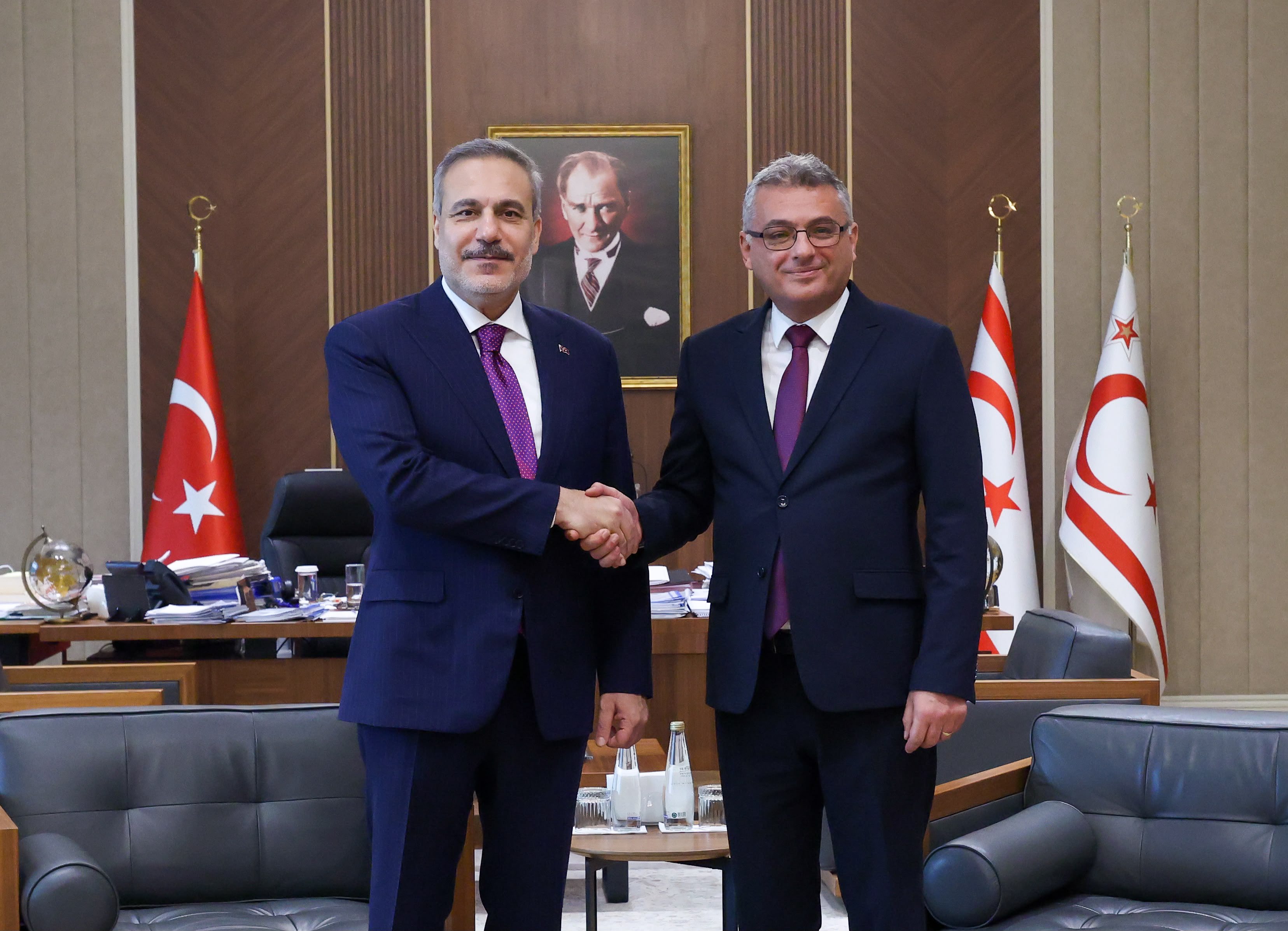
“Through his illegal visit, the Turkish foreign minister sends messages of intransigence and disregard for the decisions of the UN, an organisation to which Turkey is seeking to have its candidate elected as secretary-general, and of the European Union, of which Turkey remains a candidate for accession,” it said.
Closer to home, a survey conducted by the University of Cyprus found that more than three quarters of Greek Cypriots now accept or tolerate the idea of a federal solution to the Cyprus problem, with that survey marking the first time a federal solution has been more popular among Greek Cypriots than a unitary state, which won the support of 70.3 per cent.
A two-state solution was viewed as acceptable or tolerable by 33.3 per cent of surveyed Greek Cypriots.
That survey comes after a similar survey was conducted among Turkish Cypriots in April, and found that exactly 78.5 per cent of respondents supported a bicommunal, bizonal federal solution with political equality.
Agreement on crossing points appears to be near
The first step towards the resumption of talks and a solution beyond may come in the form of new crossing points being opened, with it being widely reported that four new crossing points may be opened following Monday’s tripartite meeting of Christodoulides, Erhurman, and Holguin.
According to those reports, the crossing points which are currently on the table are in the eastern Nicosia suburb of Mia Milia, the village of Louroujina, which is the southernmost inhabited Turkish Cypriot village, a transit road linking Athienou and the Nicosia suburb of Aglandjia, and between Kambos Kykkou and Karavostasi, west of Lefka.
These reports provoked upset among local authorities in Polis Chrysochous and the Tillyria area, where residents had widely hoped that a transit road through the Turkish Cypriot Kokkina exclave would be opened.
The Polis Chrysochous municipality and the Tillyria village cluster said on Friday morning that the possibility of Kokkina being “sidelined” has created “reasonable concern”.
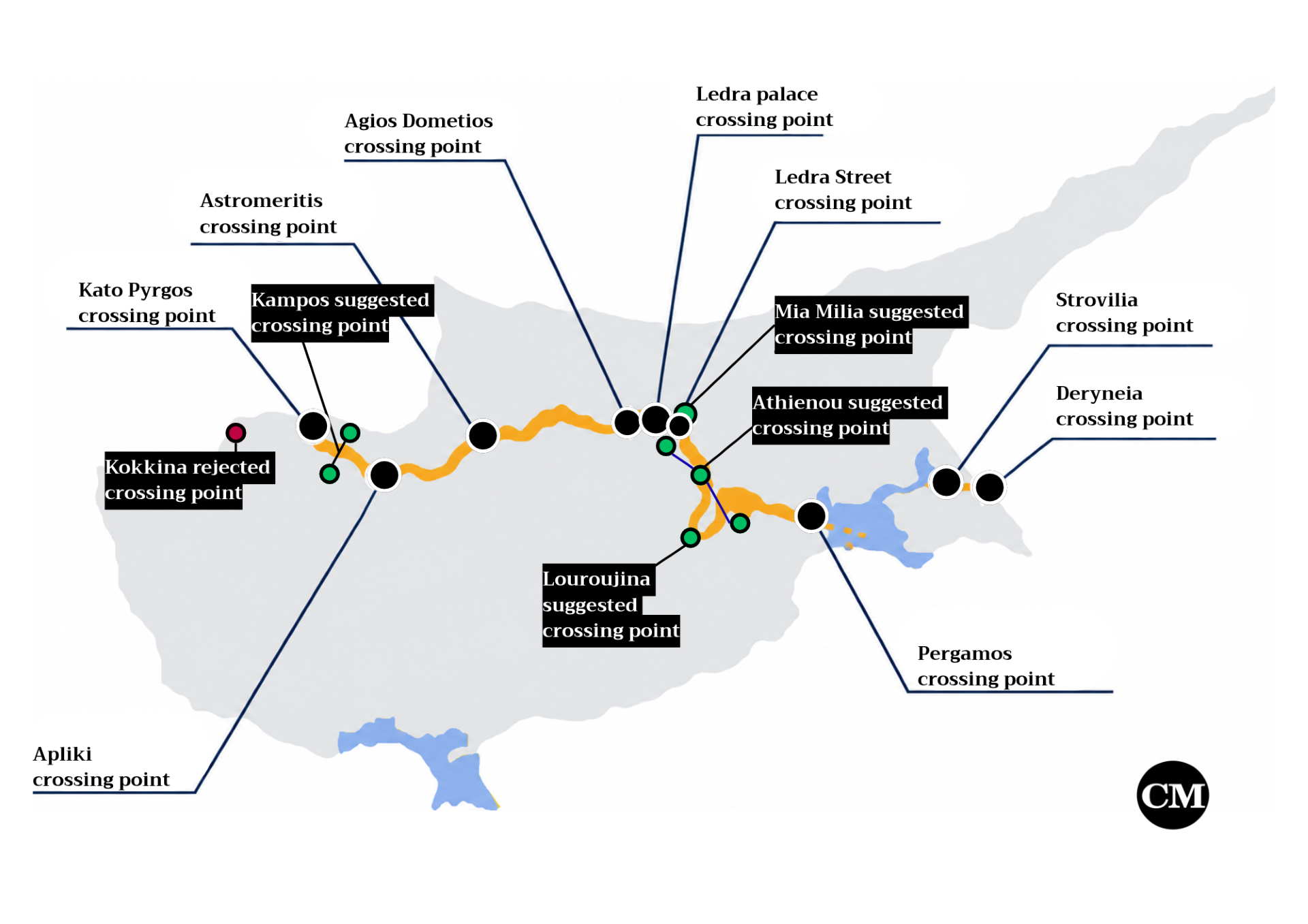
Likewise, Pyrgos village mukhtar Nikos Kleanthous told the Cyprus News Agency that “there cannot be any new agreement on crossing points which bypasses Kokkina”.
“We will not continue to tolerate the passage of the Turkish army unhindered through our village while the Kokkina crossing points remains closed,” he said, in reference to the annual trip made by Turkish Cypriot military and civilian officials to Kokkina to commemorate the anniversary of the 1964 Battle of Tillyria, in which the modern Kokkina exclave was effectively created.
Louroujina residents protest trench digging
Elsewhere, the site of another potential new crossing point was briefly the scene of protest on Friday afternoon, when residents of Louroujina parked their cars across the only open road into the village to prevent members of the Turkish Cypriot security forces from entering it.
According to newspaper Yeniduzen, they had done so after soldiers had begun digging trenches north of the village and appeared to be digging towards the village and the fields surrounding it, ostensibly with the aim of preventing people from smuggling contraband across the Green Line through the village.
The digging was then halted, and the villagers were informed that a division commander would visit them on Monday.


Click here to change your cookie preferences