
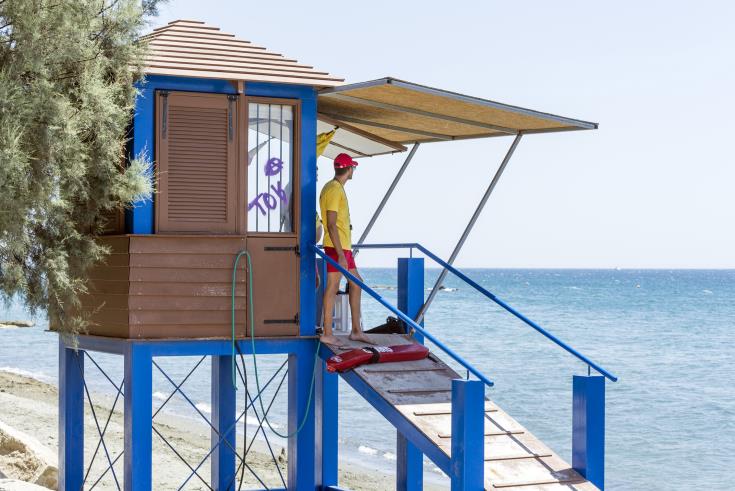
Closing lifeguard towers at 6pm during the summer months is “criminal”, lifeguard federation chairman Polys Pallikaros said on Monday, following a drowning incident at CTO beach in Larnaca.
Speaking to CyBC, Pallikaros said beaches should have lifeguard coverage from sunrise to sunset throughout July, August and September.
“Human life cannot be weighed against cost,” he said.
His comments came after a Romanian woman drowned on Saturday evening while swimming with her two daughters, aged 12 and 13.
The three got into difficulty in rough seas and were pulled from the water by other bathers. The mother could not be revived and was pronounced dead.
Police said on Monday that the 12-year-old remained intubated in intensive care but was in a stable condition.
Her 13-year-old sister had been transferred to the paediatric department at Makarios hospital.
The incident happened shortly after lifeguards had finished their shift for the day.
Pallikaros said the incident showed the need for lifeguards to be present for as long as people are using the beaches.
He said lifeguards had also rescued a mother and child from drowning in the Paphos area at around 12.30pm on Sunday.
In another case, an off-duty lifeguard was called to Coral Bay at around 7.30am and rescued a swimmer.
Pallikaros said a shortage of lifeguards was making it harder to extend their working hours.
He said most jobs were offered for only three or four months, which made it difficult for people to leave other employment.
He called for lifeguard positions to last at least eight months to attract more people to the profession.
Pallikaros further insisted that the interior ministry should inform which beaches are in fact supervised from sunrise to sunset.
“We have been discussing the same problems for fifteen years. I raise my hands in the air.”
Following the case, the ministry has responded by proposing to alter the system used to certify lifeguards from next year, while €1.5 million has been allocated for new equipment and lifeguard towers for the next two years.
Local government director at the interior ministry Antonis Economides said the shortage of lifeguards was not due to a lack of approved positions or low salaries, but to a shortage of people holding the required certification.
“The problem is that there are not enough candidates to staff the beaches,” he said.
Economides said the current certification system was “problematic” and that the ministry had been working to establish a new system.
Under the proposed changes, approved organisations would be able to provide lifeguard training and certification.
The government is also preparing new standards for lifeguards, with separate certification categories for beaches and swimming pools.
In regard to the drowning at CTO, Economides said swimmers also had a responsibility to take account of rough seas.
“There must also be personal responsibility from the public, especially from parents,” he said.
Economides said lifeguard hours currently vary depending on the beach, with shifts ending at 5pm, 6pm or 7pm.
He said keeping lifeguards on duty until 8pm was not a simple solution, given the long hours and demanding nature of the job.
“At some point the lifeguards have to be relieved,” he said, remarking that it was feasibly not possible to provide coverage around the clock.
Only ten of the 19 lifeguard towers in Larnaca district are currently staffed due to a lack of qualified applicants.
The district employs 31 lifeguards, including 11 permanent and 20 temporary staff, while 44 temporary positions have been approved.
As for Paphos, 8 of the district’s 33 towers remain closed, with a shortage of some twenty-two positions.
The staffing problem is particularly accentuated in the Famagusta district, where 30 lifeguard towers are staffed by 86 lifeguards, while seven smaller beaches have no lifeguard cover at all.
Michalis Adamou, lifeguard supervisor for the Famagusta EOA, said there had not been a single new lifeguard recruited in the area this year, while two or three had left their posting.
Adamou said the beaches typically have lifeguard cover from 9.30am to 5pm, with hours extended to 6.30pm during June, July, August and September at certain locations.
Only four beaches in Ayia Napa and Protaras have longer coverage, from 7am to 6.30pm during the summer.
Adamou said the main problem was the short period of employment, with many positions lasting only a few months.
“The months of work may not be enough motivation for someone to come and work as a lifeguard,” he said.
The starting salary is €1,560 net per month, with the possibility of additional pay through overtime.
Pallikaros has also called for lifeguard positions to offer at least eight months of employment, arguing that longer contracts would make the profession more attractive.
Economides said some lifeguards employed by district administrations work permanently, while others are employed for ten, eight or four months depending on the beach and area.
“For four months, it’s not easy for anyone to be interested in coming to work,” he said.





Click here to change your cookie preferences