
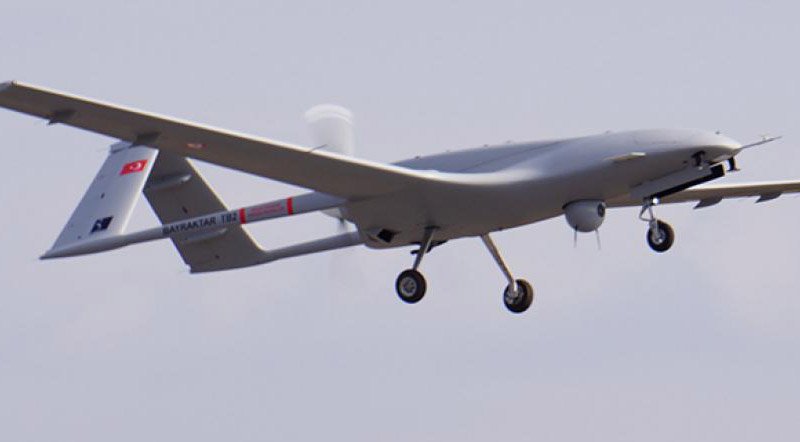
The Cyprus air traffic controllers’ union on Thursday said that flight safety in and around the island is “affected by unauthorised Turkish air force aircraft and unmanned aerial vehicles” operating in the region.
Those aircraft and drones, it said, are “operating almost constantly along critical routes and near the two aerodromes of Cyprus”, Larnaca and Paphos airports.
The Cyprus Mail attempted to verify these reports with the civil aviation authority, which said it now needs direct permission from the transport ministry to speak to the media. The Cyprus Mail has also contacted the Turkish government and is awaiting a response.
Airspace in and around Cyprus is disputed, with the Turkish Cypriot authorities operating their own air traffic control system out of northern Nicosia, and the Republic of Cyprus’ civil aviation authority nonetheless claiming responsibility for the airspace covering the whole island and its vicinity.
This has caused disputes in the past, with both Turkey and the Republic of Cyprus issuing notices to airmen (Notam) regarding possible military activities in the skies above and around the island in March after both Turkey and Greece deployed F-16 fighter jets to the island following a drone strike on the British Akrotiri air force base.
Initially, the Republic of Cyprus had issued a Notam regarding “possible military operations” in the skies off the coast of the Karpas peninsula, irking the Turkish Cypriot authorities, who then issued their own Notam.
That Notam advised “all aircraft in the region” to “take maximum precautions to ensure flight safety, carefully follow the published aeronautical information, and act in coordination with the relevant air traffic units”.
At the same time, the north’s ‘transport ministry’ had expressed disappointment that it had been issued without the Turkish Cypriot authorities’ consent, saying that “the TRNC … is the sole authorised authority responsible for providing air traffic and aeronautical information systems within its airspace”.
Later, Turkish defence ministry spokesman rear admiral Zeki Akturk declared the initial Notam to be “null and void”, saying that the Turkish Cypriot authorities had issued a “counter-Notam” which “invalidated the aforementioned Notam”.
More recently, the Turkish defence ministry has announced the conducting of training flights in the eastern Mediterranean, stating on July 21 that one such flight had been operated “in the international airspace of the Mediterranean, south of the island of Cyprus”.
Other such Turkish air force training flights have taken place in the skies south of Cyprus in previous months, with the Turkish defence ministry having announced the conducting of such flights both in February this year and in November and December last year.
The air traffic controllers’ union’s statement comes after Greek newspaper Kathimerini had reported on Tuesday that Turkish military aircraft and drones had “violated Greek airspace on 25 occasions” during that day.
“All the violations took place over the Aegean Sea, while eight involved Turkish F-16 fighter jets – two of which were armed – and 17 were committed by drones. Greek officials said the incoming aircraft were all identified and intercepted,” the newspaper reported.
It added that on one occasion, a “simulated dogfight” had broken out between Turkish and Greek fighter jets, with both pilots manoeuvring to try to secure an advantage which in wartime would allow them to shoot their opponent down.
Tuesday’s incident, the newspaper reported, was the eighth such simulated dogfight to have taken place this year.
As in the case of Cyprus, Turkey and Greece disagree over the limits of their respective airspaces in the Aegean Sea.





Click here to change your cookie preferences