
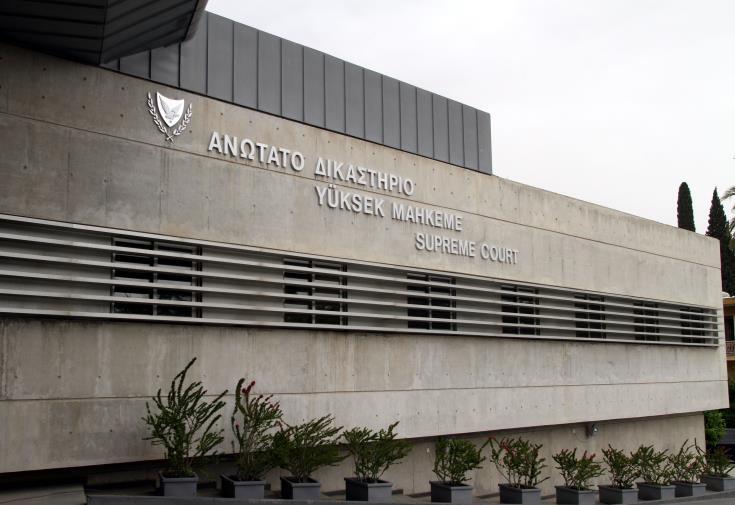
The Supreme Court has rejected an appeal by a man facing espionage and other charges in connection with the alleged surveillance of military installations in Cyprus, ruling that police had not unlawfully accessed his private communications before obtaining a court warrant.
Rashad Sultanov, 44, from Islington in north London, a dual British and Azerbaijani national, was initially arrested in June last year by the Republic of Cyprus’ authorities.
The ruling, issued on September 29, concerns a warrant granted in June 2025 authorising police to access, examine and retrieve recorded private communications from electronic devices seized during a search of the defendant’s residence.
The case relates to an investigation launched in 2025 after the suspect was reportedly observed near the British military bases at Episkopi-Akrotiri, as well as Paphos airport and the Andreas Papandreou airbase. A decision was recently made that the case would be tried in the UK rather than Cyprus due to the fact that the intelligence collected was mainly of the British military base.
According to the court decision, he had been seen carrying a large camera and three smartphones, taking photographs, making telephone calls and taking handwritten notes.
He was subsequently arrested under a court warrant on suspicion of several offences, including espionage and offences under the 2019 law on combating terrorism and protecting victims.
During a search of the apartment where he was staying, police seized two mobile phones, three SIM cards, a laptop, a camera and a camera memory card, among other items.
The appeal centred on whether police had already gained access to private communications stored on the seized devices before obtaining the necessary judicial authorisation.
According to the ruling, investigators had carried out a forensic extraction of the devices’ contents, creating copies that were stored in electronic folders before conducting further analysis.
The appellant argued that these actions already constituted access to private communications and that the subsequent warrant amounted to an attempt to retrospectively legitimise unlawful access.
However, the Supreme Court rejected that argument, finding that neither the creation of forensic copies nor the analysis conducted before the warrant involved access to recorded private communications.
The ruling also addressed the discovery of numerous photographs and videos of military installations on the seized devices.
The court drew a distinction between examining a mobile phone as a photographic device and accessing communications stored on it.
“Mobile phones are multifunctional devices. They are also cameras. To the extent that a mobile phone is examined as a camera, no issue of communication arises,” the ruling stated.
The judges clarified, however, that the situation would be different if the photographs or videos had been transmitted to another person. The court found that this was not the case in the material examined before the warrant was issued.
It consequently upheld the lower court’s finding that the forensic examination referred to in the police affidavit had not involved recorded private communications.
The Supreme Court also dismissed the appellant’s argument that the original court had failed to examine whether the access warrant complied with the principle of proportionality.
It found that the lower court had considered the issue and determined that the warrant did not violate that principle.
The appeal was therefore dismissed.
The man was arrested as part of Britain’s first overseas National Security Act investigation, led by counter-terrorism police into incidents at Britain’s RAF Akrotiri base between May 11 and June 22 last year, the Metropolitan police said. Sultanov allegedly conducted hostile surveillance on the base and is alleged to have then shared information with the IRGC, it added.
“This case shows we are able to use the National Security Act overseas when British military bases are allegedly targeted by hostile state activity,” head of counter-terrorism policing in London Helen Flanagan said.
Meanwhile at the time Israeli foreign minister Gideon Sa’ar wrote in a post on social media that a planned attack on Israeli citizens by Iran’s Islamic revolutionary guard had been averted thanks to cooperation between the authorities of Cyprus and Israel.





Click here to change your cookie preferences